H418/02 - Rylands v Fletcher
Learn the narrow rule for an exceptional accumulation escaping from land, how modern cases limit it, and when a defence defeats an otherwise established claim.
Accumulation and strict liability
The rule in Rylands v Fletcher can make a land user liable for an escape even where reasonable care was taken.
In Rylands v Fletcher (1868) the defendants commissioned a reservoir to supply their mill. Its construction connected with disused mine passages; filling it caused water to flood the claimant's working mine. The defendants themselves had not been proved negligent. The courts nevertheless imposed liability for the escape from the artificial accumulation. The principle is conventionally expressed as responsibility for bringing onto and keeping on land, for one's own purposes, something likely to do mischief if it escapes, in a non-natural use, and causing the relevant damage by an escape.
This is strict liability in a limited sense: proving the required elements does not require proof that the defendant failed to take reasonable care. It is not absolute liability for any escaped thing. Modern authority imposes substantial requirements and recognises defences. Transco v Stockport Metropolitan Borough Council (2003) retained the rule in England and Wales as a narrow form of private nuisance, rather than abolishing it or expanding it into general liability for hazardous activity. Read the judgment and its account of Rylands.
First identify a bringing onto or accumulation: the defendant stores or accumulates the thing for their purposes. Water naturally flowing through a stream is different from water deliberately stored in a reservoir. The thing need not be inherently harmful in every setting. Water is useful and ordinary in small domestic quantities but capable of serious mischief as a large artificial mass. The relevant scale, form, concentration and surroundings matter.
In Transco, Lord Bingham said the defendant must recognise, or reasonably ought to recognise by the standards of the relevant place and time, an exceptionally high risk of danger or mischief if there is an escape. This is not the same as showing that escape itself is likely. Excellent containment may make escape very unlikely while the consequences of an escape remain exceptionally dangerous. Conversely, merely showing that some damage could occur from an ordinary small spill does not satisfy the modern threshold.
Original comparison: a household watering can brought into a garden is unlikely to satisfy this exceptional-danger threshold. A very large industrial tank storing a corrosive liquid beside neighbouring land presents a much stronger argument, provided evidence establishes the relevant danger and the other elements. Calling something “a chemical” is not enough: identify its amount and the potential harm on escape.
Extraordinary and unusual use
Non-natural use means an extraordinary and unusual use in the relevant circumstances, rather than simply anything artificial.
In Transco, a normal water pipe supplied a council block of sixty-six flats. It leaked, the escaped water undermined an embankment and exposed Transco's gas main, requiring remedial work. There was no proved negligence. The House of Lords rejected the Rylands claim: supplying domestic water in that way was an ordinary use, despite the pipe's greater capacity than one supplying a single home and the large quantity which eventually escaped. The result establishes that size must be judged in its setting, not against an arbitrary household comparison.
The older expression non-natural use can mislead. A building, a pipe and a garden pond are artificial, but artificial construction alone does not satisfy the requirement. Lord Bingham preferred the test of extraordinary and unusual use for the place and time. A use can be ordinary in one setting and exceptional in another. Rickards v Lothian (1913), discussed and approved in Transco, supports the distinction between special increased danger and ordinary use.
Lord Bingham's formulation treats non-natural use and danger as connected but distinct requirements: the accumulation poses exceptional mischief if it escapes, and the use is extraordinary in context. Other speeches in Transco relate the two more closely. For ordinary English scenario analysis, explain the exceptional risk and the special use rather than treating either label as sufficient. Nor is “unreasonable use” an exact substitute: Rylands can concern an activity reasonably carried on and carefully contained whose escape risk is allocated to its creator.
Original example: a business stores an unusually large volume of reactive liquid above neighbouring gardens. Evidence that it is a special industrial accumulation, not ordinary local use, supports the claimant. The defendant may respond that similar storage is routine at this location or that the actual volume and risk are ordinary. Neither “business activity” nor “industrial district” automatically decides the issue. The argument must engage with the particular accumulation, place and time. Even if Rylands fails, proved careless maintenance might support negligence or a different nuisance claim; that requires its own elements.
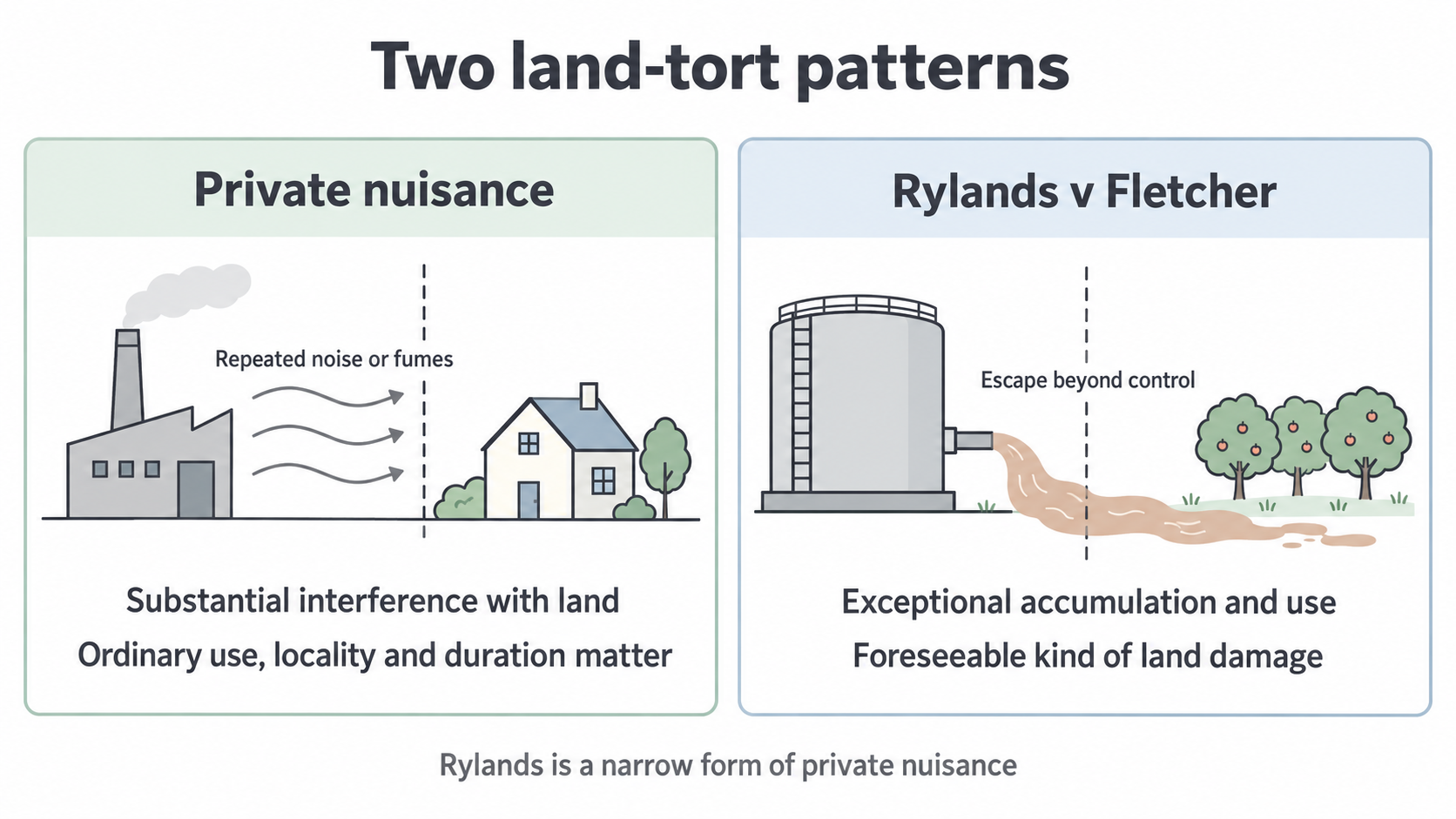
These are typical patterns, not complete legal tests. Private nuisance can sometimes arise from a single event; Rylands additionally requires its exceptional accumulation, unusual use, escape and foreseeable land damage. An industrial tank is not automatically non-natural merely because it is industrial.
Escape, land damage and remoteness
The dangerous thing must escape the defendant's occupation or control and cause a foreseeable kind of damage to a protected land interest.
An escape is movement from a place within the defendant's occupation or control to a place outside it. A boundary on a map can be relevant, but the controlling issue is occupation or control. Damage entirely within the defendant's factory does not establish this element merely because a tank leaked within a room. In Read v J Lyons (1947) an inspector was injured by a shell explosion inside a munitions factory. The House of Lords rejected a Rylands claim because there was no relevant escape. Transco confirms that escape remains essential; the rule is not general compensation for a hazardous workplace.
On the orthodox English analysis in Transco, Rylands protects interests in land. Apply a relevant proprietary interest, such as ownership or a tenancy carrying exclusive possession. Land damage includes physical damage to buildings or land and appropriately connected losses. Transco's speeches state that personal injury is not recoverable under this rule. Thus, on that approach, a visitor harmed on a neighbour's lawn cannot use Rylands merely because an escaped substance injured them; other torts require separate analysis. The earlier personal-injury cases and the persuasive authority below show why this boundary should not be described as beyond debate.
Continue this lesson.
You’re previewing NovaLearn without an account. Create a free account to read the rest.
Create free account