H418/03, H418/04 - Social control, consensus and conflict
Law influences behaviour and relationships, while social values, campaigns and conflict influence legal change. Compare formal and informal control, then use consensus, conflict and labelling theories to explain and evaluate the English legal system.
Law and society change each other
Society consists of relationships, institutions and groups whose interests and values may differ. Law can shape it by defining rights, duties and lawful institutions. It can make conduct costly, protect vulnerable people, and establish expectations about how others will behave.
The influence also runs the other way. Campaigns, changes in social attitudes, economic conditions and disputes can put pressure on lawmakers. That pressure is filtered through elections, Parliament, courts and organised groups; it does not automatically become law. Public opinion is diverse, and a widely supported reform can still conflict with a minority's interests.
Marriage (Same Sex Couples) Act 2013 section 1 makes marriage of same-sex couples lawful in England and Wales, subject to the statutory framework. The change followed public and parliamentary debate and altered access to a legally recognised institution. It also illustrates accommodation of disagreement: the Act did not extend the Church of England and Church in Wales clergy's duty to solemnise marriages to same-sex couples. This is a particular legal arrangement, not a general claim that all religious institutions must conduct every marriage.
The example supports a two-way analysis: social debate concerns the rules, while changing legal recognition changes people's rights and expectations. It does not prove unanimous consent, or that law instantly removes prejudice. A rule's practical effects also depend on enforcement and how people respond.
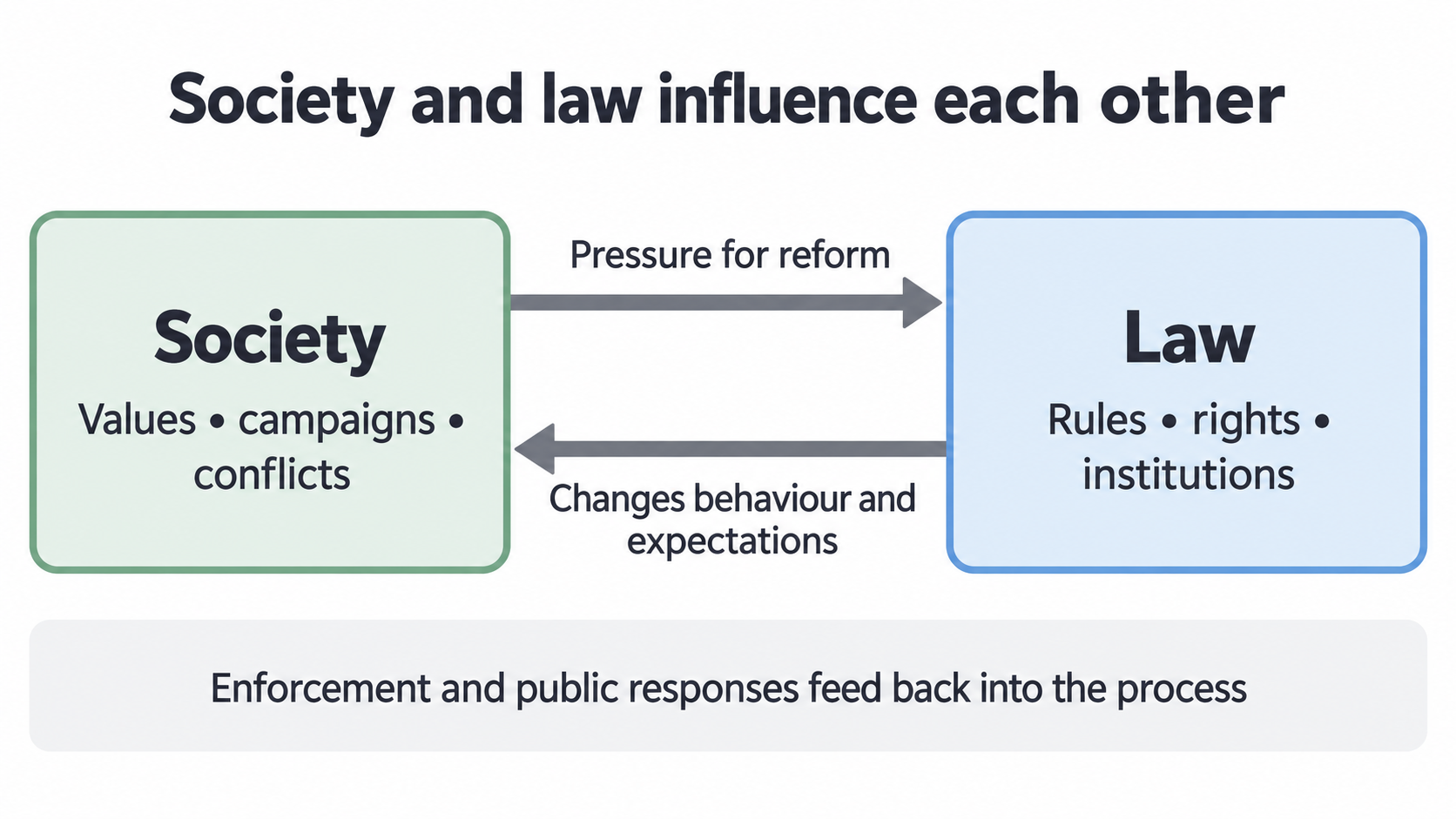
The arrows show possible influences, not a guarantee that any campaign succeeds. The feedback helps explain why the law can both reflect existing norms and lead social change.
Formal and informal social control
Social control refers to mechanisms that encourage conformity to norms or rules. It includes rewards and persuasion as well as punishment. Formal control uses organised rules and authorised procedures: criminal courts impose sentences, civil courts enforce duties and award remedies, and regulators can enforce statutory requirements.
Informal control works through ordinary relationships and expectations: praise, disapproval, peer pressure, reputation and family influence. A friend asking someone to stop making noise is informal control; enforcement of a lawful court order is formal control. A school or professional body can also use organised disciplinary rules, but not every formal rule is a rule of state criminal law.
The mechanisms interact. People may avoid theft because of prosecution, because others disapprove, or because they accept the norm themselves. If residents regard a rule as illegitimate, social pressure may favour resisting rather than obeying it. A threatening informal group can enforce harmful norms; informal control is not inherently kind or just.
Deviance means departing from a group's norms. Crime means conduct that the criminal law makes an offence. An unpopular hairstyle can be deviant within a group without being criminal. A concealed fraud can be criminal while escaping the group's disapproval. Never infer criminal liability merely from a person's outsider status.
Formal control offers defined powers, evidence requirements and opportunities for challenge. It can also be costly, selective and coercive. Informal control can secure cooperation cheaply and flexibly, yet lacks the safeguards of a court and may enforce prejudice. Legitimacy depends on whose norm is enforced, how, and with what consequences.
Consensus and social cooperation
Consensus theories emphasise shared values and the role of institutions in maintaining cooperation. People may agree that violence should be restrained and promises generally honoured, even while disagreeing over precise rules. A law can be legitimate because it protects conditions for living together.
Émile Durkheim links forms of social solidarity to law. Mechanical solidarity depends on similarity and a strong shared consciousness; organic solidarity depends on interdependence between people doing different specialised work. He associates repressive sanctions with responses to offences against collective sentiments, and restitutive law with restoring relationships needed for cooperation. These are explanatory tendencies in a sociological theory, not a literal description of every English sanction.
Criminal punishment can express condemnation of harmful conduct. Contract rules and civil remedies help people rely on others' performance, illustrating interdependence in a complex society. Restitutive here describes restoring legal relationships; it is not confined to the technical English remedy called restitution, and is not the same as every modern restorative-justice programme.
The strength of consensus theory is that law frequently enables ordinary cooperation rather than merely repressing people. It explains why many comply even when detection is unlikely. The criticism is that apparent agreement may hide unequal influence. A rule approved by a majority might disadvantage a minority, and compliance under pressure does not prove consent.
For example, broad agreement that work should be paid does not settle how wages should be set or who bears the cost of a minimum. Consensus identifies common aims, while conflict can remain over their distribution. A careful explanation does not claim that all law reflects unanimous values.
Continue this lesson.
You’re previewing NovaLearn without an account. Create a free account to read the rest.
Create free account