H418/01 - Judges and judicial independence
Learn which judges work in civil and criminal courts, how their duties differ, and why judicial decisions must be independent and impartial. Independence protects fair decisions while reasons, appeals and conduct procedures preserve accountability.
Judges in civil and criminal courts
A judge is a judicial office holder who applies the law to cases. Professional judges are legally qualified; lay magistrates are a different group of judicial decision-makers. A judge's title indicates their office, but their authorised work determines which cases they can hear. Some work across civil, family and criminal jurisdictions, and deputies or part-time judges may perform comparable functions when authorised.
| Judicial office | Typical civil work | Typical criminal work |
|---|---|---|
| District judge; deputy district judge | County Court case management and many civil trials; family work when assigned | This civil office must be distinguished from a District Judge in the magistrates' courts |
| District Judge (Magistrates' Courts) | Some work within magistrates' court jurisdiction | A legally qualified judge who normally sits alone and decides facts, law and sentence in cases within the court's powers |
| Circuit judge; recorder | County Court trials and other authorised civil/family work | Crown Court trials and sentencing; a recorder is a part-time judge |
| High Court judge | Complex and important civil claims in the King's Bench, Chancery and Family Divisions | The most serious Crown Court trials; some appellate work |
| Lord or Lady Justice of Appeal | Court of Appeal Civil Division | Court of Appeal Criminal Division |
| Supreme Court justice | Final appeals raising important legal issues, subject to the court's jurisdiction and permission rules | Final appeals on points of law within the Supreme Court's jurisdiction |
Jurisdiction means the legal power to deal with a kind of case. This table is an orientation, not an inflexible allocation rule: authorised circuit judges can sometimes sit at High Court level. A higher office does not mean every ordinary case starts there, and an appeal is not simply a fresh trial before a more senior judge. The Judiciary's directory explains the offices.
In a civil claim, the judge manages procedure, resolves questions of law, usually decides disputed facts and determines liability and the remedy. The usual civil standard is the balance of probabilities: whether a fact is more likely than not. Case management includes controlling timetables and evidence so that parties can present their cases fairly and proportionately.
At a Crown Court jury trial, the judge rules on law, admissibility of evidence and procedure, explains the law to the jury and ensures a fair trial. The jury decides whether guilt is proved to the criminal standard: it must be sure. If the defendant is convicted, the judge sentences. A guilty plea may lead directly to sentencing without a jury's verdict. In the magistrates' court, lay magistrates or a District Judge (Magistrates' Courts) decide both facts and law. Do not transfer the Crown Court judge/jury division to every criminal case.
Separation of powers and state pressure
Separation of powers distinguishes Parliament's legislative function, the government's executive function and the courts' judicial function. Parliament makes legislation, the executive administers policy and the judiciary decides legal disputes. The UK does not have complete separation: ministers are commonly parliamentarians. The principle still requires judges to decide cases without improper political direction.
Judicial independence means freedom from improper influence in judicial work. It matters especially when an individual challenges the state. If the government could order a judge to dismiss the challenge, the right to bring it would offer little protection. Judges also need independence from powerful private parties, the media, colleagues and personal interests.
The Constitutional Reform Act 2005 strengthened institutional separation. The Lord Chancellor ceased to be head of the judiciary of England and Wales; that responsibility passed to the Lord Chief Justice. The Judicial Appointments Commission provides an independent selection process for many judicial appointments. The Supreme Court began work in October 2009, replacing the House of Lords' appellate committee in a separate institution. Supreme Court judges consequently do not exercise their appellate function as members of the legislature.
Section 3 of the 2005 Act requires the Lord Chancellor, other ministers and those responsible for the administration of justice to uphold judicial independence. Ministers must not use special access to influence particular decisions. The Lord Chancellor also has responsibilities to defend independence and consider the support the judiciary needs. This is a legal safeguard, not just an expectation of polite behaviour. Section 3 states the duties.
Original example: a minister privately tells a trial judge that a conviction will help the government's popularity. The problem is attempted interference with a particular judicial decision. Parliament openly passing a general law that the judge must apply is different: applying legislation is part of the judicial role. Independence does not allow a judge to ignore an Act because they disagree with its policy.
Tenure and immunity from suit
Security of tenure protects a judge against dismissal because a decision displeases those in power. For High Court and Court of Appeal judges, the Senior Courts Act 1981 provides office during good behaviour, subject to removal by the monarch following an address from both Houses of Parliament. Supreme Court justices have a comparable protection under section 33 of the Constitutional Reform Act 2005. These are stringent procedures: a minister cannot dismiss such a judge simply for ruling against the government.
Protection is not identical at every level. A circuit judge may be removed by the Lord Chancellor for incapacity or misbehaviour, with the Lord Chief Justice's agreement under the Courts Act 1971. Lower judicial offices have statutory and procedural protections, rather than a universal requirement for both Houses to address the monarch. Security is also subject to lawful retirement rules; it does not promise unlimited service.
Immunity from suit protects judges from personal civil claims for acts performed in their judicial capacity. A disappointed litigant cannot normally turn an allegedly mistaken judgment into a damages action against the judge. This allows judges to make decisions without personal threats of litigation and helps protect finality. It also covers protection from defamation claims for statements within judicial proceedings.
The limit matters. Judicial immunity concerns the judicial function, not a general licence to break the law in private life. An error in a decision may be addressed by an appeal; a personal conduct complaint may be investigated through the judicial disciplinary system. Those routes have their own grounds and powers. An appeal court corrects a legal decision; a conduct body does not rehear the merits merely because the loser dislikes the result.
Original example: a company loses a civil trial and threatens to sue the judge personally unless the order is changed. Immunity prevents the threat from becoming a routine means of controlling judicial decisions. The company should pursue any available appeal on proper grounds. Conversely, evidence of a judge's unrelated private misconduct is not answered by saying that judges are immune from all accountability.
Impartiality and apparent bias
Impartiality means deciding without favouring a party or prejudging an issue. Institutional independence supports impartiality, but does not guarantee it in each case. A judge free from ministers could still have a personal connection to a litigant. Independence from the case requires consideration of financial interests, relationships and other circumstances that may compromise a fair hearing.
In Porter v Magill [2001] UKHL 67, the House of Lords considered whether an auditor determining a local-government matter appeared biased after a press conference. It formulated the test by asking whether a fair-minded and informed observer, having considered the facts, would conclude that there was a real possibility of bias. The actual challenge failed after the circumstances were examined. The case therefore teaches an objective test, not a rule that every controversial statement proves bias. The judgment explains the test and its application.
A judge may need to recuse themselves: withdraw from hearing the case. Actual dishonesty or deliberate favouritism need not be proved where the objective apparent-bias test is satisfied. Equally, a party's unsupported suspicion or dislike of an earlier ruling is not sufficient. The informed observer considers the actual circumstances, rather than assuming either that all judges are perfectly neutral or that any acquaintance makes fairness impossible.
Original example: a judge is assigned to a dispute involving a company in which they have a substantial personal financial interest. That connection creates an obvious reason to question impartiality. A different judge who once ruled against the same litigant in an unrelated case does not automatically have a conflicting interest. Relevant facts must support the inference.
An objective appearance standard protects confidence: parties should not have to accept a potentially interested decision-maker on a promise of personal fairness. Its application must nevertheless be careful. Readily accepting unsupported allegations could enable a litigant to delay proceedings or choose a preferred judge.
Independence, quality and accountability
An independent judiciary can protect both individuals and the legal system: cases turn on evidence and law, officials can be held to their legal powers, and unpopular litigants can receive fair hearings. Professional experience helps judges evaluate complex arguments and give reasoned decisions. Consistent legal reasoning also supports certainty and the development of precedent.
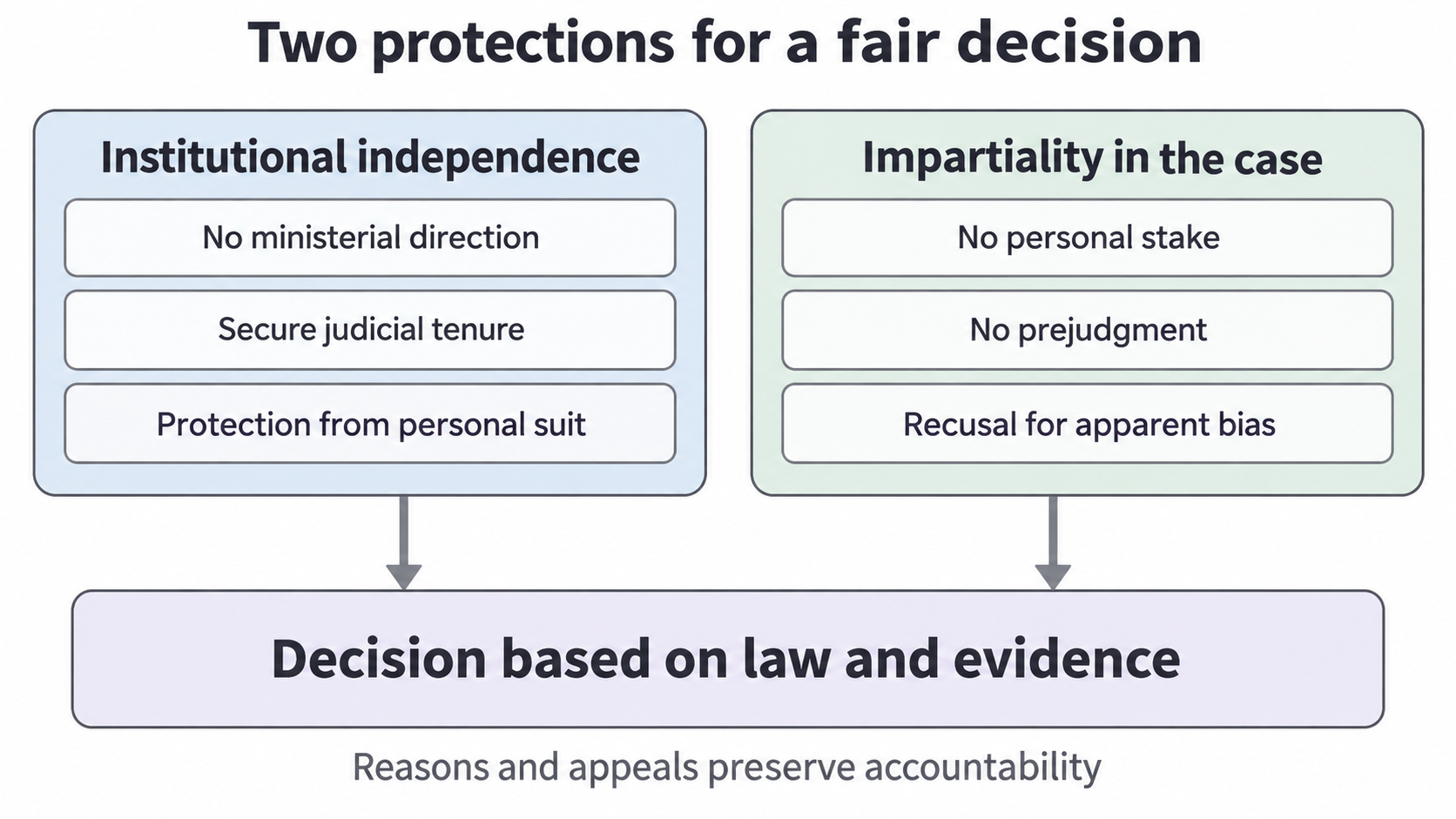
Independence has an institutional dimension and a case-specific dimension. Tenure and protection from personal suits reduce external pressure; recusal addresses a particular judge's connection to a dispute. Both aim to protect the decision itself.
There are reasons to evaluate judicial performance as well as defend independence. Legal expertise does not eliminate unconscious assumptions. A judiciary drawn from a narrow range of experiences may have difficulty understanding some litigants' circumstances, or appear distant from the public. Diversity can broaden perspectives and improve confidence, while appointment on merit remains important: demographic identity alone does not establish competence or impartiality.
Another criticism is that strong tenure and immunity make judges hard to challenge. That concern is strongest if decisions are unexplained or misconduct receives no response. However, accountability need not mean political control of outcomes. Public hearings, reasoned judgments, appeals and fair disciplinary processes allow scrutiny without threatening a judge for applying the law against the government. Appeals can be costly and do not guarantee correction of every error, so these mechanisms have practical limits.
Original argument: “Since judges are unelected, ministers should be able to remove them whenever voters dislike a decision.” Electoral accountability can justify ministers making policy and Parliament legislating. It does not justify punishment for applying the law in a particular case, especially where a minority needs protection against popular pressure. The stronger response is scrutiny through legal and conduct mechanisms, with legislative change where appropriate. This preserves both democratic law-making and fair adjudication rather than treating them as incompatible.
Quick recap
Judges' duties vary between civil trials, magistrates' courts, jury trials and appeals. Separation of powers, secure tenure and judicial immunity reduce improper pressure. Impartiality must also be protected in the individual case. Independence works alongside scrutiny, reasons, appeals and lawful conduct procedures.