H418/01 - Intentional serious harm and evaluation
The same injury can lead to different offences because fault matters as well as harm. Learn section 18's two fault routes, then assess whether the non-fatal offences provide clear, proportionate protection and how proposed reform might improve them.
Wounding or causing GBH under section 18
Section 18 of the Offences Against the Person Act 1861 concerns unlawfully and maliciously wounding or causing grievous bodily harm with a specified further intention. The physical result is a wound or GBH, not necessarily both. The definitions are the same as for section 20: a wound breaks through the whole skin; GBH is really serious bodily harm, including sufficiently serious recognised psychiatric illness. “By any means whatsoever” makes the means of causing harm broad.
The prosecution must prove factual and legal causation, unlawfulness and the appropriate fault. A knife is not a compulsory ingredient, and serious harm does not automatically establish section 18. A deliberate trap, for example, could cause GBH without a face-to-face attack. An omission may also cause harm where the law recognises a duty; the wording does not create a universal duty to rescue strangers.
Section 18 is more serious than section 20 principally because of its additional intention. Its maximum sentence is life imprisonment; sections 20 and 47 have five-year maxima on indictment. These are statutory maxima, not predictions of the sentence in every case. Individual sentencing depends on the applicable law, guidelines and circumstances. Do not read the nineteenth-century language of “penal servitude” as describing a modern punishment.
There are two important routes: intending to cause GBH, or intending to resist or prevent lawful apprehension or detention while acting maliciously as to some harm. The second is easy to miss if the offence is shortened to “GBH with intent”. Reading the actual statutory alternatives shows why a convenient label cannot replace the rule.
The two fault routes
For the ordinary route, the defendant must intend to cause GBH. Intending a wound alone does not necessarily mean intending really serious harm: a person could mean a small full-thickness cut. Recklessness as to GBH is also insufficient for this route. “Maliciously” adds nothing where the intention to cause GBH is proved, because that intention already includes the lesser fault as to some harm.
Intention is inferred from all the evidence, including statements, planning, weapons, the force and location of blows, repetition and opportunities to stop. These are evidential factors, not automatic legal presumptions. Repeated heavy blows aimed at the skull strongly support an intention to cause serious injury. A single push does not necessarily support the same conclusion simply because the victim falls badly. Belfon (1976) illustrates that foresight or recklessness cannot simply be substituted for the required intention. If oblique intention is in issue, apply the carefully defined virtual-certainty approach taught in the fault lesson; mere probability is insufficient.
The alternative route requires intention to resist or prevent the lawful apprehension or detention of oneself or another, together with “malice” as to some bodily harm. The defendant need not intend GBH on this route. A wound or GBH must nevertheless result, and the apprehension or detention must be lawful. The Judicial College's Crown Court Compendium explains this as separate proof of injury fault and the arrest-prevention purpose. It is not an offence established merely by disliking a police officer.
Original comparison: Ben deliberately lashes out to stop a lawful arrest, foreseeing a minor injury, and causes the officer a full-thickness cut. The arrest route may establish section 18 even without an intention to cause GBH. Change the purpose: Ben strikes during a private argument, intending only the minor cut and not serious harm. The arrest route is absent and the ordinary section 18 intention is unproved; section 20 is a stronger candidate.
Harm, fault and fair labelling
Evaluating the offences means testing their operation against reasons for criminalisation and punishment. Fair labelling asks whether the offence name accurately describes the wrong. Correspondence asks whether the required fault matches the harm for which liability is imposed. Protection of victims, proportionality, practical enforcement and legal certainty may pull in different directions.
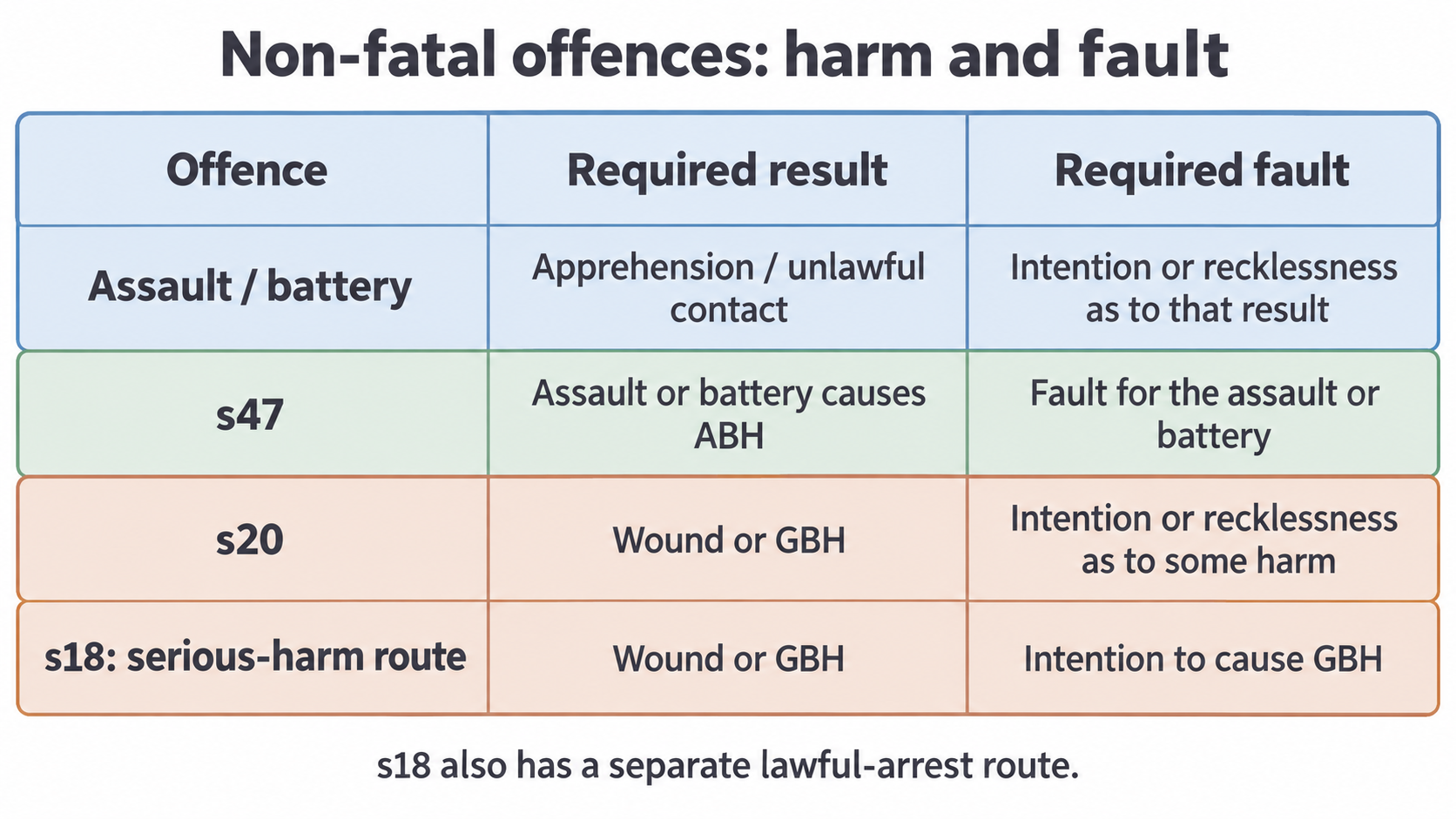
Required result and fault are separate questions for each offence.
The comparison shows why result and fault must be assessed independently. It is an overview, not a rule that every case moves sequentially through all four rows; section 18's lawful-arrest route is separate.
Section 47 imposes liability for ABH without foresight of injury. Section 20 can impose liability for GBH when only slight harm was intended or foreseen. A critic argues that this makes offence classification depend heavily on luck: equally blameworthy punches can produce different injuries. A minor intended contact might unexpectedly become an ABH conviction. The defendant's mental responsibility does not fully correspond to the injury label.
A counterargument is that someone who deliberately infringes another's bodily security should bear responsibility for harm causally flowing from that wrong. The victim's actual suffering matters; fault for the underlying wrong prevents wholly accidental conduct from automatically becoming section 47. Section 20 also requires some injury fault, and section 18 distinguishes the particularly culpable serious-injury purpose. The law has a workable protective structure even if it lacks perfect correspondence.
Wounding creates a further anomaly. A small full-thickness cut and major internal damage can enter the same section 20 category, while section 47 and section 20 share a five-year maximum despite their apparent position on a ladder of seriousness. That weakens a perfectly orderly hierarchy. Yet maximum penalties leave room for proportionate sentencing, and charge selection can reflect the overall facts. This mitigates the problem without changing the elements or curing the label itself.
Continue this lesson.
You’re previewing NovaLearn without an account. Create a free account to read the rest.
Create free account