H418/01 - Acts, omissions and involuntariness
An offence's external element may require conduct, circumstances or a result. Learn how voluntary acts differ from involuntary behaviour, and when a recognised duty makes a failure to act legally significant.
Conduct and consequence crimes
The actus reus comprises the offence's external elements, rather than simply “something the defendant did”. It can include conduct, circumstances and consequences.
A conduct crime does not require proof of a particular harmful result. Fraud by false representation under Fraud Act 2006 section 2 can be complete when the defendant dishonestly makes the qualifying false representation with the required knowledge and intent to gain, cause loss or expose another to risk of loss; a victim need not actually part with money. Calling it a conduct crime does not remove its mental elements.
A consequence crime requires a specified result caused by the defendant's conduct. Murder requires a death; basic criminal damage requires destruction or damage. For basic criminal damage, ownership by another is a circumstance and damage is a result. Causation links the defendant's conduct to that result. A failed attack may raise an attempt, but it does not establish the completed result offence merely because the defendant wished to succeed.
Original comparison: Noor knowingly submits a dishonest false invoice intending to obtain money, but the recipient spots it and pays nothing. Absence of actual gain does not by itself defeat fraud by false representation. Noor then deliberately throws a stone at a window; if it misses and causes no damage, that act does not complete criminal damage. Identify the required result from the offence definition, not from whether the behaviour sounds harmful.
Voluntary acts and loss of control
Criminal liability ordinarily requires voluntary conduct: the defendant must have control over the relevant act.
Involuntariness concerns lack of voluntary control, not reluctance, anger or a bad choice. Someone who deliberately strikes another while furious still acts voluntarily. A reflex movement following a sudden external blow, by contrast, may lack control. Automatism requires a complete loss of voluntary control, rather than reduced awareness or poor concentration. The legal classification of its cause matters: an internal disease of the mind may engage insanity rules, while an external cause may support non-insane automatism. These defences and their restrictions receive fuller treatment later.
In Hill v Baxter [1958] 1 QB 277, an unexplained claim of lost awareness did not establish automatism in a driving case. The court's discussion of possibilities such as a swarm of bees was illustrative reasoning, not a finding that bees caused the defendant's conduct. The lesson is to require a proper evidential basis. In Attorney-General's Reference (No 2 of 1992) [1994] QB 91, a lorry driver's impaired awareness while still exercising some control did not meet the requirement of total destruction of voluntary control.
Original application: evidence that a driver continued steering deliberately around obstacles weakens a claim of complete automatism, even if the driver remembers little. Medical evidence of total loss after an unforeseeable blow points differently. Also consider earlier voluntary conduct: choosing to drive despite a known dangerous condition can create liability even though a later movement was uncontrolled. Do not turn an unexpected accident into guilt merely because someone was hurt, or turn any memory gap into an acquittal.
State-of-affairs offences
Some offences focus on a prohibited situation or status, so their external element is described as a state of affairs.
Road Traffic Act 1988 section 5(1)(b) concerns being in charge of a motor vehicle on a road or other public place after consuming alcohol above the prescribed limit. It does not require proof that the defendant drove or intended to drive. Section 5(2) supplies the specific defence of proving no likelihood of driving while still over the limit. “In charge” must itself be established: merely standing near someone else's vehicle is not automatically enough.
Historical Larsonneur (1933) 24 Cr App R 74 illustrates a particularly severe state-of-affairs approach: the defendant was forcibly brought back to the UK by Irish authorities and convicted under the then alien-control rule of being found here contrary to its conditions. It illustrates liability despite involuntary arrival under that historical provision. It is not a current immigration rule or a general power to criminalise anyone's involuntary presence.
The categories answer different questions. State of affairs describes the external element; strict liability concerns the absence of a fault requirement for an element. An offence may exhibit both, but the phrases are not synonyms. Interpret the actual provision and any defences. A general requirement of voluntariness cannot simply be asserted to override an offence whose legal construction takes a different approach; equally, one historical conviction does not make all possession, presence or status offences absolute.
Recognised duties to act
An omission is a failure to do something; criminal liability ordinarily requires a recognised legal duty to do it.
There is no general criminal duty to rescue every stranger. A morally shocking failure to help is therefore not automatically homicide. A duty can nevertheless arise through several routes:
| Duty route | Legal significance and example |
|---|---|
| Statute | A provision can expressly require action. Road Traffic Act 1988 section 170 imposes stop/details/reporting duties in specified road-accident circumstances; identify which duty and conditions apply. |
| Contract | A role can carry a duty protecting others. In R v Pittwood (1902) 19 TLR 37, a railway gatekeeper failed to close a crossing gate, leading to a fatal collision. The contractual duty supported manslaughter liability; it was not restricted to protecting his employer. |
| Relationship | A parent owes duties to a dependent child. In R v Gibbins and Proctor (1918) 13 Cr App R 134, the father and his partner deliberately withheld food from his child, who died. The father's parental duty and the partner's assumed responsibility supported murder convictions with the required fault. Not every family relationship automatically creates an identical duty. |
| Assumed care | Taking responsibility for a dependent person can generate a duty. In R v Stone and Dobinson [1977] QB 354, taking a vulnerable relative into the household and undertaking care supported a duty; their failure to obtain adequate help was relevant to manslaughter. A brief friendly gesture does not invariably assume complete responsibility. |
| Public office | A public official can have duties attached to the role. R v Dytham [1979] QB 722 concerned an on-duty police officer who deliberately failed to intervene in a fatal assault. The conviction was misconduct in public office, rather than an automatic conviction for causing the death. |
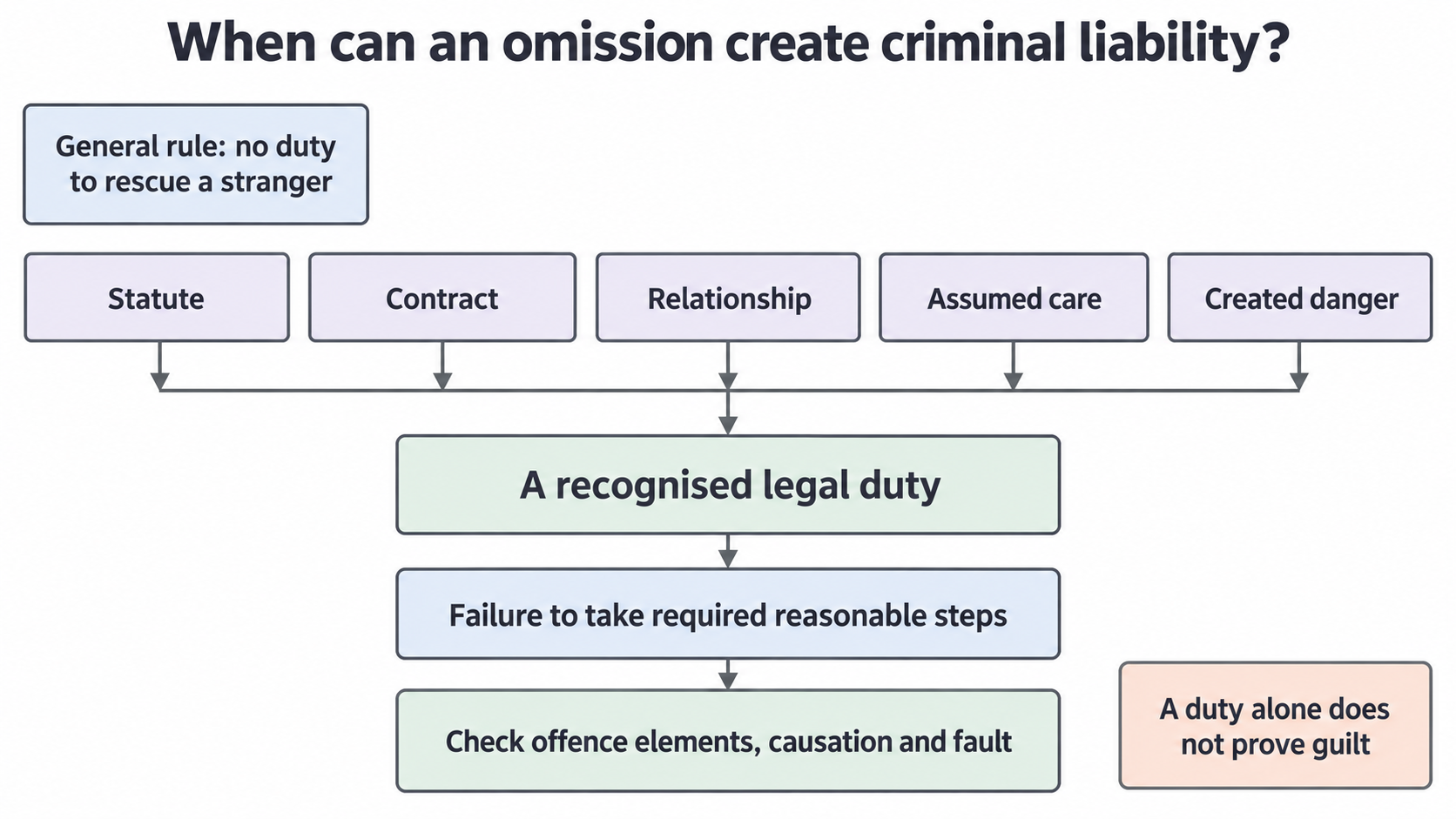
The diagram organises the common gateways. Public-office duties must also be considered where the role and offence make them relevant. After finding a duty, ask what action it required, whether the defendant could take it, and whether the offence permits liability by omission. Then prove any required causation and fault. Unlawful-act manslaughter, for example, requires an act and cannot be based simply on an omission. A duty alone does not prove guilt.
Creating danger and responding
A person who creates a dangerous situation may acquire a duty to take reasonable steps when they become aware of the danger.
In R v Miller [1983] 2 AC 161, a cigarette accidentally set a mattress alight. Miller woke, saw the fire and moved to another room without trying to prevent the damage or seeking help. The House of Lords upheld arson liability: accidental creation followed by a culpable failure to address the recognised danger could satisfy the offence. The court preferred explaining this through responsibility to act rather than artificially treating the whole sequence as one continuous act.
In R v Evans [2009] EWCA Crim 650, supplying heroin contributed to a life-threatening situation. The supplier recognised overdose symptoms but failed to obtain medical help. A duty will normally arise where someone creates or contributes to a state of affairs which they know, or ought reasonably to know, has become life-threatening. This supports examination of gross negligence manslaughter by omission; it does not make every supplier guilty of manslaughter whenever an adult self-administers drugs.
Original worked example: Pavel knocks a solvent container over accidentally, then notices a dangerous spill near a heater. He can turn the heater off and call for help safely but leaves. The initial accident does not establish deliberate damage; recognition and a reasonable opportunity to prevent harm make the later omission significant. If he immediately warns others and contacts help because approaching the spill would expose him to serious danger, those may be the reasonable steps required. If the resulting harm would have occurred before any possible intervention, causation remains a separate problem. Liability concerns a proportionate response, not a demand for impossible or suicidal rescue.
Quick recap
Read the offence's external elements carefully. Distinguish controlled conduct, complete involuntariness and prohibited states of affairs. For an omission, identify a recognised duty and then examine the required steps, causation and fault.