2.7-2.8 - Series and parallel circuits
Series and parallel circuits are two different ways to connect components to a supply. The choice is not just a drawing style: it changes whether components depend on each other and how the current in the circuit responds when the supply or components change. In this lesson you will learn how to choose the more appropriate circuit for an application, including domestic lighting, and how to reason qualitatively about current in a series circuit.
One path and branches
A circuit must make a complete conducting path from one terminal of the supply to the other. Series and parallel circuits differ in the number of paths available through the components.
Series circuit
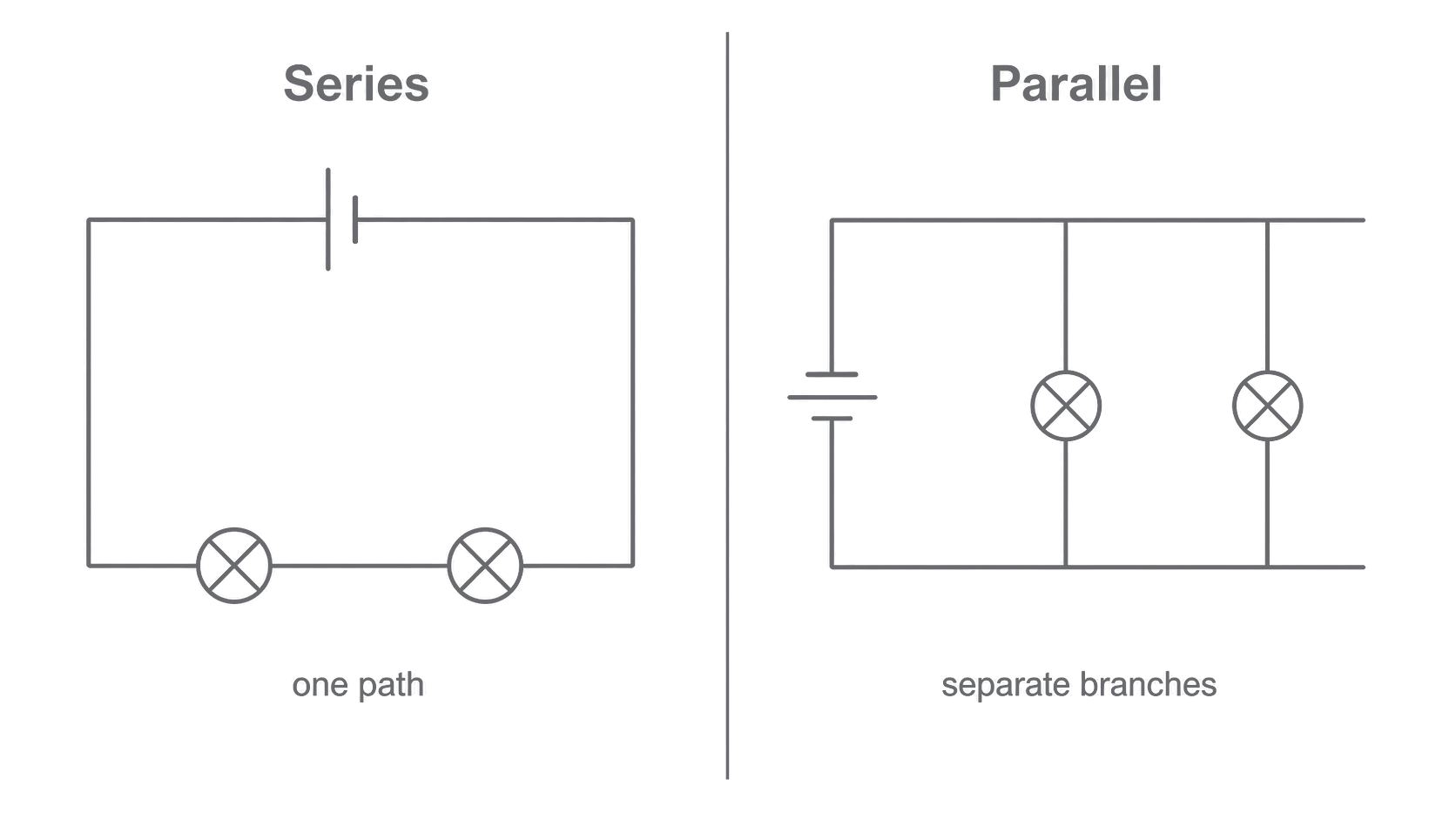
A series circuit has components connected one after another in a single path.
In a series circuit, the same route passes through every component. If that route is broken at any point, there is no complete path, so current cannot flow anywhere in the circuit.
Parallel circuit
A parallel circuit has components connected in separate branches across the supply.
In a parallel circuit, each branch gives a separate route through part of the circuit. Opening one branch does not necessarily break the other branches, because they can still form complete paths with the supply.
[DIAGRAM: asset_name: Series and parallel circuits - diagram 01; asset_slug: p15_series_and_parallel_circuits__diagram_01; recommended_method: image_gen; description: Monochrome side-by-side GCSE circuit schematic. The left panel is labelled Series and shows one complete loop with a cell and two lamps one after another, with the note one path. The right panel is labelled Parallel and shows a cell or supply connected across two rails with exactly two separate lamp branches between the rails, each branch containing one lamp, with the note separate branches.]
Choosing the circuit
When Edexcel asks which circuit is more appropriate, it is usually looking for a reason linked to how the circuit behaves, not a vague answer such as "it is better".
| Need in the application | More suitable arrangement | Physics reason |
|---|---|---|
| One switch should turn the whole circuit on or off | Series switch with the load | The switch is in the only path, so opening it breaks the whole circuit. |
| Several lamps should be controlled independently | Parallel branches | Each lamp can have its own branch and switch. |
| One lamp failing should not turn off all the other lamps | Parallel branches | Other branches can still have complete paths. |
| All components should stop together when one part opens | Series arrangement | A break anywhere in the single path stops the current everywhere. |
Domestic lighting is a key example. A house does not use one long series chain of lamps. If it did, one failed lamp or one open switch could break the only path and turn off many lights. Also, changing the number of lamps in the chain would change the current through all of them.
Domestic lights are connected in parallel branches. This means a bedroom light, kitchen light and hallway light can be switched independently. If one lamp fails, the other branches can still work because they are not all relying on the same single path.
Series circuits are still useful when the whole circuit should be controlled together. For example, a simple switch is placed in series with a lamp so that opening the switch breaks the only path to that lamp.
Current in a series circuit
In a series circuit, there are no junctions where current can split into different branches. The current has only one route, so the current is the same through each series component.
This does not mean the current is "used up" by the first lamp or resistor. Current is the rate at which charge passes a point in the circuit. In a complete series circuit, the same charge flow passes through each component in turn.
The brightness of lamps in series gives a useful clue. If two identical lamps are connected in series to one cell, the same current passes through both lamps. If a third identical lamp is added in series, there is still only one current, but it is smaller than before, so all three lamps are dimmer.
The important series idea is global: a change anywhere in the single path affects the current everywhere in that path.
What changes series current
The specification asks how current in a series circuit depends on three things: the applied voltage, the number of components and the nature of the components.
The applied voltage is the voltage supplied across the whole series circuit. If the same series circuit is connected to a larger applied voltage, the current tends to increase. If the applied voltage is reduced, the current tends to decrease.
The number of components matters because every series component is in the only path. Adding another lamp, resistor or motor in series usually makes it harder for current to flow, so the current decreases. Removing a series component, while still keeping a complete circuit, usually makes it easier for current to flow, so the current increases.
The nature of the components matters because different components affect the current differently. A short connecting wire has very little effect compared with a lamp or resistor. An open switch, broken lamp or disconnected wire is different again: it creates a gap, so there is no complete path and the current is zero.
| Change to the same basic series circuit | Expected effect on current | Why |
|---|---|---|
| Increase the applied voltage | Current increases | The supply pushes charge around the circuit more strongly. |
| Decrease the applied voltage | Current decreases | The supply pushes charge around the circuit less strongly. |
| Add another lamp in series | Current decreases | There is another component in the only path. |
| Replace a lamp with a component that opposes current less | Current increases | The single path is easier for current to pass through. |
| Open the switch | Current becomes zero | The circuit is incomplete. |
Exam explanations
A strong circuit-choice answer links the arrangement to the application. Use the words series, parallel, path, branch, complete circuit, independent and current carefully.
For a domestic lighting question, a high-scoring answer might say:
Parallel is more appropriate because each lamp is on a separate branch. Each light can be switched independently, and if one lamp fails the other lamps can still have complete circuits. In a series chain, one break would stop the current through every lamp.
For a series-current question, keep the comparison clear:
Increasing the applied voltage increases the current if the components are unchanged. Adding more components in series decreases the current because there are more components in the single path. Changing the type of component also changes the current because different components oppose current by different amounts.
Common mistakes to avoid:
- saying current is used up by each lamp in series
- saying a parallel circuit is chosen only because it has "more electricity"
- forgetting that one break in a series circuit stops current everywhere
- explaining domestic lighting without mentioning independent branches or independent switching
- using detailed calculation rules when the question only asks for a qualitative explanation