2.3-2.6 - Power, energy and mains electricity
Domestic appliances are useful because an electric current transfers energy to components inside them. In this lesson, the important ideas are tightly connected: current in a resistor can produce heating, power links current and voltage, fuse ratings are chosen from the normal operating current, and energy transfer depends on how long the appliance is on. The lesson finishes by separating mains a.c. from the d.c. supplied by cells and batteries.
Heating in resistors
A resistor is a component that makes it harder for charge to flow. When a current passes through a resistor, electrical energy is transferred in the resistor and the resistor's temperature increases.
One useful way to picture this is that moving charges repeatedly interact with the atoms in the resistor. Energy is transferred to the resistor's internal energy store, so the atoms vibrate more and the temperature rises. In exam answers, keep the chain of reasoning clear:
current in resistor -> electrical energy transferred -> temperature increases
This heating effect is not always unwanted. It is deliberately used in domestic appliances where a heating element acts as a resistor. Examples include a kettle heating water, a toaster heating bread, an iron heating its base, and an electric heater warming the air nearby.
The same idea also explains why too large a current can be dangerous: wires and components have resistance, so a very large current can cause excessive heating.
Power, current and voltage
The power of an appliance tells you how quickly it transfers energy. A high-power heater transfers energy faster than a low-power heater when both are working normally.
Electrical power
In this equation:
Pis power in watts,WIis current in amperes,AVis voltage in volts,V
The equation can be rearranged depending on what the question asks for:
Worked example: a 24 W lamp is connected to a 12 V supply.
So the current in the lamp is 2.0 A.
A common mistake is to treat watts as if they are the same thing as amperes. They are not. A watt is a unit of power; an ampere is a unit of current. The equation connects them only when the voltage is known.
Choosing fuses
A fuse is chosen from the normal current used by the appliance. In calculation questions, the usual route is:
- Use the appliance power and supply voltage to calculate the normal operating current.
- Choose a fuse rating just above that current from the ratings given.
The fuse must be above the normal operating current so the appliance can work without the fuse melting during normal use. It should not be much higher than necessary, because a very high fuse rating may allow an unsafe current to continue for longer before the circuit is broken.
Worked example: a 690 W appliance is connected to a 230 V mains supply. The available fuse ratings are 3 A, 5 A and 13 A.
A 3 A fuse would be right on the normal operating current and could blow during normal use. The next rating above 3.0 A is 5 A, so the appropriate fuse is 5 A.
If a question gives a calculated current of 2.6 A with available fuse ratings 1 A, 3 A and 13 A, choose 3 A: it is above the normal current and is the smallest suitable rating.
Energy transferred over time
Power tells you the rate of energy transfer. If the same appliance is left on for longer, it transfers more energy. For this lesson, the required relationship combines current, voltage and time directly.
Electrical energy transferred
In this equation:
Eis energy transferred in joules,JIis current in amperes,AVis voltage in volts,Vtis time in seconds,s
Use seconds for time unless the question clearly tells you to use another unit. If a time is given in minutes, convert it first.
Worked example: a 2.0 A heater is connected to a 230 V supply for 60 s.
So 27600 J of energy is transferred.
Notice the direct proportionality: if current and voltage stay the same, doubling the time doubles the energy transferred. That is why leaving an appliance on for longer transfers more energy.
A.c. and d.c.
Mains electricity is alternating current, written a.c.. In an alternating current, the current repeatedly changes direction.
A cell or battery supplies direct current, written d.c.. In a direct current, the current flows in one direction only.
[DIAGRAM: asset_name: Power, energy and mains electricity - diagram 01; asset_slug: p14_power_energy_and_mains_electricity__diagram_01; recommended_method: matplotlib; description: Monochrome 16:9 two-panel current-time graph comparing d.c. from a cell or battery as a constant positive current with a.c. mains as a sine wave crossing zero and reversing direction. Axes are labelled current and time, with the labels "d.c. from cell/battery" and "a.c. mains".]
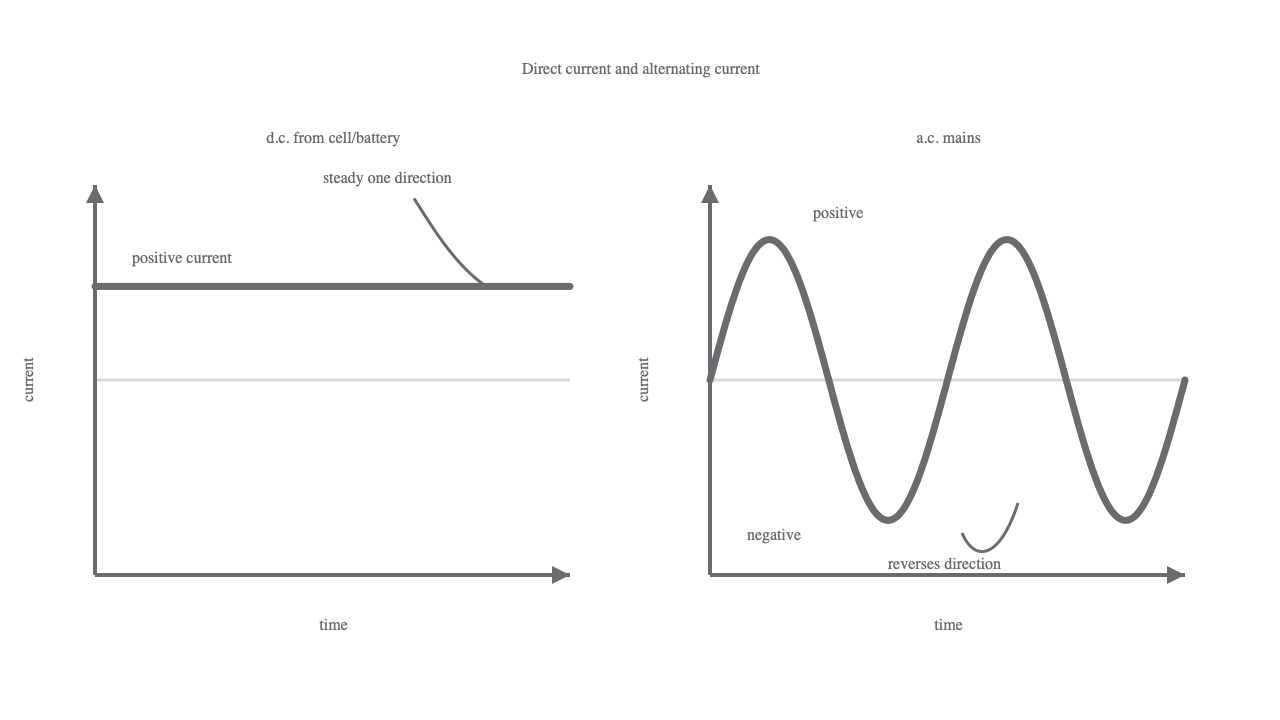
The diagram is a useful memory aid, but the exam wording is even shorter:
- mains electricity is
a.c. - a cell or battery supplies
d.c. a.c.changes direction repeatedlyd.c.flows in one direction only
Do not say that a.c. means the current is sometimes on and sometimes off. The current reverses direction; it is still supplying energy to the appliance during normal operation.