1.29P - Newton's third law
Newton's third law is about what happens when two objects interact. It does not say that forces disappear because they are equal and opposite. It says that a force is never alone: if one object exerts a force on another, the second object exerts an equal and opposite force on the first.
Forces from interactions
A force is a push or pull on an object. Newton's third law links that force to the object causing it.
Newton's third law
When two objects interact, they exert forces on each other that are equal in size and opposite in direction.
The two forces form a Newton pair, also called an interaction pair or action-reaction pair. The word "pair" matters because there are always two objects involved. Object A exerts a force on object B, and object B exerts a force on object A.
The forces in the pair:
- act on two different objects
- are equal in size
- act in opposite directions
- are the same type of force, such as two contact forces or two gravitational forces
- happen at the same time
That last point is easy to miss. "Action and reaction" can sound as if one force happens first and the other force happens later. For Newton's third law, the forces are simultaneous parts of the same interaction.
Naming force pairs
The safest way to identify a Newton pair is to name the two objects and switch their positions in the sentence.
If object A exerts a force on object B, the paired force is object B exerting a force on object A. In short:
- force of A on B
- force of B on A
[DIAGRAM: asset_name: Newton's third law - diagram 01; asset_slug: p11_newtons_third_law__diagram_01; recommended_method: image_gen; description: Monochrome 16:9 diagram of two simple carts or blocks touching on a horizontal surface. Object A is on the left and object B is on the right. A right-pointing arrow on object B is labelled "force of A on B"; a left-pointing arrow on object A is labelled "force of B on A". The arrows are the same length, in opposite directions, and clearly act on different objects. Include the note "equal size, opposite direction".]
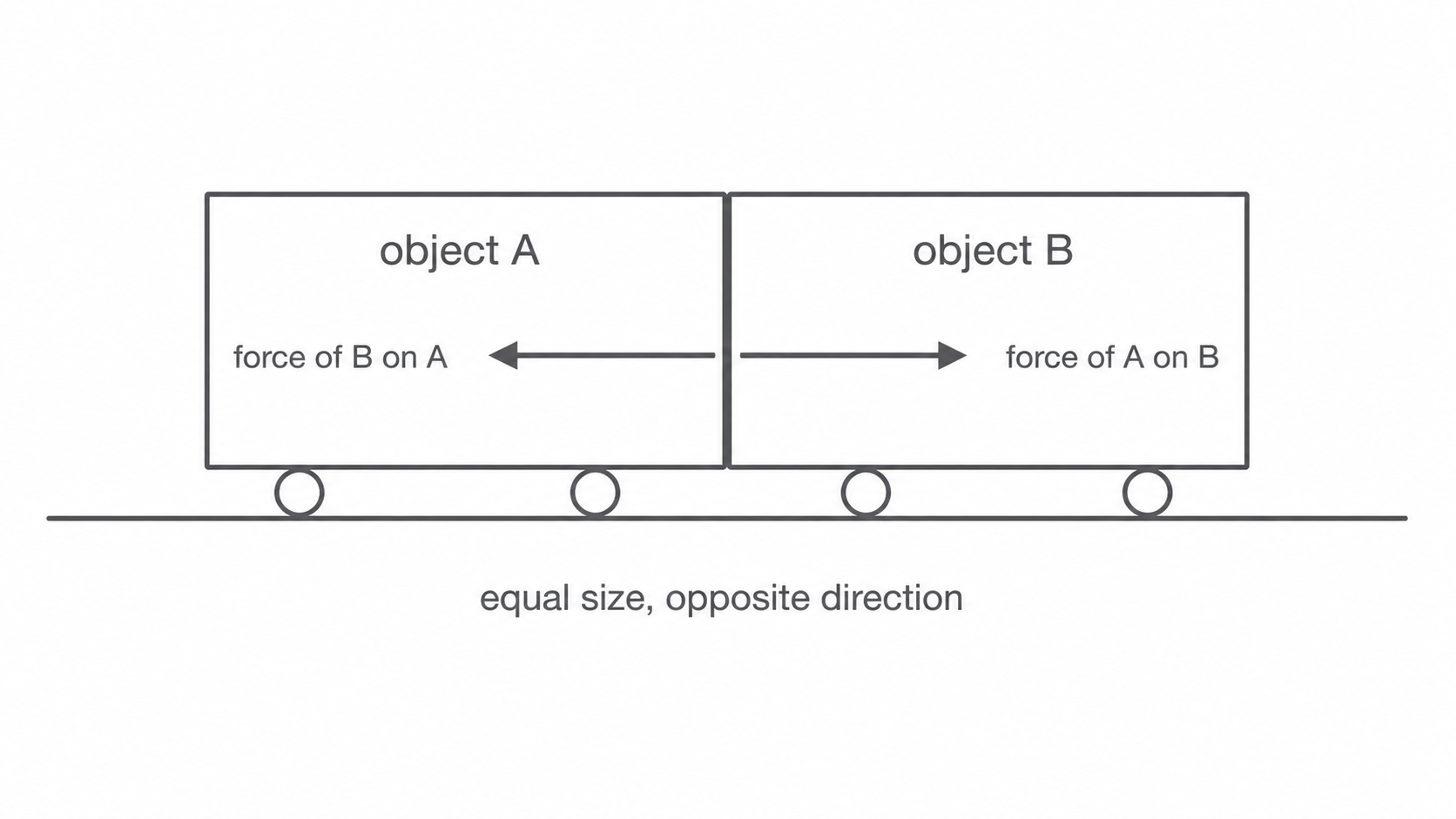
Notice the pattern in the labels. The first force is not "on A"; it is the force that A exerts on B. The paired force reverses the objects: B exerts a force on A.
This naming method works for contact forces and non-contact forces. If the Earth pulls a ball downwards, the ball pulls the Earth upwards with an equal gravitational force. The objects are different, the directions are opposite, and the force type is the same.
Why they do not cancel
Equal and opposite forces can cancel only when they act on the same object. Newton-pair forces act on different objects, so they do not cancel each other for either object.
Think about a book resting on a table. Two forces on the book may be balanced: the Earth's gravitational pull down on the book and the table's upward contact force on the book. Those two forces both act on the book, so they can give zero resultant force on the book.
That is not a Newton pair. The Newton pair for the table's upward force on the book is the book's downward force on the table. One force acts on the book; the other acts on the table.
This distinction is a common exam trap:
- balanced forces: two or more forces on one object can give zero resultant force
- Newton pair: two equal and opposite forces act on two different objects
So, if a person pushes a wall, the wall pushes back on the person. The wall's force on the person is not cancelled by the person's force on the wall, because those forces act on different objects.
Examples and unequal effects
Newton's third law applies whenever two objects interact.
When you walk, your shoe pushes backwards on the ground. The ground pushes forwards on your shoe. The forward force on you is one reason you can move forwards.
When a rocket engine fires, hot gases are pushed backwards. The gases push the rocket forwards. The force on the gases and the force on the rocket are equal in size and opposite in direction.
When two trolleys collide, trolley A pushes trolley B and trolley B pushes trolley A. It does not matter if one trolley is heavier or moving faster before the collision: during the interaction, the force on A from B is equal in size to the force on B from A.
The effects on the two objects can still be different. A small trolley may change its motion more noticeably than a massive trolley. That does not mean the force on the small trolley was larger; it means the same size force can have different effects on different objects. Newton's third law compares the forces, not the resulting motion.
Exam language
For an Edexcel explanation, write the pair as two complete forces. Avoid saying only "there is an equal and opposite reaction", because that can be too vague.
A strong answer usually includes:
- the first object, the second object, and the direction of the first force
- the second object, the first object, and the opposite direction of the paired force
- the fact that the forces are equal in size and act on different objects
For example:
The skater pushes backwards on the wall. The wall pushes forwards on the skater with an equal-size force. These forces act on different objects, so they form a Newton pair.
Common mistakes to avoid:
- saying the bigger object exerts the bigger force
- saying the moving object exerts the bigger force
- saying the forces cancel because they are equal and opposite
- naming only one object, such as "the reaction force", without saying what exerts it and what it acts on
- mixing a balanced-force pair on one object with a Newton pair on two objects