1.25P-1.28P - Momentum and safety
Momentum is a way to describe how much motion an object has. In a collision, momentum helps you predict what happens to objects and explain why safety features reduce injury. The important idea is not just "big things are dangerous"; it is that changing a large momentum quickly needs a large average force.
Momentum as moving mass
An object has momentum when it has mass and velocity. A stationary object has no momentum because its velocity is zero.
Momentum
Momentum is the product of an object's mass and velocity.
The relationship is:
Momentum
In this formula, is momentum, is mass in kilograms, and is velocity in metres per second. The unit of momentum is therefore:
Momentum has a direction because velocity has a direction. In one-dimensional calculations, choose one direction as positive. A velocity in the opposite direction is then negative. This is why a rebound can involve a bigger change in momentum than simply stopping.
Worked example: a car moving at has momentum:
If the same car travels in the opposite direction at the same speed, its momentum would be using that sign convention.
Force from momentum change
A resultant force changes an object's momentum. For the same momentum change, the average force is smaller if the change happens over a longer time.
The Edexcel relationship is:
Force and momentum change
Here is the initial velocity, is the final velocity, is the mass, and is the time taken for the change. In collision questions, is usually the average force during the contact time.
Notice the order in the numerator: final momentum minus initial momentum. If you use signs consistently, the sign of tells you the direction of the force.
Worked example: a ball moving right at is brought to rest by a wall in . Take right as positive.
Initial momentum:
Final momentum:
Average force:
The negative sign means the force on the ball acts left, opposite to its original motion. The magnitude of the force is .
Safety features and stopping time
If a person in a car crash goes from moving quickly to rest, their momentum must decrease to zero. For the same person and the same initial speed, the change in momentum is fixed. The safety question is: how quickly does that change happen?
[DIAGRAM: asset_name: Momentum and safety - diagram 01; asset_slug: p10_momentum_and_safety__diagram_01; recommended_method: matplotlib; description: Monochrome force-time graph comparing a hard stop with a short stopping time and large average force against a safety feature with a longer stopping time and smaller average force for the same total change in momentum.]
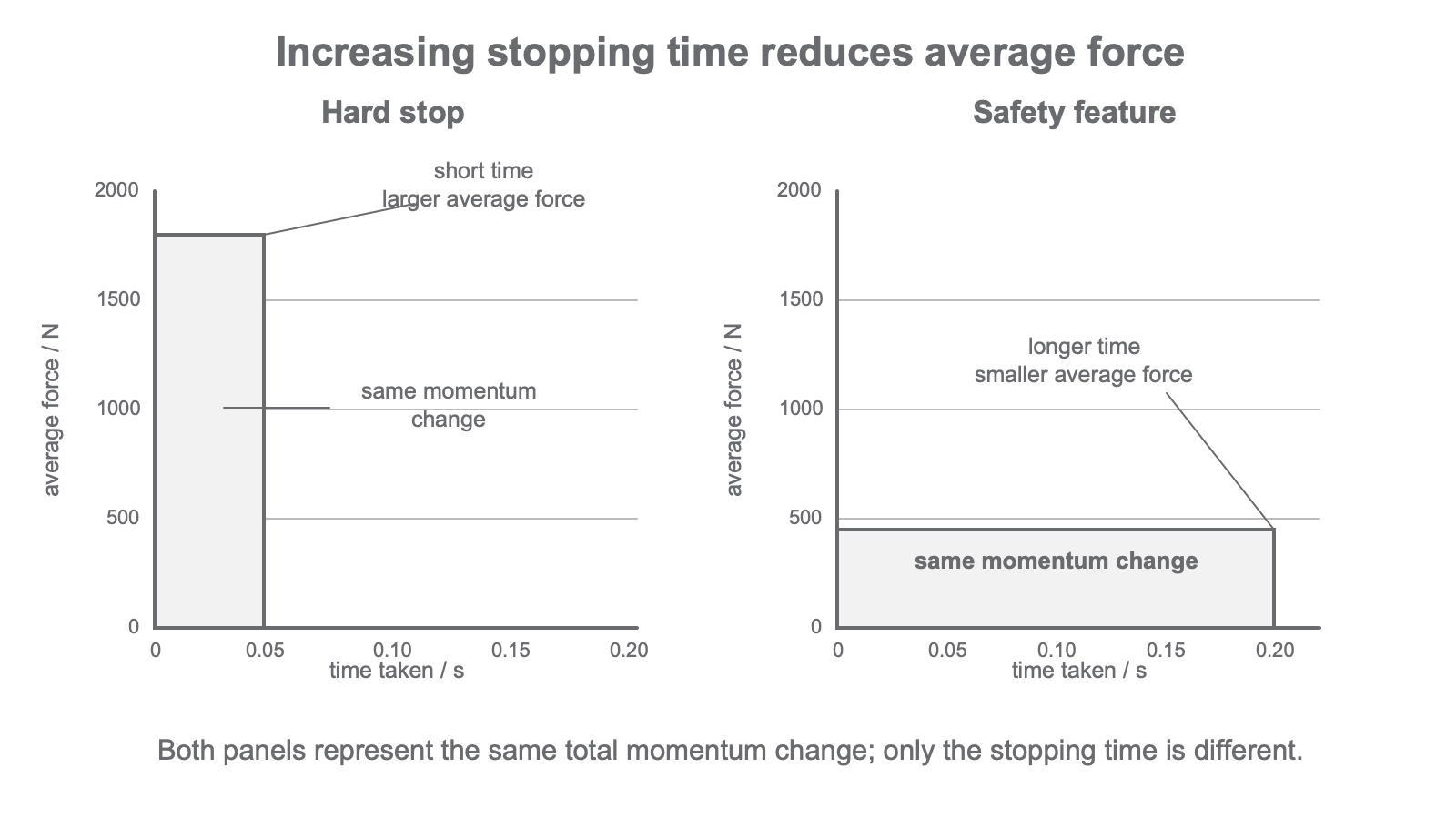
From
increasing the time taken reduces the average force. This is the momentum explanation behind many safety features.
| Safety feature | Momentum explanation |
|---|---|
| Crumple zone | The car front or rear deforms, increasing the time over which the car and passengers slow down. |
| Seat belt | It restrains the passenger and stretches slightly, increasing the time over which the passenger's momentum changes. |
| Airbag | It provides a softer, compressing surface, increasing the time over which the head or body is brought to rest. |
| Helmet or padding | It compresses during impact, increasing stopping time and reducing the average force on the head or body. |
A common mistake is to say that a crumple zone "absorbs the force". The better Physics answer is that it increases the collision time. For the same change in momentum, a longer time means a smaller average force.
Conservation of momentum
In a collision or separation where external forces are negligible, total momentum is conserved. This means the total momentum before the event equals the total momentum after the event.
Conservation of momentum
Momentum is conserved when the total momentum of a system before an event is equal to the total momentum of the same system after the event.
The "system" is the set of objects you are considering. In exam questions, this is usually two trolleys, two vehicles, or two people on ice. During a short collision, external forces such as friction are often treated as small enough to ignore.
Use a signed direction convention. For example, if right is positive, then left is negative:
| Object | Momentum before | Momentum after |
|---|---|---|
| A | ||
| B | ||
| Total |
Object A has lost of momentum. Object B has gained . The total stays the same.
For one-dimensional calculations, the conservation equation is:
Then replace each momentum with .
Conservation calculations
The safest calculation method is to make a before-and-after momentum table.
Worked example: a trolley moving right at collides with a stationary trolley. They stick together. Calculate their velocity after the collision.
Before the collision:
| Object | Mass / kg | Velocity / m/s | Momentum / kg m/s |
|---|---|---|---|
| Moving trolley | 0.80 | 3.0 | |
| Stationary trolley | 1.20 | 0 | 0 |
| Total | 2.4 |
After the collision, the combined mass is:
Momentum is conserved, so the total momentum after is still .
The joined trolleys move right at .
The same idea works for objects pushing apart. If the total momentum before is zero, the total momentum after must also be zero. One object moving right must be balanced by momentum of the other object to the left.
Worked example: two skaters are initially at rest. After they push apart, skater A has momentum . The total momentum before was , so skater B must have momentum . If skater B has mass , then:
The negative sign means skater B moves in the opposite direction to skater A.