2.13-2.16 - Voltage, current, resistance and charge
Electric circuits are easier to reason about when the four key quantities stay separate. Current tells you how quickly charge is flowing. Voltage, current and resistance are connected by one calculation relationship, and charge, current and time are connected by another. In metal wires, the moving charges are negatively charged electrons.
Current As Charge Flow
Electric current is not a substance that gets used up. It is a rate: it tells you how much electric charge passes a point each second.
Electric Current
Electric current is the rate of flow of electric charge.
The symbol for current is I. The unit is the ampere, A. A current of 1 A means 1 C of charge passes a point every second, so an ampere is the same as a coulomb per second.
Charge has the symbol Q and is measured in coulombs, C. Time has the symbol t and is measured in seconds, s. If more charge passes the point in the same time, the current is larger. If the same charge takes longer to pass, the current is smaller.
When an Edexcel question asks what current means, the important phrase is "rate of flow of charge". A common near miss is to say "number of electrons per second". In a metal, electrons do move, but the definition of current is about charge per second, not number of particles.
Charge, Current And Time
Because current is charge per second, charge can be calculated from current and time.
Charge, Current And Time
In this equation:
| Quantity | Symbol | Unit |
|---|---|---|
| charge | Q | coulomb, C |
| current | I | ampere, A |
| time | t | second, s |
The equation can be rearranged depending on the unknown:
For example, if a current of 0.40 A flows for 30 s, then:
If a question gives time in minutes, convert to seconds before substituting. For example, 4.0 min = 240 s, so a current of 2.5 A transfers:
Keep the final unit with the answer. A numerical value without C, A or s is usually incomplete in an exam calculation.
Voltage, Current And Resistance
Voltage is measured in volts, V. In circuit calculations, it is the potential difference across the component you are considering. Resistance is measured in ohms, Ω, and describes how much a component opposes the current through it.
For this cluster, the required relationship is:
Voltage, Current And Resistance
In this equation:
| Quantity | Symbol | Unit |
|---|---|---|
| voltage | V | volt, V |
| current | I | ampere, A |
| resistance | R | ohm, Ω |
The same equation can be rearranged:
For example, if the voltage across a resistor is 6.0 V and the current through it is 0.50 A, then:
Use the relationship as a sense check: for the same voltage, a larger resistance would make the calculated current smaller.
Electrons In Metals
In a solid metallic conductor, such as a copper wire, the moving charge carriers are negatively charged electrons. The positive metal ions are arranged in a fixed lattice and do not travel along the wire.
[DIAGRAM: electron_flow_in_metal: Voltage, current, resistance and charge - diagram 01; asset_slug: p17_voltage_current_resistance_and_charge__diagram_01; recommended_method: image_gen; description: Monochrome conductor cutaway showing fixed positive metal ions and negatively charged electrons flowing from a negative end towards a positive end, with a cross-section labelled as charge passing a point.]
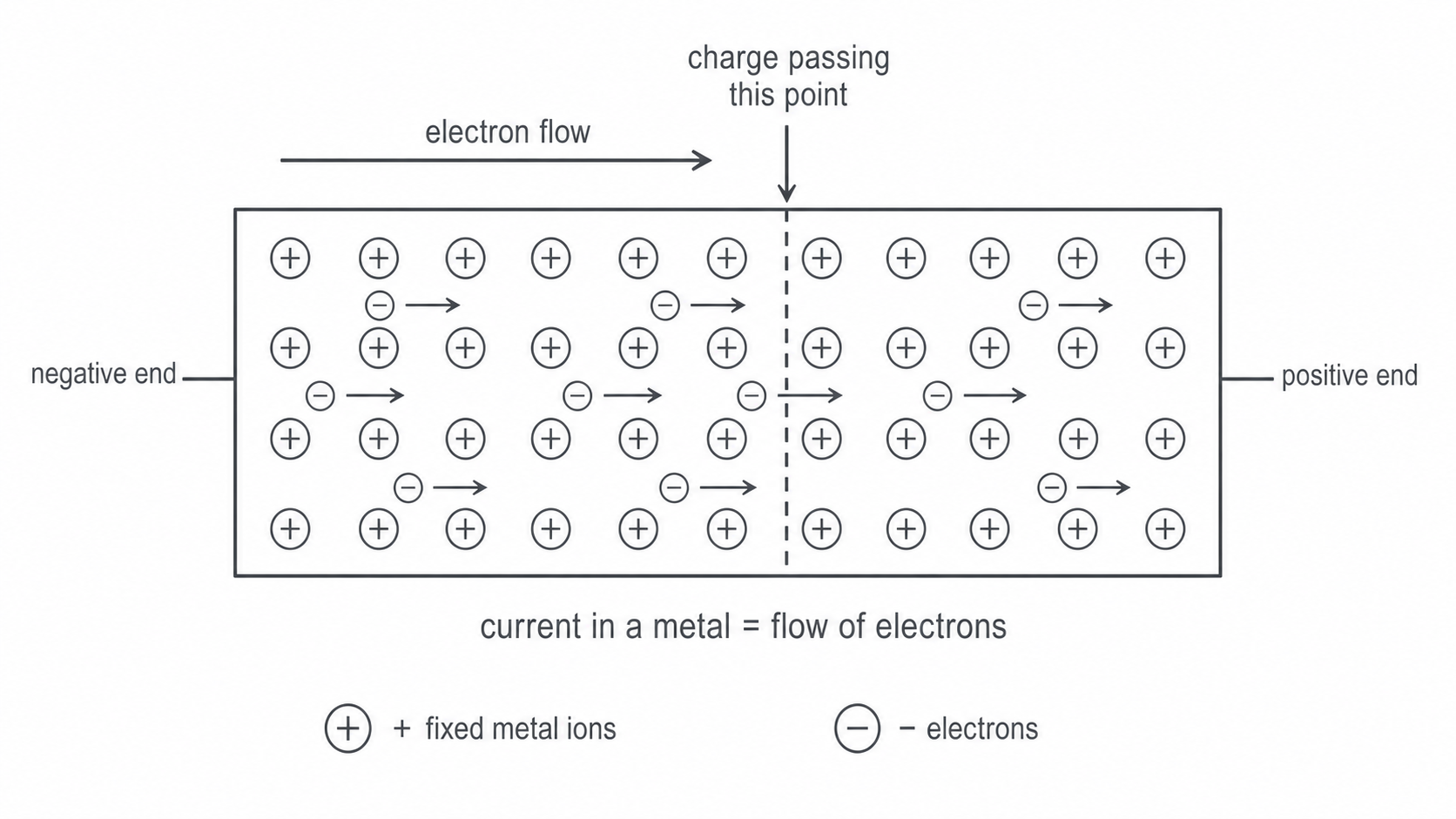
The diagram links two ideas that are often confused:
| Idea | What it means |
|---|---|
| Current | the rate at which charge passes a point |
| Current in a metal | the flow of negatively charged electrons through the solid metal |
The current is still measured in amperes, even though the individual moving particles are electrons. You do not need to count electrons in ordinary IGCSE current calculations; you use the total charge in coulombs.
Some later circuit diagrams may use conventional current direction, which is defined as the direction positive charge would move. Electron flow in a metal is opposite to conventional current. For this lesson's specification point, the key statement is simply: current in solid metallic conductors is a flow of negatively charged electrons.
Choosing The Equation
Most mistakes in this topic come from choosing the wrong relationship or forgetting to convert the time unit. Start by identifying the three quantities in the question.
| If the question mentions... | Use... | Typical unknowns |
|---|---|---|
| charge, current, time | Q = I × t | Q, I or t |
| voltage, current, resistance | V = I × R | V, I or R |
Use the units as a check. Coulombs belong with charge, amperes with current, seconds with time, volts with voltage, and ohms with resistance. If your answer to a resistance calculation is in coulombs, you have chosen the wrong equation.
Here is a linked example.
A charge of 36 C passes through a resistor in 12 s. The resistor has a resistance of 5.0 Ω. Calculate the current and then the voltage across the resistor.
First find the current:
Then use the current in the voltage equation:
Notice the order: Q = I × t gives the current, then V = I × R uses that current. The equations are connected by I, but they do different jobs.