1.10 - Constant acceleration equation
When an object moves with constant acceleration, its starting speed, finishing speed, acceleration and distance are linked by one time-free relationship. This lesson is about choosing that equation, using it cleanly in calculations, and recognising what the answer means. The key habit is to work with squared speeds first, then take the square root only when the final unknown is a speed.
The relationship and its symbols
The Edexcel relationship for this lesson is:
Constant acceleration equation
Here:
uis the initial speed, in m/svis the final speed, in m/sais the acceleration, in m/s^2sis the distance moved, in m
The equation connects two speeds with the distance covered during the same interval of motion. It is called a constant acceleration equation because it only works when the acceleration is constant over that interval.
Notice that the equation uses v^2 and u^2, not just v and u. If you are finding a speed, your calculation will usually find v^2 or u^2 first; the final step is to take the square root.
When to use it
Use this equation when a question links:
- initial speed
- final speed
- acceleration
- distance moved
It is most useful when the time is not given and is not being asked for. If the question gives speed, acceleration and distance data, this equation often avoids needing to find the time first.
[DIAGRAM: velocity_time_constant_acceleration: Constant acceleration equation - diagram 01; asset_slug: p04_constant_acceleration_equation__velocity_time_area; recommended_method: matplotlib; description: Monochrome velocity-time graph for motion with constant acceleration, showing a straight line from initial speed u to final speed v over a time interval, a gradient arrow labelled acceleration a, and the area under the graph labelled distance moved s. Use white background and #6A6B6E labels, axes, linework and shading.]
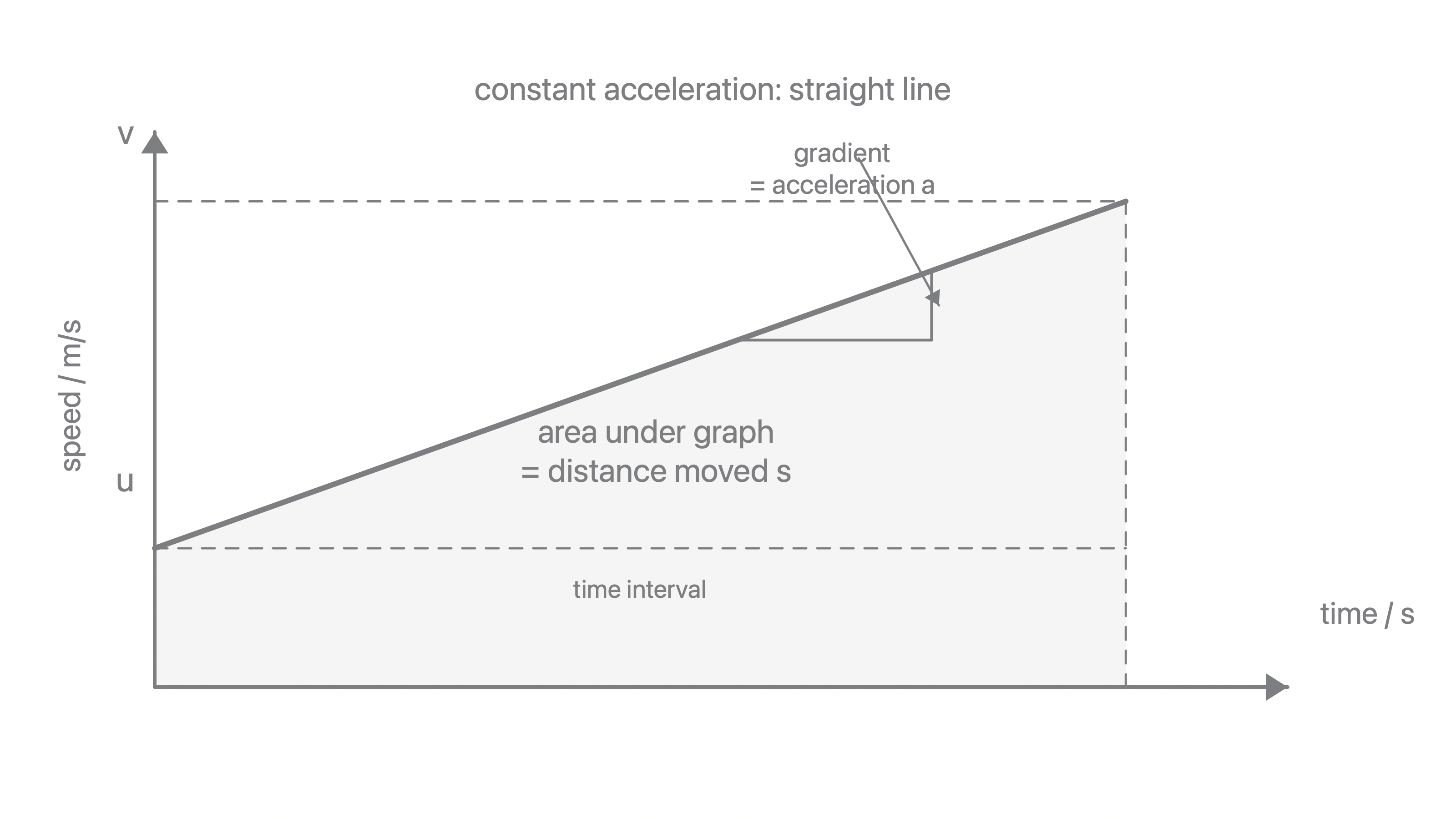
The graph is not needed for every calculation, but it gives a useful picture. For constant acceleration, the velocity-time graph is a straight line. The slope represents acceleration, and the area under the line represents distance moved, so it makes sense that the final relationship connects a, s, u and v.
If an object is slowing down, the acceleration may be negative. For example, a car moving forwards and braking can have a = -4.0 m/s^2. A negative answer for acceleration usually means the object is decelerating in the chosen direction.
Finding final speed
Suppose a trolley starts from rest and accelerates uniformly at 1.5 m/s^2 over a distance of 12 m. Find its final speed.
Write the known values:
u = 0 m/sa = 1.5 m/s^2s = 12 m
Substitute into the equation:
Now take the square root:
The final speed is 6.0 m/s. The answer is positive because speed is a size; if the context needs direction, the question will usually make that clear separately.
The common mistake is to stop at v^2 = 36 and write 36 m/s. That is not a speed. It is the squared speed, so the square root step is essential.
Rearranging the equation
The same relationship can be rearranged to find acceleration or distance. Start from:
To find acceleration:
To find distance moved:
For example, a cyclist slows uniformly from 12 m/s to 4.0 m/s over 35 m. Determine the acceleration.
The negative sign shows that the acceleration is opposite to the cyclist's motion: the cyclist is slowing down. If a question asks for the deceleration, give the size as 1.8 m/s^2, because deceleration already means a slowing-down acceleration.
Exam calculation habits
Pearson-style calculation marks usually reward the method as well as the final answer. A strong answer shows the equation, substitutes the numbers with units in mind, then gives the numerical answer with the correct unit.
Use this routine:
- Write
v^2 = u^2 + 2as. - List the known values and the unknown.
- Rearrange before substituting if the unknown is
aors. - Keep the squared speeds as squared speeds until the final square-root step.
- Check whether acceleration should be positive or negative.
- Give the final unit: m/s for speed, m/s^2 for acceleration, or m for distance.
For a braking calculation, signs matter. A car travelling at 20 m/s brakes uniformly to rest with acceleration -5.0 m/s^2. Its stopping distance is:
This answer is sensible: the distance is positive, while the acceleration is negative because the car is slowing down.