1.22-1.24 - Springs, Hooke's law and elastic behaviour
Stretching a spring, wire or rubber band is a simple way to see how a force can change the shape of an object. In this lesson you will learn how to measure extension, how to investigate the relationship between applied force and extension, and how to read the initial straight-line region of a force-extension graph as Hooke's law. You will also separate that graph idea from elastic behaviour: whether the material returns to its original shape after the force is removed.
Extension and deformation
A force can change an object's shape. In this topic the change is usually a stretch, so the object becomes longer than it was before the force was applied.
The key measurement is extension, not total length. If a spring is 12.0 cm long before loading and 15.5 cm long after loading, its extension is:
extension = new length - original length
extension = 15.5 cm - 12.0 cm = 3.5 cm
Extension
Extension is the increase in length of an object compared with its original length.
This matters because two objects can have different original lengths. A longer reading on the ruler does not automatically mean a larger extension; you must subtract the original length first.
When the force is removed, the object may return to its original shape. That is elastic behaviour, and we will come back to it after looking at how the measurements are made.
Investigating force and extension
The required practical idea is to investigate how extension varies with applied force for:
- helical springs
- metal wires
- rubber bands
For a spring or rubber band, a typical setup uses a clamp stand, a ruler, a pointer or marker, a mass hanger and slotted masses. The object hangs vertically. The masses provide the applied force because each mass has weight, so the results table should record force in newtons rather than just mass in grams. The ruler is placed close to the object, but not touching it.
For a metal wire, the extension may be much smaller, so the setup often needs a long wire and a clear marker. The same principle is used: measure the starting position, apply a greater load, then measure the new position.
In this investigation:
| Quantity | Role | How it is changed or measured |
|---|---|---|
| Applied force | Independent variable | Increase the load in steps |
| Extension | Dependent variable | Measure new length or marker position, then subtract the original value |
| Type of object | Comparison variable | Repeat the method for a spring, wire and rubber band |
Use a sensible range of loads and add masses gently. After each load is added, wait for the object to settle, then read the ruler at eye level to reduce parallax error. Repeat readings help you spot anomalies and calculate a mean extension for each force.
Safety is part of the method. Wear eye protection, secure the clamp stand, keep feet away from falling masses and place a mat below the masses. Do not overload the spring, wire or rubber band so far that it snaps or permanently changes shape unless the teacher has specifically planned that range.
Force-extension graphs
Once the results are collected, they are shown on a force-extension graph. A common layout puts applied force on the vertical axis and extension on the horizontal axis, then uses the shape of the graph to judge the relationship.
[DIAGRAM: force_extension_graph: Springs, Hooke's Law and Elastic Behaviour - diagram 01; asset_slug: p09_springs_hookes_law_and_elastic_behaviour__diagram_01; recommended_method: matplotlib; description: Monochrome force-extension graph with applied force on the vertical axis and extension on the horizontal axis. Show a straight initial line through the origin labelled Hooke's law region, a curved continuation labelled not proportional, and a separate non-linear rubber band curve. Use #6A6B6E linework and labels on white.]
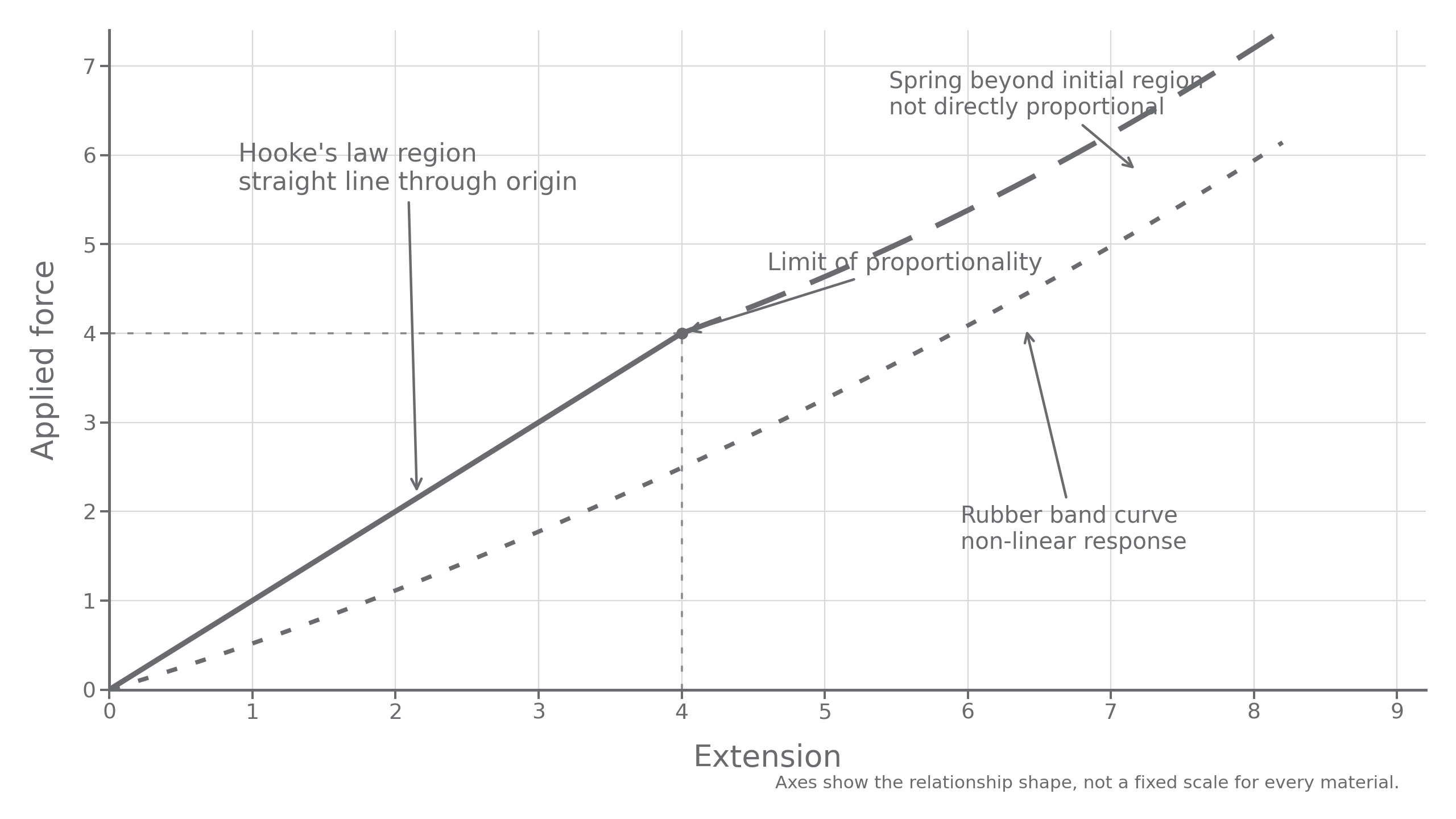
The initial straight-line region is the Hooke's law region. In that region, extension is directly proportional to applied force:
- doubling the force doubles the extension
- tripling the force triples the extension
- the graph is a straight line through the origin
Hooke's law region
The Hooke's law region is the initial linear region of a force-extension graph where extension is directly proportional to applied force.
For many helical springs and some metal wires, the first part of the graph is close to a straight line. A rubber band is often more curved, so its extension is not usually directly proportional to force over the same range.
Do not describe the whole graph as Hooke's law just because part of it is straight. Hooke's law applies only to the initial linear region.
Elastic behaviour
Elastic behaviour is about what happens after the force is removed. A material shows elastic behaviour if it recovers its original shape when the forces causing deformation are taken away.
Elastic behaviour
Elastic behaviour is the ability of a material to recover its original shape after the forces causing deformation have been removed.
This is not exactly the same idea as Hooke's law. Hooke's law is about the shape of the force-extension graph while the material is being stretched. Elastic behaviour is about whether the material returns to its original shape after unloading.
That difference is a common exam trap:
- A straight initial graph means the object obeys Hooke's law in that region.
- A curved graph means force and extension are not directly proportional in that region.
- Elastic behaviour means the object returns to its original shape after the force is removed.
So a material can stop obeying Hooke's law before it becomes permanently deformed. If it returns to its original length after the force is removed, it has still behaved elastically over that loading and unloading cycle.
Comparing materials and conclusions
A good conclusion links the graph shape to the material being tested.
For a helical spring, the graph often starts as a straight line through the origin. This shows that extension is proportional to applied force in the initial region, so Hooke's law applies there. If the graph later curves, the spring is no longer obeying Hooke's law in that part.
For a metal wire, the extension for the same load may be small, so careful measurement is important. The initial region can still be linear, but the readings may be close together and harder to measure accurately.
For a rubber band, the graph is commonly curved over much of the range. That means equal increases in force do not produce equal increases in extension. A rubber band can still return to its original shape after unloading over a safe range, but the force-extension relationship is not a simple straight-line one.
When writing about results, use precise language:
| Weak wording | Stronger wording |
|---|---|
| "The spring stretches more." | "The extension increases as applied force increases." |
| "The graph is normal." | "The initial region is a straight line through the origin." |
| "It is elastic because it is straight." | "It is elastic if it returns to its original shape after the force is removed." |
| "The rubber band is wrong." | "The rubber band's force-extension graph is non-linear, so extension is not directly proportional to force." |
Hooke's law is identified from the initial straight-line region of a force-extension graph; elastic behaviour is identified by whether the material returns to its original shape after the deforming force is removed.
The most common practical mistake is to record the total length as the extension. Always calculate extension from:
extension = loaded length - original length
The most common graph mistake is to say that any object which stretches has obeyed Hooke's law. Stretching alone is not enough. The graph must show direct proportionality in the initial linear region.