2.1-2.2 - Electrical units and mains safety
Electrical quantities need correct units, otherwise a physics answer is incomplete. Domestic appliances also need safety features that stop a fault turning the metal case, cable, or user into a dangerous current path. This lesson keeps the focus on the seven required electrical units and on how insulation, double insulation, earthing, fuses and circuit breakers reduce risk.
The required electrical units
The specification expects you to use seven units accurately. A unit tells the reader what kind of quantity the number measures.
| Quantity | Unit name | Unit symbol |
|---|---|---|
| current | ampere | A |
| charge | coulomb | C |
| energy transferred or work done | joule | J |
| resistance | ohm | Ω |
| time | second | s |
| voltage or potential difference | volt | V |
| power | watt | W |
The symbols are part of the answer. For example, 3 A is a current, 3 C is a charge, and 3 W is a power. The number is the same, but the physics is different.
Use the capital letters carefully. A, C, J, V and W are capital letters. The symbol for second is lower-case s. The symbol for ohm is Ω.
Using units in answers
In calculation answers, the unit usually comes after the numerical value:
| Correct style | Why it is clear |
|---|---|
0.25 A | a current of 0.25 amperes |
18 C | a charge of 18 coulombs |
230 V | a voltage of 230 volts |
60 W | a power of 60 watts |
12 Ω | a resistance of 12 ohms |
45 J | an energy transfer of 45 joules |
8 s | a time of 8 seconds |
Do not guess the unit from the number size. A large number can have a small-risk meaning if it has the wrong unit attached, and a small number can still be dangerous if it is a current through a person. Match the unit to the quantity named in the question.
A good habit is to read your final answer as a phrase: "the current is 0.25 amperes", "the resistance is 12 ohms", or "the energy transferred is 45 joules". If the phrase sounds like the wrong kind of quantity, the unit probably needs fixing.
Insulation and double insulation
Insulation is material that does not allow charge to flow through it easily. In domestic appliances, plastic or rubber insulation is used around wires and around live parts so that a user cannot touch a conductor.
Insulation protects in two linked ways:
- it prevents a user from making direct contact with a live conductor
- it helps keep separate conductors apart, reducing the chance of a short circuit
Double insulation means the appliance has two independent insulating barriers, or an insulating outer case as well as insulated internal parts. The key point is that there should be no exposed conducting case that could become live and shock the user.
| Appliance feature | How it protects |
|---|---|
| insulated cable | separates the live conductor from hands and from other conductors |
| insulated handle or casing | lets the user hold the appliance without touching live parts |
| double-insulated plastic case | removes the need for an earth wire because the outside is not a conducting case |
A plastic phone charger, electric drill, or hairdryer may be double insulated. A damaged cable is unsafe because the insulation no longer separates the user from the live conductor.
Earthing metal-cased appliances
Earthing is used when an appliance has exposed metal parts, such as a metal case. The earth wire connects the metal case to the ground through a low-resistance path. In normal use, the earth wire should carry no current.
[DIAGRAM: asset_name: Electrical units and mains safety - diagram 01; asset_slug: p13_electrical_units_and_mains_safety__diagram_01; recommended_method: image_gen; description: Monochrome schematic of a metal-cased domestic appliance fault: a live wire touches the metal case, the earth wire provides a low-resistance path to earth, fault current flows through the earth path and the fuse or circuit breaker disconnects the circuit, keeping the user out of the current path.]
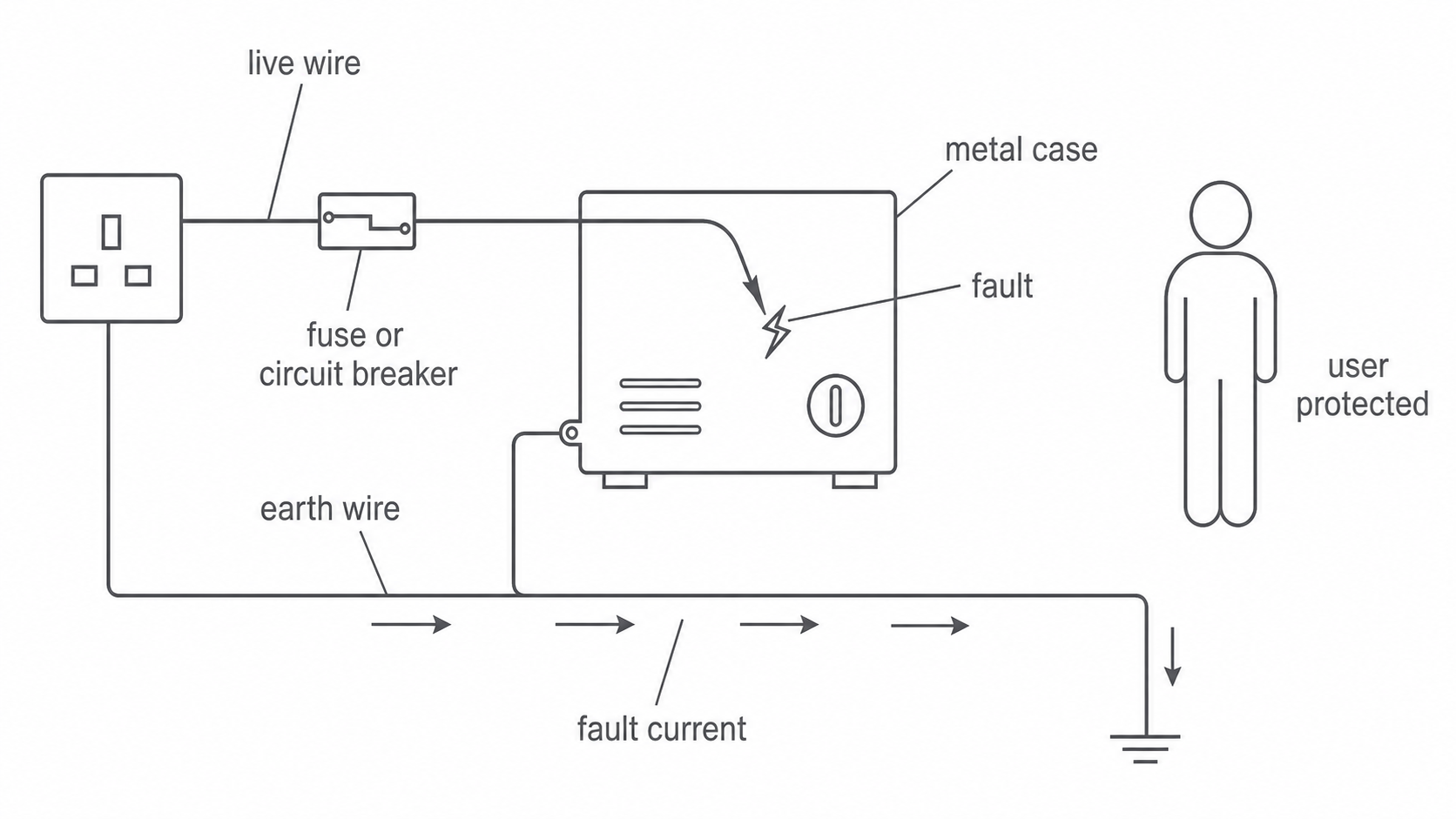
The important fault sequence is:
- A live wire touches the metal case.
- The metal case is connected to earth by the earth wire.
- A large fault current flows through the low-resistance earth path.
- The large current makes the fuse melt or the circuit breaker trip.
- The supply is disconnected, so the metal case is not left live.
Earthing is not just "a spare wire". It only protects properly when it gives fault current a safer path and helps a fuse or circuit breaker disconnect the circuit quickly.
Fuses and circuit breakers
Fuses and circuit breakers protect by disconnecting a circuit when the current becomes too large. A high current can overheat wires, damage an appliance, or increase fire risk. If the high current is caused by a live-to-case fault in an earthed appliance, disconnection also helps protect the user.
| Protection device | What it does | After it operates |
|---|---|---|
| fuse | a thin wire melts when the current is too large, breaking the circuit | it must be replaced |
| circuit breaker | a switch trips open when it detects a fault or excessive current | it can be reset after the fault is fixed |
In a domestic appliance, the safety features work together. Insulation reduces the chance of a fault. Earthing gives fault current a low-resistance path if a metal case becomes live. A fuse or circuit breaker then disconnects the supply.
The device or user being protected depends on the fault. A fuse in an appliance plug can protect the cable and appliance from overheating. Earthing plus a fuse or circuit breaker can protect the user by making sure a live metal case is disconnected quickly.