1.19-1.21 - Stopping distances and terminal velocity
A moving vehicle does not stop at the instant the driver notices a hazard. It travels while the driver reacts, then travels farther while the brakes slow it down. Falling objects also change motion because their forces change as their speed changes, until some objects reach a steady speed called terminal velocity.
Stopping distance
The stopping distance of a vehicle is the total distance it travels from the moment the driver first needs to stop to the moment the vehicle is at rest.
It has two parts:
- thinking distance: the distance travelled during the driver's reaction time, before the brakes are applied
- braking distance: the distance travelled after the brakes are applied, while the vehicle slows to rest
Stopping distance
For example, if a car travels 12 m while the driver reacts and then 28 m while braking, its stopping distance is:
A common exam mistake is to describe only the braking distance. The stopping distance starts earlier, when the driver first notices the need to stop.
Thinking distance and reaction time
Thinking distance depends on how far the vehicle travels during the driver's reaction time. Reaction time is the time between noticing the hazard and starting to brake.
At a steady speed during the reaction time:
Thinking distance
This means thinking distance increases if the vehicle is moving faster, because it covers more metres each second. It also increases if the driver's reaction time is longer.
Reaction time can be increased by factors such as tiredness, distraction, alcohol, drugs, or anything else that delays the driver noticing the hazard or moving to the brake. At the same speed, doubling reaction time doubles thinking distance.
Worked example: a car is travelling at 18 m/s. The driver's reaction time is 0.60 s.
The car travels 10.8 m before the brakes even begin to act.
Braking distance factors
Braking distance is affected by how quickly the vehicle can decelerate after the brakes are applied. The braking force must reduce the vehicle's speed to zero.
Several factors increase the braking distance:
| Factor | Main effect | Why the distance increases |
|---|---|---|
| Higher speed | Increases thinking distance and braking distance | The vehicle travels more metres each second before braking, and more speed has to be removed during braking. |
| Greater mass | Mainly increases braking distance | For the same braking force, a larger mass has a smaller deceleration, so it takes longer and farther to stop. |
| Poor road condition | Mainly increases braking distance | Wet, icy, loose, or greasy roads reduce friction between tyres and road, so the braking force is smaller. |
| Longer reaction time | Increases thinking distance | The vehicle keeps moving before braking begins. |
Speed is especially important because it affects both parts of stopping distance. A faster vehicle covers more distance during the driver's reaction time and also needs a longer distance to slow down once braking starts.
When explaining road condition, connect the condition to friction. A phrase such as "the road is icy" is not enough by itself; the physics is that reduced friction gives a smaller braking force, so the vehicle decelerates less quickly.
Forces on falling objects
A falling object usually has two important forces acting on it:
- weight, acting downwards because of gravity
- air resistance or drag, acting upwards against the motion
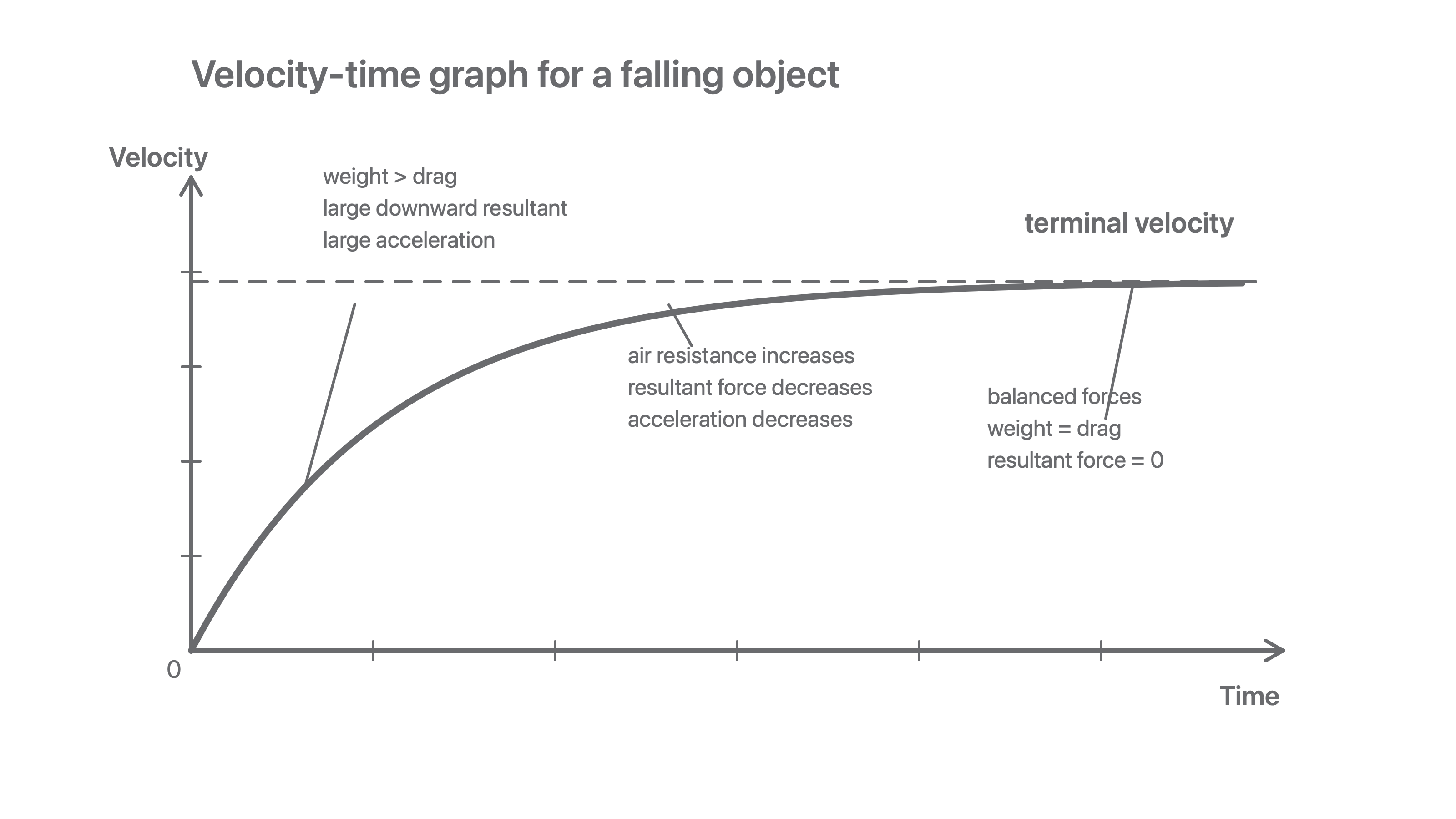
When the object is first released, its speed is small, so the air resistance is small. Weight is larger than air resistance, so the resultant force is downwards and the object accelerates downwards.
As the object gets faster, air resistance increases. Weight stays almost constant, but the upward drag force grows. The resultant downward force becomes smaller, so the object still speeds up, but its acceleration decreases.
[DIAGRAM: terminal_velocity_velocity_time_graph: Stopping Distances and Terminal Velocity - diagram 01; asset_slug: p08_stopping_distances_and_terminal_velocity__diagram_01; recommended_method: matplotlib; description: Monochrome velocity-time graph for a falling object. The curve rises steeply at first, becomes less steep as air resistance increases, and levels off at a dashed horizontal line labelled terminal velocity. Labels connect the early steep part to weight greater than drag, the curving part to decreasing resultant force, and the flat part to balanced forces.]
Terminal velocity
An object reaches terminal velocity when its weight and air resistance are equal in size and opposite in direction. The forces are balanced, so the resultant force is zero.
Zero resultant force does not mean the object stops. It means there is no acceleration. If the object is already moving downwards, it continues moving downwards at a constant velocity.
The sequence is:
- At the start, weight is greater than air resistance, so the object accelerates downwards.
- As speed increases, air resistance increases, so the resultant force and acceleration decrease.
- At terminal velocity, air resistance equals weight, so resultant force is zero and velocity is constant.
In exam answers, use the chain of reasoning. Do not only say "the object reaches terminal velocity". Explain why: increasing speed increases air resistance until air resistance balances weight.