1.30P-1.33P - Moments, centre of gravity and equilibrium
A force can do more than change the speed or shape of an object. If the force acts away from a pivot, it can have a turning effect called a moment. This lesson shows how to calculate moments, place weight through the centre of gravity, use the principle of moments, and explain the support forces on a light beam.
Moment of a force
A pivot is the point an object turns about. A force produces a bigger turning effect if the force is larger, or if the force acts further from the pivot.
Moment
The moment of a force is the turning effect of the force about a pivot.
For this specification, the moment is calculated using the force and the perpendicular distance from the pivot to the force's line of action.
Moment Of A Force
If force is measured in newtons, N, and distance is measured in metres, m, the unit of moment is newton metre, N m. In moment questions, N m is not written as joules, even though the base units look the same.
[DIAGRAM: asset_name: Moments, centre of gravity and equilibrium - diagram 01; asset_slug: p12_moments_centre_of_gravity_and_equilibrium__diagram_01; recommended_method: image_gen; description: Monochrome labelled line-art diagram of a horizontal lever on a pivot with a downward force on the right, a vertical line of action, the perpendicular distance from pivot to line of action, and a curved clockwise moment arrow.]
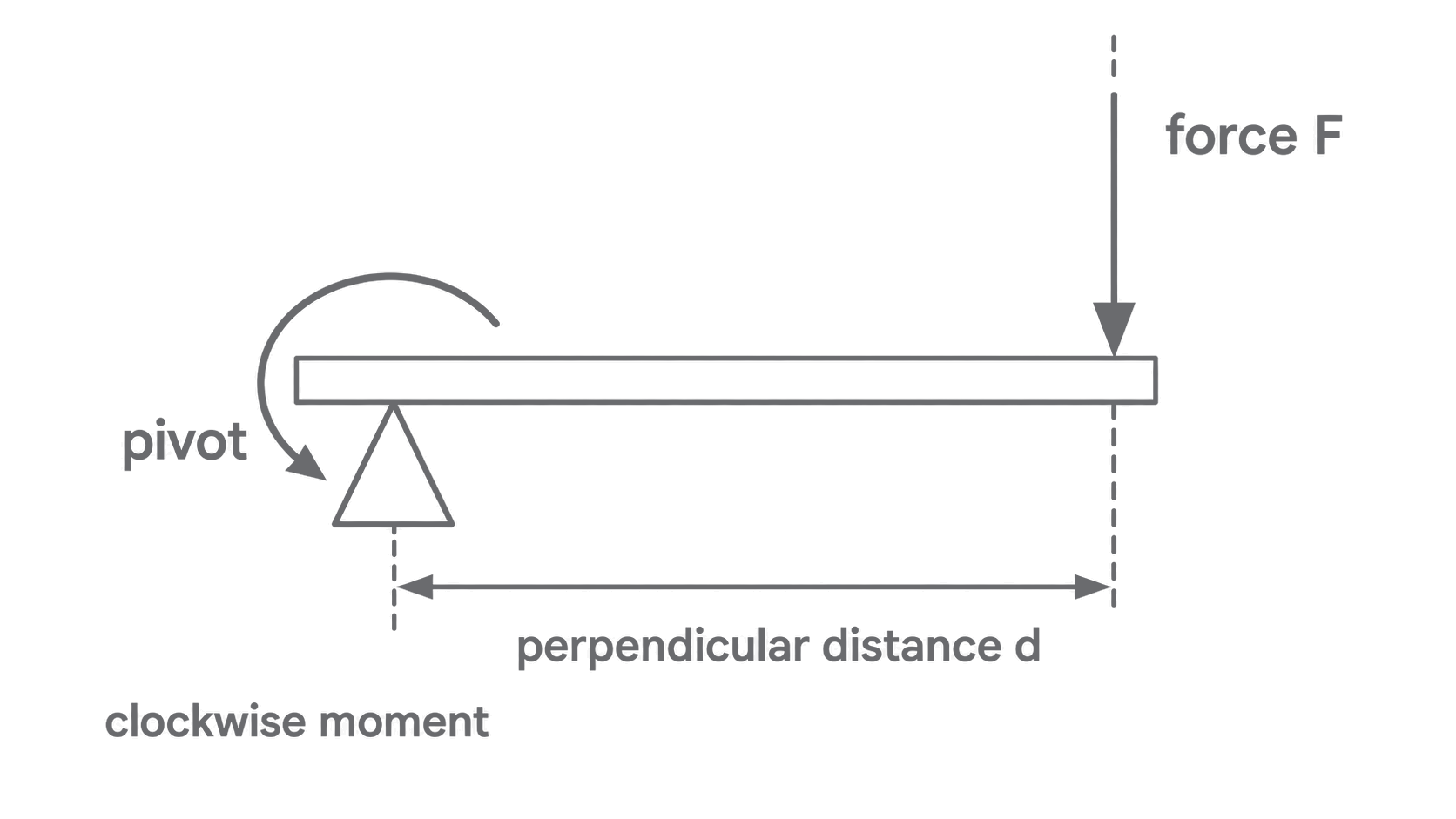
The distance must be perpendicular to the force's line of action. If the force acts straight down, the perpendicular distance is the horizontal distance from the pivot to the vertical line through the force.
For example, a 20 N force acts downwards 0.30 m from a pivot:
The answer also needs a direction: clockwise or anticlockwise. A downward force on the right of a pivot gives a clockwise moment.
Centre of gravity
Weight is the force of gravity on an object. In a moment diagram, you do not draw a separate tiny weight force for every part of the object. Instead, the whole weight of the object is treated as one downward force acting through one point.
Centre Of Gravity
The centre of gravity of a body is the point through which its weight acts.
For a uniform, symmetrical object, the centre of gravity is usually at the geometrical centre. For a non-uniform object, it may not be at the middle. The important exam idea is not the shape of the object; it is that the weight force is drawn vertically downwards through the centre of gravity.
This matters when taking moments. If a ruler is not light, its own weight acts through its centre of gravity and can produce a moment about a pivot. If a beam is described as light, its own weight is small enough to ignore, so only the added load's weight needs to be included.
Principle of moments
A simple system of parallel forces is in rotational equilibrium when it has no resultant turning effect. For a balanced beam or ruler, the clockwise moments and anticlockwise moments about the same pivot cancel.
Principle Of Moments
For a body in equilibrium, the total clockwise moment about a pivot equals the total anticlockwise moment about the same pivot.
This principle is used only after the forces and distances have been identified. A force whose line of action passes through the pivot has zero moment about that pivot because its perpendicular distance is zero.
Suppose a light ruler is balanced on a pivot. A 30 N force acts 0.20 m to the left of the pivot, and a force acts 0.50 m to the right.
The left force gives an anticlockwise moment:
For equilibrium, the clockwise moment on the right must also be 6.0 N m:
The forces do not have to be equal. A smaller force can balance a larger force if it acts further from the pivot.
Parallel force calculations
In this lesson, the forces are parallel and act in one plane. A good moment calculation has a clear pivot, distances measured from that pivot, and separate clockwise and anticlockwise moments.
A useful method is:
- Choose the pivot named in the question, or choose a pivot that makes one unknown force have zero moment.
- Mark each force as clockwise or anticlockwise about that pivot.
- Calculate each moment using force x perpendicular distance.
- If the system is balanced, set total clockwise moments equal to total anticlockwise moments.
For example, two downward forces act on opposite sides of a pivot. A 16 N force acts 0.25 m to the left. A 10 N force acts a distance to the right.
The left moment is:
For balance:
A common mistake is to use centimetres in one moment and metres in the other. Convert distances so both sides use the same unit.
Supported light beam
Now consider a light beam supported at both ends, with a heavy object placed on the beam. The beam is light, so its own weight is ignored. The heavy object has a downward weight, and the supports exert upward forces on the beam.
[DIAGRAM: asset_name: Moments, centre of gravity and equilibrium - diagram 02; asset_slug: p12_moments_centre_of_gravity_and_equilibrium__diagram_02; recommended_method: image_gen; description: Monochrome three-panel line-art diagram of a light beam supported at both ends, comparing a load near the left support, at the centre, and near the right support. Show larger upward support force nearer the load, equal forces at the centre, and smaller upward force at the far support.]
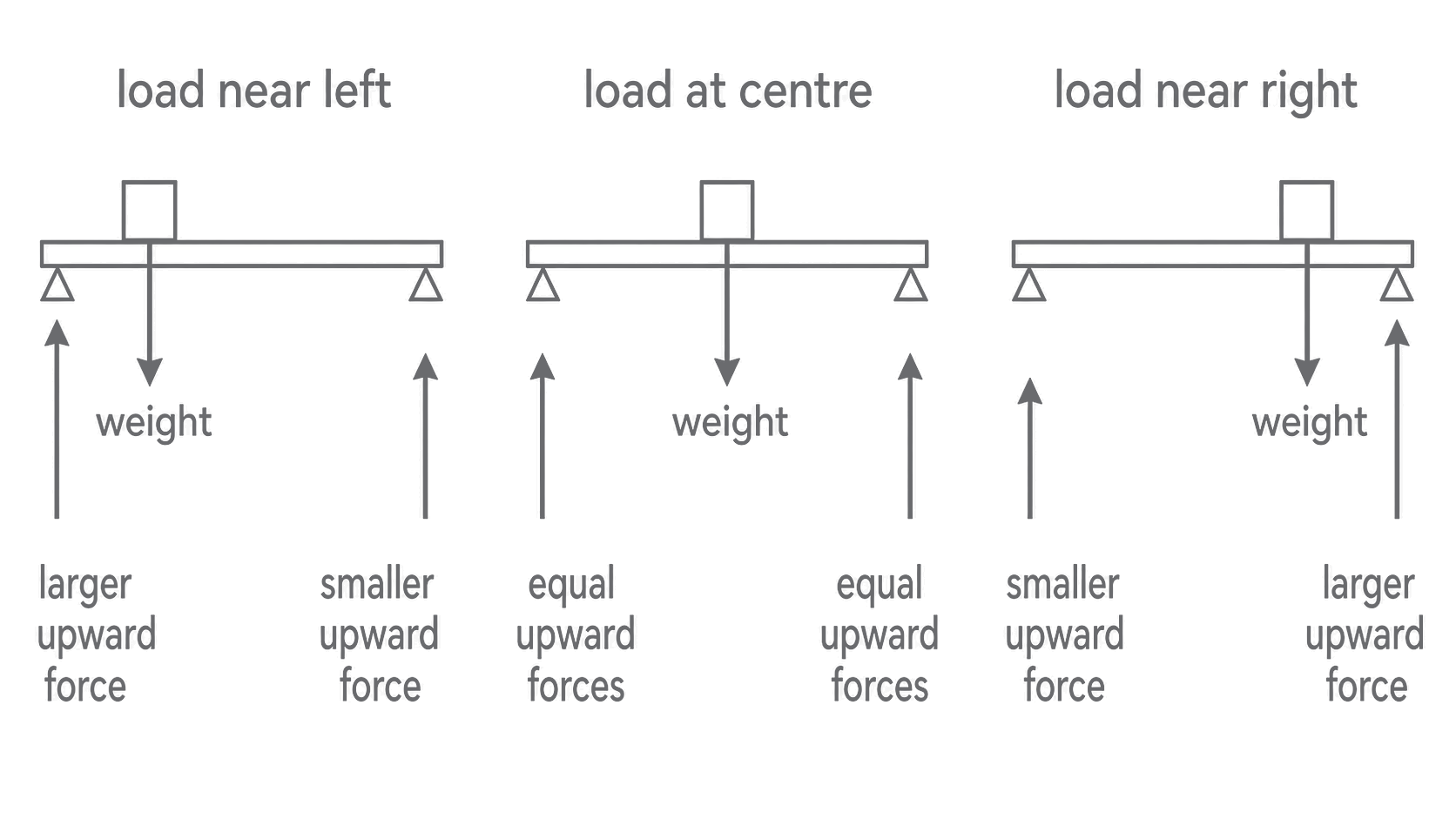
The support force is larger at the end nearer the object. If the object is exactly in the centre, the two upward forces are equal. As the object moves from left to right, the left upward force decreases and the right upward force increases.
The moments explain why. Imagine taking moments about the left support. The right support force has a moment because it acts at the far end of the beam. The object's weight also has a moment, and its moment increases as the object moves further from the left support. So the right support force must increase as the object moves towards the right.
For a numerical example, a 120 N object is placed on a 4.0 m light beam, 1.0 m from the left support. Let the right support force be .
Taking moments about the left support:
The total upward force must balance the 120 N weight, so:
The left support force is larger because the object is closer to the left support.