1.13-1.16 - Scalars, vectors and resultant forces
Some physical quantities are fully described by a number and a unit. Others also need a direction, and the direction changes the physics. In this lesson you will distinguish scalars from vectors, treat force as a vector, calculate resultant forces along one straight line, and use friction as a force that opposes motion.
Scalar or vector
A scalar quantity has magnitude only. Magnitude means size or amount, usually with a unit. If a mass is , the number and unit are enough; there is no direction to add.
A vector quantity has magnitude and direction. Saying that a runner has a velocity of is incomplete because the direction matters. A velocity of north and a velocity of south have the same magnitude, but they are different vectors.
| Quantity | Scalar or vector? | Why |
|---|---|---|
| mass | scalar | needs no direction |
| time | scalar | needs no direction |
| speed | scalar | gives how fast only |
| velocity | vector | east is different from west |
| force | vector | the size and direction of the push or pull both matter |
Use the words carefully. Speed is scalar; velocity is vector. Distance is scalar; displacement is vector. A scalar can be large or small, but it does not point anywhere.
Force as a vector
Force is a vector quantity. A force must have a magnitude, measured in newtons , and a direction. For example, " to the right" and " to the left" have the same magnitude, but they are not the same force.
Force arrows help show this. The arrowhead gives the direction of the force. A longer arrow usually represents a larger force, as long as the diagram is drawn consistently.
[DIAGRAM: asset_name: Scalars, vectors and resultant forces - diagram 01; asset_slug: p06_scalars_vectors_and_resultant_forces__diagram_01; recommended_method: image_gen; description: Monochrome force-line diagram showing a single force of 8 N to the right, two opposite collinear forces of 10 N right and 4 N left with resultant 6 N right, and friction opposing rightward motion.]
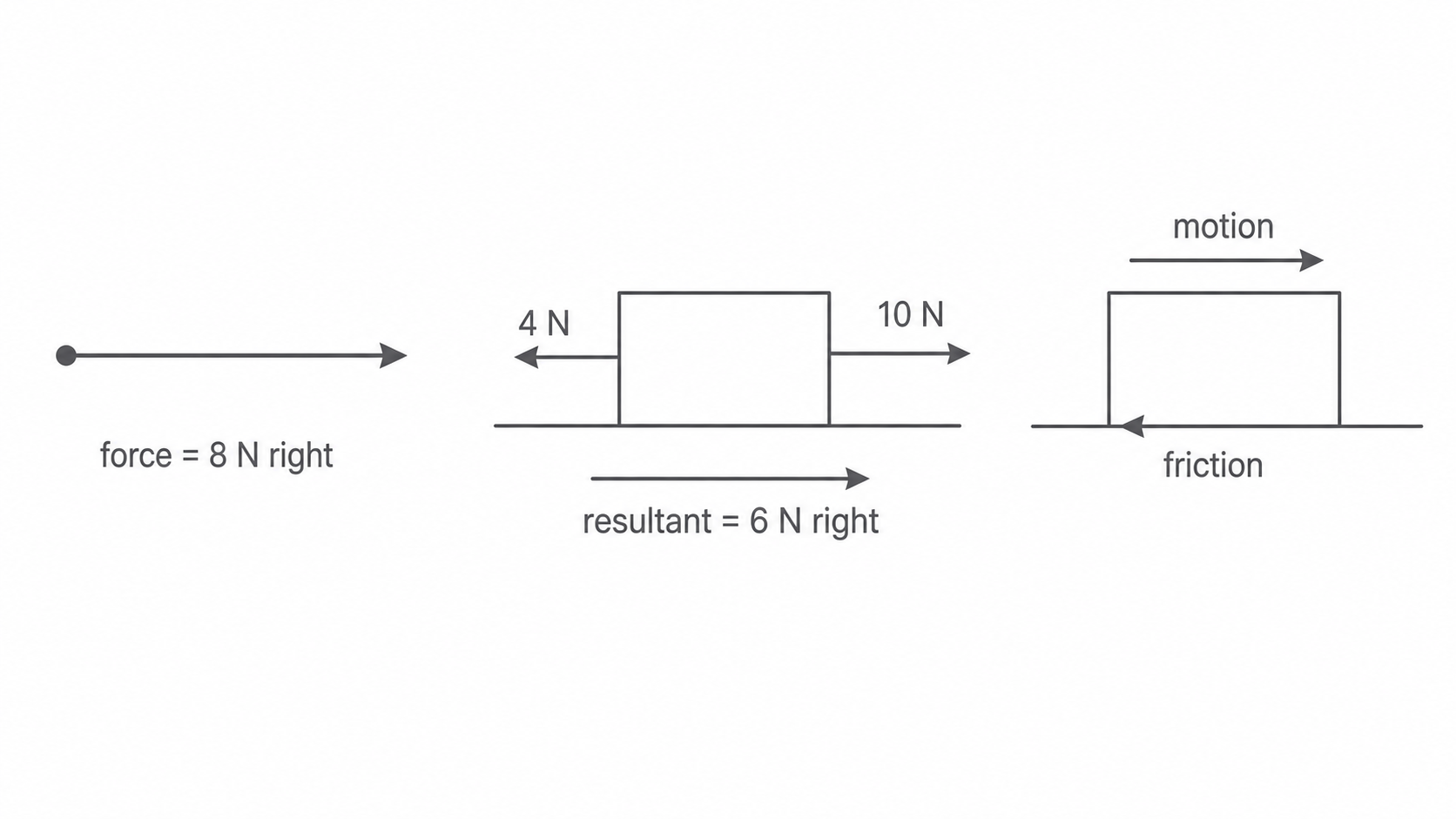
Because direction matters, two forces of the same size can have very different effects. Two equal pushes in the same direction combine. Two equal pushes in opposite directions balance along that line.
Resultant forces along a line
The resultant force is the single force that has the same overall effect as all the forces acting together. In this lesson, every resultant force calculation is along one straight line, such as left-right or east-west.
Forces in the same direction add. Forces in opposite directions subtract. The final answer should include the unit and a direction, unless the resultant force is .
Resultant force along one line
Worked example 1: a trolley is pushed with to the right and to the right. The forces act in the same direction:
The resultant force is to the right.
Worked example 2: a box has a force to the right and a force to the left. The forces act in opposite directions:
The larger force is to the right, so the resultant force is to the right.
Worked example 3: a rope has pulling left and pulling right. The resultant force is . The forces are balanced along that line, so there is no direction to state for the resultant.
Friction opposes motion
Friction is a force between surfaces in contact. It acts in a direction that opposes motion, or opposes the motion that would happen if the surfaces started to slide.
This means friction is not always "to the left" or "backwards on the page". Its direction depends on the motion. If a box slides to the right, friction on the box acts to the left. If the same box slides to the left, friction on the box acts to the right.
Friction is still a force, so it is still a vector. Include it in resultant force calculations using its direction. If a crate is pushed with to the right and friction is to the left, the resultant force is:
If the crate is pulled with to the left and friction is to the right, the resultant force is:
Exam habits for resultants
For a one-line resultant force calculation, use a fixed method:
- Choose one direction as positive, such as right or east.
- Write forces in that direction as positive.
- Write forces in the opposite direction as negative.
- Add the signed forces.
- Convert the sign of the answer back into a direction.
For example, choose east as positive. A force east, a force east and a friction force west give:
The positive answer means the resultant force is east.
Common mistakes are adding forces that act in opposite directions, forgetting that force needs a direction, giving a friction force in the same direction as motion, or writing a direction for a scalar quantity.