4B.9-4B.11 - Halogen Trends And Displacement
This lesson explains the Group 7 trends in physical state, melting and boiling temperatures, electronegativity, and reactivity, then uses halogen-halide displacement as redox evidence for the trend. It deliberately stops before chlorine disproportionation, halide tests with silver nitrate, hydrogen halides, and predictions about fluorine and astatine, which belong to neighbouring rows. The Pearson skill is to connect an observation to particles, electron transfer, equations, and a practical solvent-layer conclusion.
The Observation That Needs Explaining
A chemist adds chlorine water to aqueous potassium bromide, shakes the mixture, then adds a small volume of an organic solvent. The organic layer becomes orange. The same chlorine water added to potassium iodide gives a purple organic layer, but iodine water added to potassium chloride gives no displacement.
Those observations are not separate facts to memorise. They are evidence for a reactivity order:
F2 > Cl2 > Br2 > I2
In this lesson, "more reactive" means "more able to gain electrons from halide ions". A reactive halogen is a stronger oxidising agent because it removes electrons from another species and is itself reduced.
The displacement row in the specification names Cl2, Br2 and I2 reacting with halide ions in aqueous solution. Fluorine belongs in the general Group 7 trend, but it is not part of this school displacement set because it is too reactive for the same simple aqueous comparison.
Physical Trends Down Group 7
Group 7 elements exist as diatomic molecules: F2, Cl2, Br2 and I2. At room temperature, fluorine and chlorine are gases, bromine is a liquid, and iodine is a solid.
The melting and boiling temperatures increase down the group:
F2 lowest < Cl2 < Br2 < I2 highest
The reason is intermolecular, not covalent. Each molecule is simple molecular, so melting or boiling separates molecules from each other; it does not break the covalent bond inside X2.
Down the group:
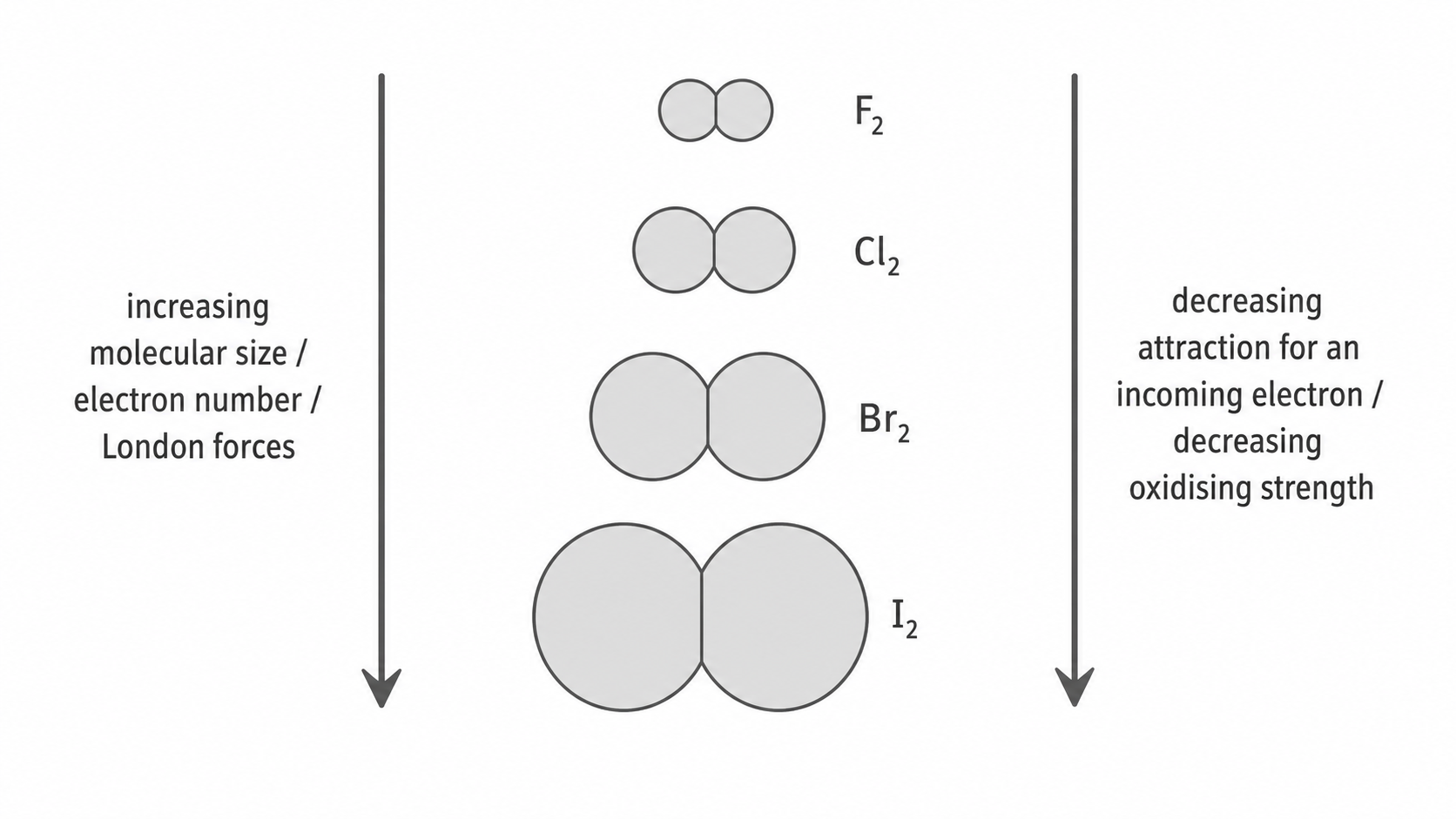
- the molecules contain more electrons
- the electron clouds are larger and more easily distorted
- instantaneous dipole-induced dipole attractions, also called London forces, become stronger
- more energy is needed to separate the molecules
- melting and boiling temperatures therefore increase
[DIAGRAM: asset_name: Group 7 Trend Ladder; asset_slug: edexcel_a_level_chemistry_l021_group_7_trend_ladder; recommended_method: image_gen; description: Monochrome Group 7 trend ladder showing F2, Cl2, Br2 and I2 molecules increasing in size down the group, with London forces increasing and oxidising strength decreasing.]
Worked example: explaining why bromine is a liquid but chlorine is a gas at room temperature
Chlorine and bromine are both simple molecular substances with diatomic molecules. Bromine molecules are larger and contain more electrons than chlorine molecules. The electron cloud in Br2 is more polarisable, so London forces between Br2 molecules are stronger. More energy is needed to overcome these intermolecular forces, so bromine has a higher boiling temperature and is liquid at room temperature, while chlorine is gaseous.
The mark-earning chain is:
larger molecule / more electrons -> stronger London forces -> more energy needed to separate molecules -> higher boiling temperature
Common-error contrast
Do not write that bromine has a higher boiling temperature because the covalent bond in Br2 is stronger. Boiling does not break the Br-Br bond; it overcomes attractions between neighbouring Br2 molecules.
Local active check
Electronegativity And Reactivity
Electronegativity is the ability of an atom to attract a shared pair of electrons in a covalent bond. The Edexcel Data Booklet gives this order for the halogens:
F 4.0 > Cl 3.0 > Br 2.8 > I 2.5
Electronegativity decreases down Group 7. The atoms become larger and have more occupied electron shells. Shielding increases, so the nucleus attracts an outer shared pair less strongly, even though the nuclear charge has increased.
The same particle model explains the reactivity trend. A halogen atom reacts by gaining one electron to form a halide ion:
X2 + 2e- -> 2X-
Down the group, the outer shell is further from the nucleus and more shielded by inner shells. The attraction for an incoming electron is weaker, so the halogen molecule is less readily reduced. Reactivity as an oxidising agent decreases:
Cl2 is a stronger oxidising agent than Br2
Br2 is a stronger oxidising agent than I2
Standard electrode potentials later make the same order quantitative:
1/2Cl2 + e- -> Cl-      E = +1.36 V
1/2Br2 + e- -> Br-      E = +1.09 V
1/2I2 + e- -> I-        E = +0.54 V
You do not need electrochemical-cell calculations in this lesson. The useful idea is that the more positive reduction potential belongs to the species more readily reduced; therefore Cl2 is a stronger oxidising agent than Br2, and Br2 is stronger than I2.
Feynman diagnostic
Explain to a younger student why iodine is less reactive than chlorine without saying only "iodine is lower down the group".
A strong explanation says: iodine atoms are larger and have more shielding, so the nucleus attracts an incoming electron less strongly. Iodine molecules are therefore less easily reduced to iodide ions than chlorine molecules are to chloride ions. The trap is to say "iodine has more protons so it attracts electrons more strongly"; that ignores distance and shielding, which dominate down the group.
Displacement As Redox Evidence
A halogen displacement reaction happens when a more reactive halogen oxidises the halide ion of a less reactive halogen. The more reactive halogen gains electrons and forms its own halide ion. The halide ion loses electrons and forms the less reactive halogen.
Worked example: chlorine and bromide ions
Observation after adding organic solvent: an orange organic layer shows that bromine has formed.
Half-equations:
Cl2 + 2e- -> 2Cl-       chlorine is reduced
2Br- -> Br2 + 2e-       bromide ions are oxidised
Overall ionic equation:
Cl2(aq) + 2Br-(aq) -> 2Cl-(aq) + Br2(aq)
Oxidation number check:
Cl in Cl2: 0 to -1      reduction
Br in Br-: -1 to 0      oxidation
This proves that chlorine is a stronger oxidising agent than bromine because chlorine removes electrons from bromide ions.
Displacement outcomes for Cl2, Br2 and I2
| Halogen added | Halide ion present | Reaction? | Ionic equation if reaction occurs | Evidence after organic solvent |
|---|---|---|---|---|
Cl2(aq) | Br-(aq) | yes | Cl2 + 2Br- -> 2Cl- + Br2 | orange organic layer from Br2 |
Cl2(aq) | I-(aq) | yes | Cl2 + 2I- -> 2Cl- + I2 | purple organic layer from I2 |
Br2(aq) | Cl-(aq) | no | none | bromine remains; no chloride oxidation |
Br2(aq) | I-(aq) | yes | Br2 + 2I- -> 2Br- + I2 | purple organic layer from I2 |
I2(aq) | Cl-(aq) | no | none | iodine remains; no chloride oxidation |
I2(aq) | Br-(aq) | no | none | iodine remains; no bromide oxidation |
For a Pearson-style "explain" answer, include the direction of electron transfer. For example, "chlorine displaces iodine from iodide" is a start, but it is not the full reasoning. The full explanation is that chlorine is more readily reduced than iodine, so Cl2 oxidises I- to I2 while Cl2 is reduced to Cl-.
Guided practice
Bromine water is added to aqueous potassium iodide. Predict the observation after an organic solvent is added and write the ionic equation.
Answer:
Br2(aq) + 2I-(aq) -> 2Br-(aq) + I2(aq)
The organic layer becomes purple because iodine has formed. Bromine is reduced to bromide ions; iodide ions are oxidised to iodine.
Using An Organic Solvent As Evidence
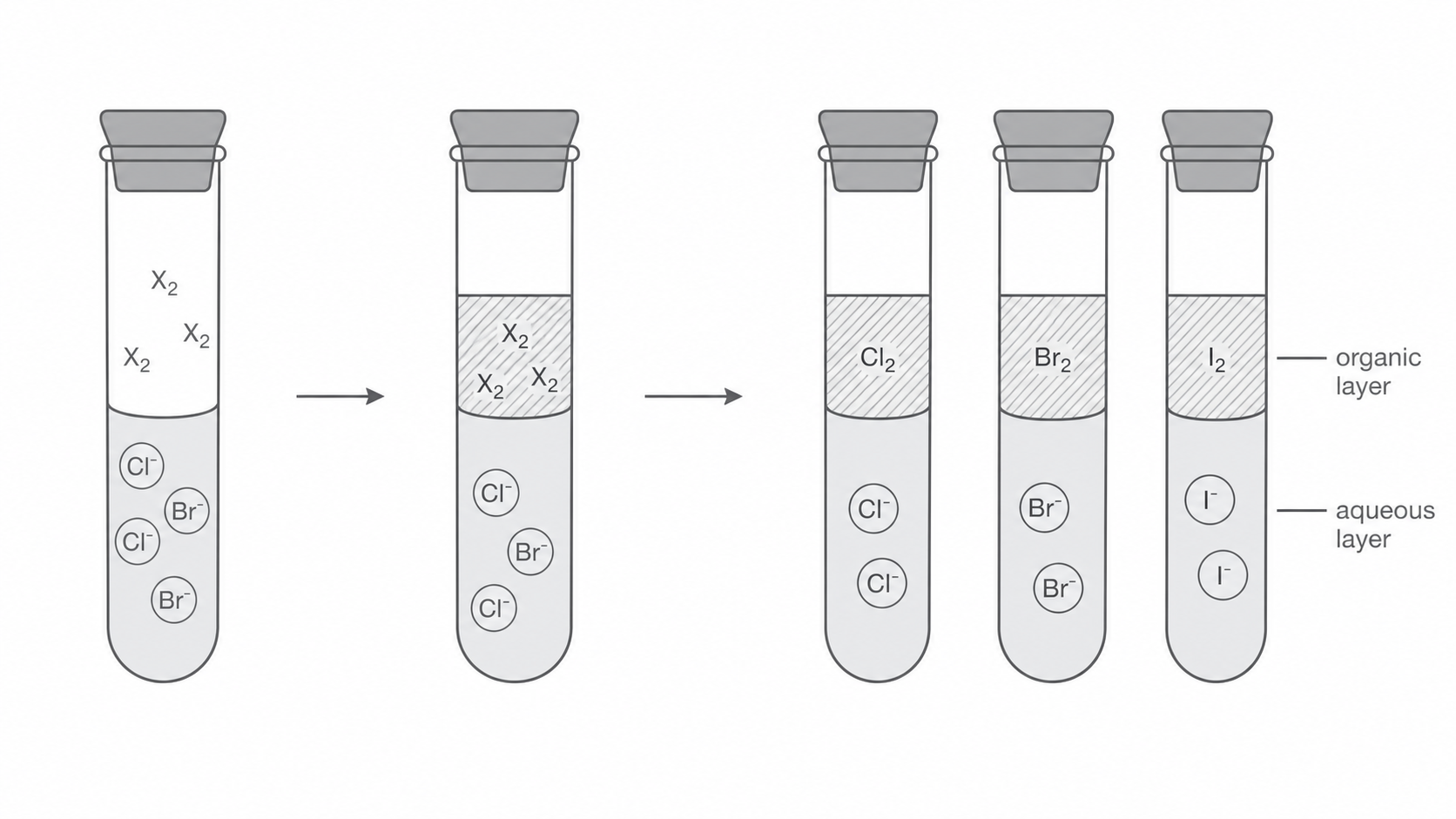
The organic solvent step makes the halogen product easier to identify. Molecular halogens dissolve better in the organic layer than in the aqueous layer, so after shaking and allowing the layers to separate, the colour of the organic layer gives evidence for which halogen molecule is present.
[DIAGRAM: asset_name: Halogen Solvent Extraction; asset_slug: edexcel_a_level_chemistry_l021_halogen_solvent_extraction; recommended_method: image_gen; description: Monochrome schematic of stoppered test tubes showing molecular halogen extracted into an organic solvent layer above an aqueous halide layer after shaking.]
Typical observations are:
| Molecular halogen in organic layer | Observation used in this lesson |
|---|---|
Cl2 | very pale green or pale yellow |
Br2 | orange or orange-brown |
I2 | purple or violet |
In many school demonstrations the organic solvent is less dense than water, so the organic layer is the upper layer. The important evidence is the colour in the organic layer, not the layer position; a different organic solvent could change which layer is on top.
Practical reasoning
Use small volumes, stopper the tube before shaking, and allow the layers to settle before recording the colour. Halogens are harmful and volatile, and many organic solvents are flammable, so the method needs eye protection, good ventilation or a fume cupboard when required, and careful waste handling. Do not use the solvent-layer colour as a silver nitrate halide test; that is a different reaction family and belongs to the next lesson.
Pearson-style local active check
Recap
Group 7 physical trends come from increasingly strong London forces between larger molecules. Group 7 reactivity decreases down the group because larger, more shielded atoms attract an incoming electron less strongly. Displacement reactions turn that model into evidence: a more reactive halogen oxidises a less reactive halide ion, and the organic solvent layer helps identify the molecular halogen produced.