2A.1-2A.6 - Ionic Bonding And Ionic Evidence
This lesson covers Pearson Edexcel 9CH0 2A.1-2A.6: ionic bonding as electrostatic attraction, the effect of ionic charge and radius, ion formation by electron transfer, dot-and-cross diagrams for ions, ionic-radius trends, and evidence for ions from properties and migration. It deliberately leaves covalent bonding and covalent dot-and-cross diagrams to 2A.7-2A.9, and leaves lattice-energy calculations to later energetics work. The important A-level move is to connect what can be observed, such as melting point or conductivity, to what charged particles are doing in the structure.
Ionic Bonding Is A Force, Not A Tiny Stick
A crystal of sodium chloride looks quiet, but the particle model is full of strong attractions. The solid is not made from separate NaCl molecules. It is a giant ionic lattice: a repeating arrangement of positive and negative ions, with each ion attracted to oppositely charged ions around it.
An ionic bond is the strong electrostatic attraction between oppositely charged ions. The word electrostatic matters because the attraction is between charges, not between electron pairs shared in a local bond. In an ionic lattice the attraction acts in all directions through the structure.
The strength of ionic bonding depends mainly on two linked ideas.
| Factor | Effect on attraction | Why it matters |
|---|---|---|
| Ionic charge | Higher positive and negative charges give stronger attraction | Mg2+ and O2- attract more strongly than Na+ and Cl- |
| Ionic radius | Smaller ions can get closer together, giving stronger attraction | Na+ attracts a given anion more strongly than the larger K+ does |
A useful qualitative version of the model is:
stronger ionic bonding = larger ionic charges + smaller ionic radii
Do not turn this into a full lattice-energy calculation here. The specification later treats lattice energy quantitatively; in this lesson the charge/radius model explains trends and evidence.
Worked example: choosing the stronger ionic bonding
Suppose two ionic compounds have the same lattice type: NaF and KF.
- The anion is the same in both compounds:
F-. - The cation charge is the same:
Na+andK+are both+1. - The deciding factor is radius.
Na+is smaller thanK+. - The smaller
Na+can approachF-more closely, so the electrostatic attraction is stronger inNaF.
The mark-earning explanation is not just "sodium is smaller". It is: the smaller Na+ ion gives a shorter distance between oppositely charged ions, so the electrostatic attraction is stronger.
Forming Ions By Electron Transfer
Atoms form simple ions by losing or gaining electrons. Losing electrons gives a positive ion, called a cation, because there are now more protons than electrons. Gaining electrons gives a negative ion, called an anion, because there are now more electrons than protons.
The charge tells you the electron transfer.
| Particle | Electron change | Ion formed | Electron configuration change |
|---|---|---|---|
| sodium atom | loses 1 electron | Na+ | 2,8,1 -> 2,8 |
| magnesium atom | loses 2 electrons | Mg2+ | 2,8,2 -> 2,8 |
| chlorine atom | gains 1 electron | Cl- | 2,8,7 -> 2,8,8 |
| oxygen atom | gains 2 electrons | O2- | 2,6 -> 2,8 |
In dot-and-cross diagrams for ionic compounds, dots and crosses show where the outer-shell electrons came from. They do not show a shared electron pair. A good ionic dot-and-cross diagram has three visible features:
- Each ion is shown separately, usually in square brackets.
- The charge is written outside the bracket, such as
[Na]+or[O]2-. - The anion has a full outer shell, with transferred electron(s) shown using the other symbol.
Worked example: drawing sodium chloride
Sodium has one outer electron and chlorine has seven outer electrons. Sodium loses its outer electron to form Na+. Chlorine gains that electron to form Cl-, so the chloride ion has eight outer-shell electrons.
A written planning route is:
Na: 2,8,1  ->  Na+: 2,8 + e-
Cl: 2,8,7 + e-  ->  Cl-: 2,8,8
Overall ions: [Na]+ and [Cl]-
Dot-and-cross: chloride has seven of chlorine's own outer electrons plus one transferred electron from sodium.
Worked example: drawing magnesium oxide
Magnesium loses two electrons to form Mg2+. Oxygen gains two electrons to form O2-. The oxide ion should have eight outer-shell electrons: six originally from oxygen and two transferred from magnesium.
Mg: 2,8,2  ->  Mg2+: 2,8 + 2e-
O: 2,6 + 2e-  ->  O2-: 2,8
Overall ions: [Mg]2+ and [O]2-
Dot-and-cross: oxide has six of oxygen's own outer electrons plus two transferred electrons from magnesium.
A common error is to draw a line between the ions, as if the transferred electron has become a covalent bond. For this specification row, the diagram must communicate electron loss/gain and charged ions, not shared pairs.
Charge Density And Stronger Ionic Attraction
The charge/radius model becomes more powerful when you treat ions as charged spheres. A small ion with a high charge has high charge density. High charge density means the electric field around the ion is strong, so it attracts oppositely charged ions strongly.
For early A-level bonding questions, you usually do not need a numerical value for charge density. You need to use it as a reasoning bridge:
higher charge and/or smaller radius
-> greater charge density
-> stronger electrostatic attraction between oppositely charged ions
-> stronger ionic bonding
This chain explains why compounds with 2+ and 2- ions often have higher melting temperatures than compounds with 1+ and 1- ions, provided the comparison is otherwise fair. More energy is needed to overcome stronger attractions in the lattice.
Worked example: explaining a melting-temperature difference
MgO has a much higher melting temperature than NaCl.
The answer should not stop at "magnesium oxide is ionic". Both are ionic. The difference is that MgO contains Mg2+ and O2-, whereas NaCl contains Na+ and Cl-. The larger charges in MgO produce stronger electrostatic attractions between oppositely charged ions, so more energy is needed to overcome the attractions in the lattice.
If radius is also relevant, add it explicitly. For example, CaO would have weaker attraction than MgO if the anion and charges are kept the same, because Ca2+ is larger than Mg2+.
Ionic Radius Trends
Ionic radius is not just "atomic radius with a charge label". It depends on the number of occupied electron shells, the number of protons in the nucleus, and the number of electrons being attracted.
Down a group, ionic radius increases. For example, Li+, Na+, and K+ all have a +1 charge, but each step down the group adds an occupied electron shell. The outer electron shell is farther from the nucleus and there is more shielding, so the ion is larger.
Across an isoelectronic series, the trend is different. Isoelectronic ions have the same number of electrons and the same electron arrangement. The classic Edexcel example is:
N3-, O2-, F-, Na+, Mg2+, Al3+
All six ions have 10 electrons, with the arrangement 2,8. The number of protons increases from nitrogen to aluminium:
| Ion | Number of protons | Number of electrons | Relative radius idea |
|---|---|---|---|
N3- | 7 | 10 | largest in this set |
O2- | 8 | 10 | smaller |
F- | 9 | 10 | smaller |
Na+ | 11 | 10 | smaller |
Mg2+ | 12 | 10 | smaller |
Al3+ | 13 | 10 | smallest in this set |
Because the electron arrangement is the same, the increasing nuclear charge pulls the same electron cloud more strongly. So the ionic radius decreases:
N3- > O2- > F- > Na+ > Mg2+ > Al3+
Worked example: justifying the smallest isoelectronic ion
Question: Which ion is smaller, Na+ or Mg2+?
Both ions have 10 electrons and the same electron arrangement, 2,8. Magnesium has 12 protons, while sodium has 11 protons. The Mg2+ nucleus attracts the same number of electrons more strongly, so Mg2+ has the smaller ionic radius.
Physical Properties As Evidence For Ions
The ionic model is useful because it explains evidence. A substance that contains mobile charged particles conducts electricity. A substance with charged particles locked into fixed positions does not conduct, even though charges are present.
In a solid ionic lattice, ions vibrate about fixed positions. They are charged, but they are not free to move through the structure. Solid sodium chloride does not conduct electricity because there are no mobile charge carriers.
When an ionic compound is molten or dissolved in water, the ions can move. The mobile ions carry charge through the liquid, so the melt or solution conducts electricity. This is strong evidence that the compound contains charged particles rather than neutral molecules.
[DIAGRAM: asset_name: Ionic Lattice Mobile Ions; asset_slug: edexcel_a_level_chemistry_l008_ionic_lattice_mobile_ions; recommended_method: image_gen; description: Monochrome schematic comparing fixed alternating ions in a solid lattice with mobile positive and negative ions moving toward opposite electrodes in a molten or aqueous ionic compound.]
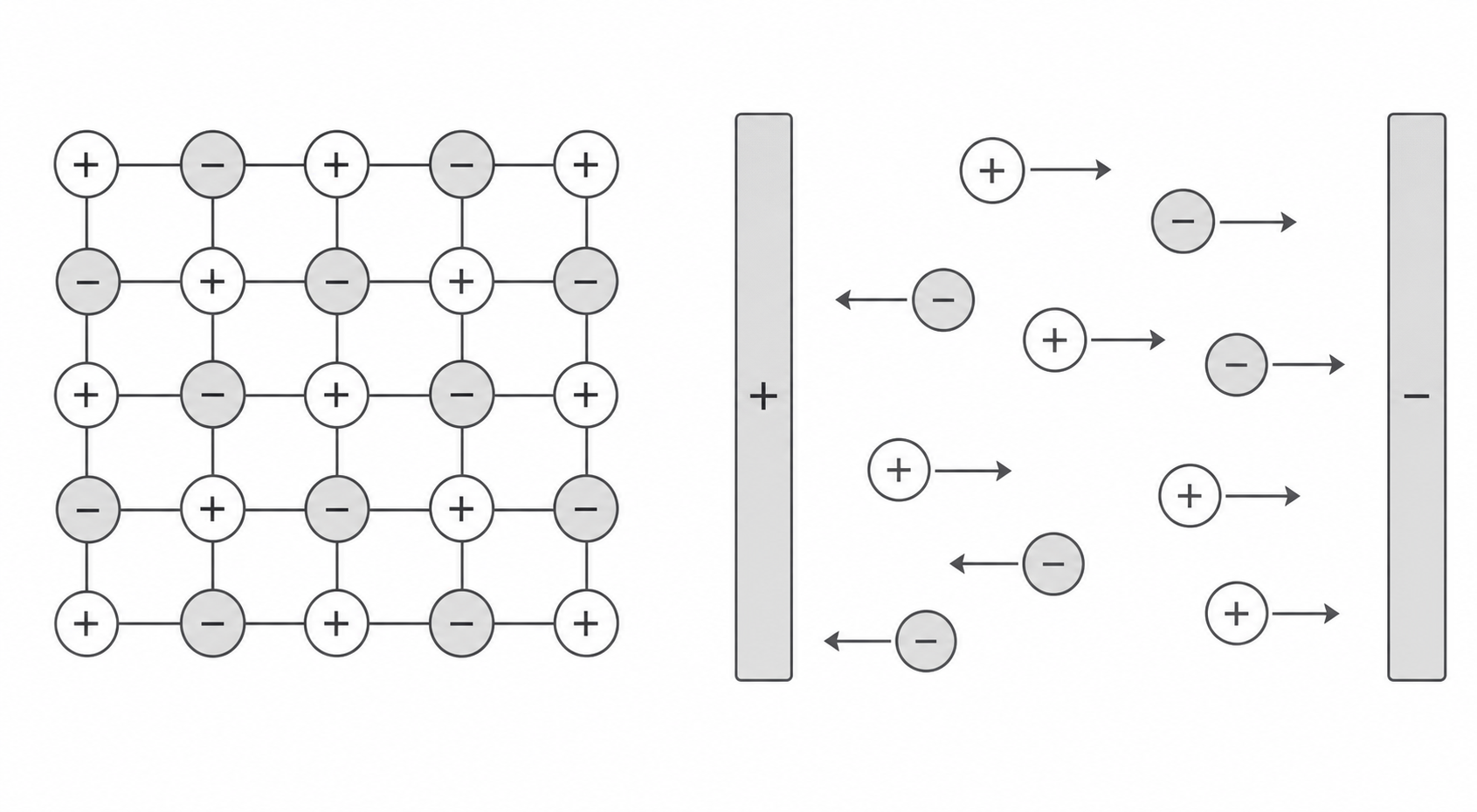
High melting temperatures are also evidence for strong attractions in a giant ionic lattice. A large amount of energy is needed to overcome enough electrostatic attraction for the lattice to lose its fixed structure. This does not mean covalent bonds inside molecules are being broken; in an ionic lattice, the relevant attractions are between ions throughout the structure.
Worked example: explaining conductivity
A student says: "Sodium chloride contains charged ions, so solid sodium chloride should conduct electricity."
The first clause is right, but the conclusion is wrong. Solid sodium chloride contains ions, but they are fixed in the lattice and cannot move through the solid. Molten sodium chloride conducts because the ions are mobile and can carry charge.
Migration Of Ions
Ion migration gives more direct evidence than conductivity alone. If an electric field is applied across a solution containing coloured ions, positive ions move towards the negative electrode and negative ions move towards the positive electrode. The direction of movement reveals the charge on the particles.
In a U-tube experiment with a solution containing coloured cations and anions, the colours gradually separate towards opposite electrodes. For example, a blue or blue-green cation would move towards the negative electrode, while a yellow anion such as chromate(VI), CrO4^2-, would move towards the positive electrode. The movement is not random diffusion only; it is directed motion of charged particles in an electric field.
This is why "conducts when molten" and "ions migrate under a potential difference" are evidence statements, not just property statements. They show that the charge carriers are ions that can move when the lattice is disrupted or when the substance is in solution.
Pearson-style reasoning shape
For an explain question, build the answer in this order:
- Name the structure or particles: giant ionic lattice / positive and negative ions.
- State the relevant movement: fixed ions in a solid, mobile ions in a melt or solution.
- Link movement to evidence: mobile charged ions conduct or migrate to oppositely charged electrodes.
- Use charge/radius language only if the question asks about strength, melting temperature, or a comparison.
That order keeps the mark-earning cause-and-effect visible. It also prevents a common error: writing "free electrons" for an ionic melt. Free electrons are not the charge carriers in molten sodium chloride; mobile ions are.