1.15 - Evidence For Shells And Subshells
This lesson covers Pearson Edexcel 9CH0 specification point 1.15: how evidence from atomic emission spectra, successive ionisation energies, and first ionisation energies of successive elements led chemists to the shell and subshell model. It assumes you can already define first and successive ionisation energies from 1.11-1.14, and it deliberately leaves exact shell capacities, orbital shapes, and 1s/electrons-in-boxes notation to 1.16-1.22. The skill is not memorising a configuration: it is using observations and data to justify why the model has shells and then smaller divisions within shells.
Evidence Before The Model
Imagine two possible atoms. In one, an electron can have any energy it likes, a little like a bead sliding anywhere along a wire. In the other, an electron is allowed only certain energies, a little like a lift that stops only at particular floors. Chemistry chose the second picture because several independent observations keep pointing that way.
The evidence in this lesson has three different shapes:
| Evidence | What is observed | What the model must explain |
|---|---|---|
| Atomic emission spectra | Heated or excited atoms emit sharp lines, not every possible frequency of light | Electrons change between fixed energy levels; this supports quantum shells |
| Successive ionisation energies | Some removals need much more energy than the one before | Electrons are arranged in shells; the number before the first large jump shows the outer-shell electron count and therefore the group for many main-group elements |
| First ionisation energies of successive elements | Across a period, the general increase has specific drops | Electrons in the same main shell are not all equivalent; there are subshells |
That last column matters. A model earns its place when it explains the pattern better than a simpler model. "Atoms have electrons" is not enough; the evidence forces the stronger claim that electrons occupy quantised shells and that each shell can contain subshells of slightly different energy.
Atomic Emission Spectra
When atoms in a gas are given energy, some electrons are promoted to higher energy levels. When those electrons fall back to lower levels, energy is released as light. The key observation is that the spectrum contains lines at particular frequencies rather than a continuous smear of all frequencies.
Each line corresponds to one allowed energy change:
energy emitted as light = energy of higher level - energy of lower level
You do not need to calculate photon energies for this specification point. The reasoning is qualitative: if electrons could have any energy, falling back could release any energy, so a continuous spectrum would be expected. Sharp lines show that only certain energy differences are allowed, which is evidence for discrete quantum shells.
Worked example: interpreting a line spectrum
A sample of hydrogen gas is excited in a discharge tube. The emitted light separates into several sharp visible lines.
- Observation: several sharp lines are seen.
- Particle-level event: electrons fall from higher allowed energy levels to lower allowed energy levels.
- Evidence statement: each line represents a fixed energy gap.
- Model conclusion: electrons occupy fixed energy levels, so emission spectra support the existence of quantum shells.
Notice the careful wording. The line spectrum alone does not tell you the full electron configuration of a many-electron atom, and it does not tell you the number of electrons that fit into each shell. It gives evidence that electron energy is quantised.
Successive Ionisation Energies
Successive ionisation energies measure the energy required to remove one electron after another from gaseous particles of the same element. For magnesium, the first three steps are:
Mg(g) -> Mg+(g) + e-
Mg+(g) -> Mg2+(g) + e-
Mg2+(g) -> Mg3+(g) + e-
Each successive ionisation energy is larger than the previous one because an electron is being removed from an increasingly positive ion. The important evidence is not just "it increases"; it is where it increases suddenly by a much larger factor.
[DIAGRAM: asset_name: Successive Ionisation Mg; asset_slug: edexcel_a_level_chemistry_l005_successive_ionisation_mg; recommended_method: matplotlib; description: Log-scale plot of magnesium successive ionisation energies, with large jumps after two electrons and after ten electrons removed.]
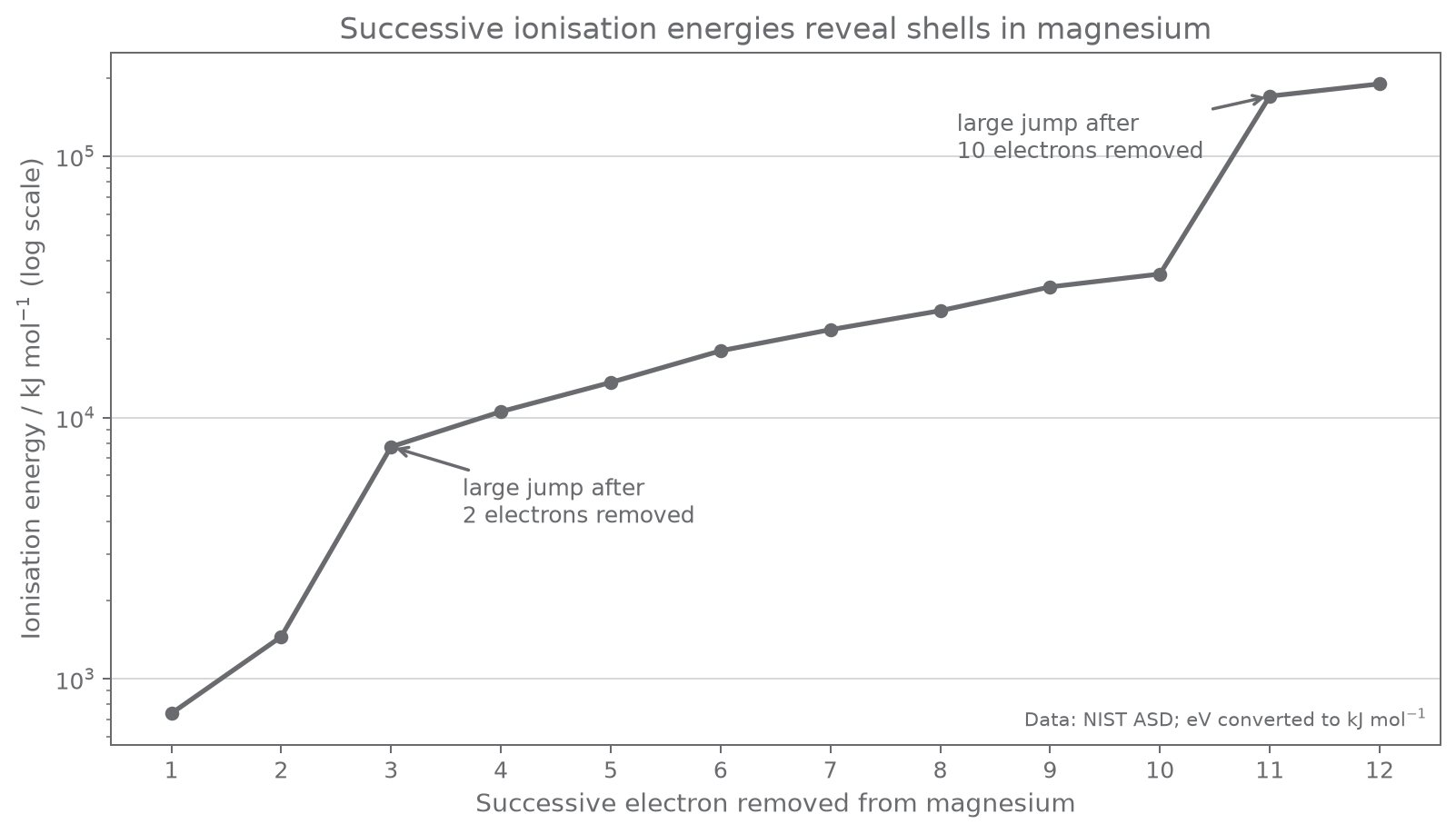
For magnesium, the first two electrons are relatively easier to remove. The third removal needs a much larger energy because the third electron is being removed from an inner shell that is closer to the nucleus and less shielded by other electrons. This large jump after two removals shows that magnesium has two outer-shell electrons, so it belongs in Group 2.
The later large jump after ten removals gives the same kind of shell evidence deeper inside the atom. After ten electrons have been removed, the next electron is from an even more strongly held inner shell. Successive ionisation energy data therefore supports both the existence of quantum shells and the group of the element, when the outer-shell electron count maps to the main group.
Worked example: using a large jump
An element has these first four successive ionisation energies, in kJ mol^-1:
| Ionisation energy | 1st | 2nd | 3rd | 4th |
|---|---|---|---|---|
| Value | 590 | 1150 | 4910 | 6490 |
The largest jump is between the second and third ionisation energies. That means the first two electrons were in the outer shell, but the third electron is from an inner shell. The element has two outer-shell electrons, so this pattern is evidence for a Group 2 element and for shells.
First Ionisation Energies Across A Period
First ionisation energy data across a period gives a different kind of evidence. If all electrons in the same main shell were equivalent, you would expect a fairly smooth increase across Period 2: nuclear charge increases from lithium to neon, while the electron removed is still in the second shell and shielding changes only slightly.
The real pattern is not perfectly smooth.
[DIAGRAM: asset_name: Period2 First Ionisation; asset_slug: edexcel_a_level_chemistry_l005_period2_first_ionisation; recommended_method: matplotlib; description: Plot of first ionisation energy across Period 2, showing drops from beryllium to boron and from nitrogen to oxygen as evidence for subshells.]
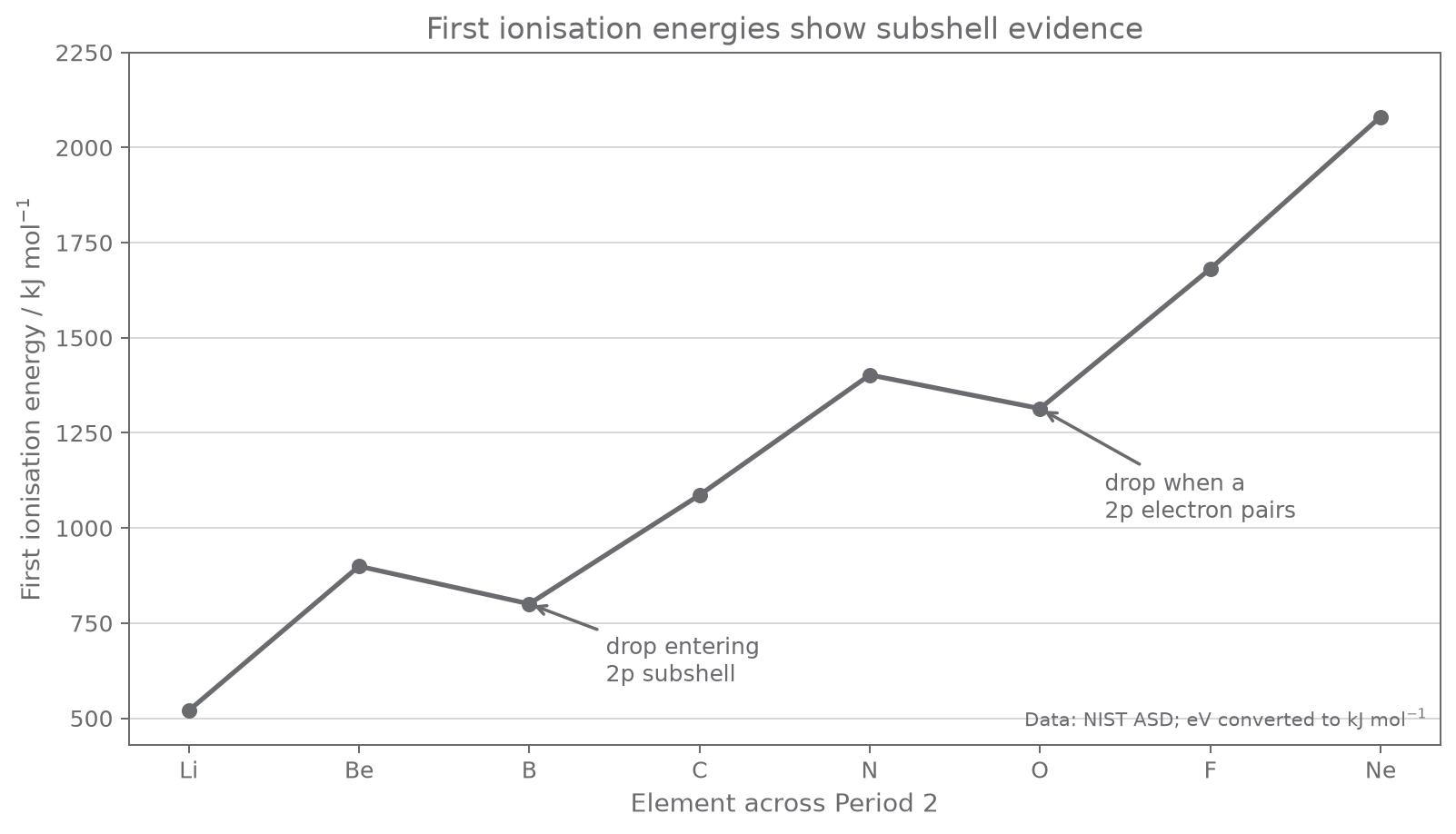
Two drops are especially important.
From beryllium to boron, first ionisation energy decreases even though boron has one more proton. The electron removed from boron is in a higher-energy 2p subshell, whereas the electron removed from beryllium is from the lower-energy 2s subshell. That makes the boron electron easier to remove.
From nitrogen to oxygen, first ionisation energy also decreases. Oxygen has one more proton, so a shell-only model would not predict the drop. The explanation is that the electron removed from oxygen is paired with another electron in a 2p orbital, so electron-electron repulsion makes it easier to remove than might otherwise be expected.
The exact orbital notation and filling rules come next. For point 1.15, the mark-earning idea is that first ionisation energies of successive elements show that a shell contains subshells with different energies.
Writing The Evidence Chain
Pearson questions on this idea often reward the link between evidence and conclusion, not just the name of the evidence. A good answer moves in this order:
observation or data pattern -> electron-level interpretation -> model conclusion
Here is a compact model answer for the whole specification point.
Worked example: explain how the electronic configuration model developed from evidence
Atomic emission spectra contain sharp lines. These lines show that electrons emit only certain energies of light when they move from higher to lower energy levels, so electrons must occupy fixed, quantised shells.
Successive ionisation energies show large jumps after a certain number of electrons have been removed. A large jump means the next electron is being removed from an inner shell, closer to the nucleus and less shielded. The number of electrons removed before the first large jump gives the number of outer-shell electrons and can identify the main group of the element.
First ionisation energies across a period generally increase because nuclear charge increases, but the drops from beryllium to boron and from nitrogen to oxygen show that electrons in a shell are not all equivalent. This is evidence for subshells, such as 2s and 2p, within a quantum shell.
Common-error contrast
Do not write: "The big jump after the third ionisation energy means the element has three shells."
Write: "The big jump after the third ionisation energy means the atom had three outer-shell electrons; the next electron removed is from an inner shell."
Do not write: "Emission spectra show the exact arrangement of electrons."
Write: "Emission spectra provide evidence for fixed energy levels because only certain photon energies are emitted."