1.1-1.4 - Atoms And Subatomic Particles
This lesson covers spec points 1.1-1.4: the structure of an atom in terms of protons, neutrons and electrons; their relative masses and charges; the meanings of atomic number and mass number; and how to determine particle numbers in atoms, molecules and ions. The next lesson uses the same counting model for isotopes and relative masses, so here the focus is deliberately on a clean particle-accounting method. This matters for Pearson Edexcel 9CH0 because later mass spectrometry, ionisation energy, formulae and ionic equations all rely on knowing exactly what is being counted.
Inside an Atom
Every chemical formula is a compact claim about particles. Before you can read formulae well, you need a reliable picture of what an atom contains.
An atom has a tiny central nucleus containing protons and neutrons. Electrons are outside the nucleus. Later in Topic 1 this outside region is refined into shells, subshells and orbitals; for this first counting lesson, the key separation is simple: protons and neutrons are nuclear particles, electrons are not.
[DIAGRAM: asset_name: Atom Structure Schematic; asset_slug: edexcel_a_level_chemistry_l001_atom_structure_schematic; recommended_method: image_gen; description: Monochrome atom schematic showing a central nucleus containing protons and neutrons, with electrons outside the nucleus.]
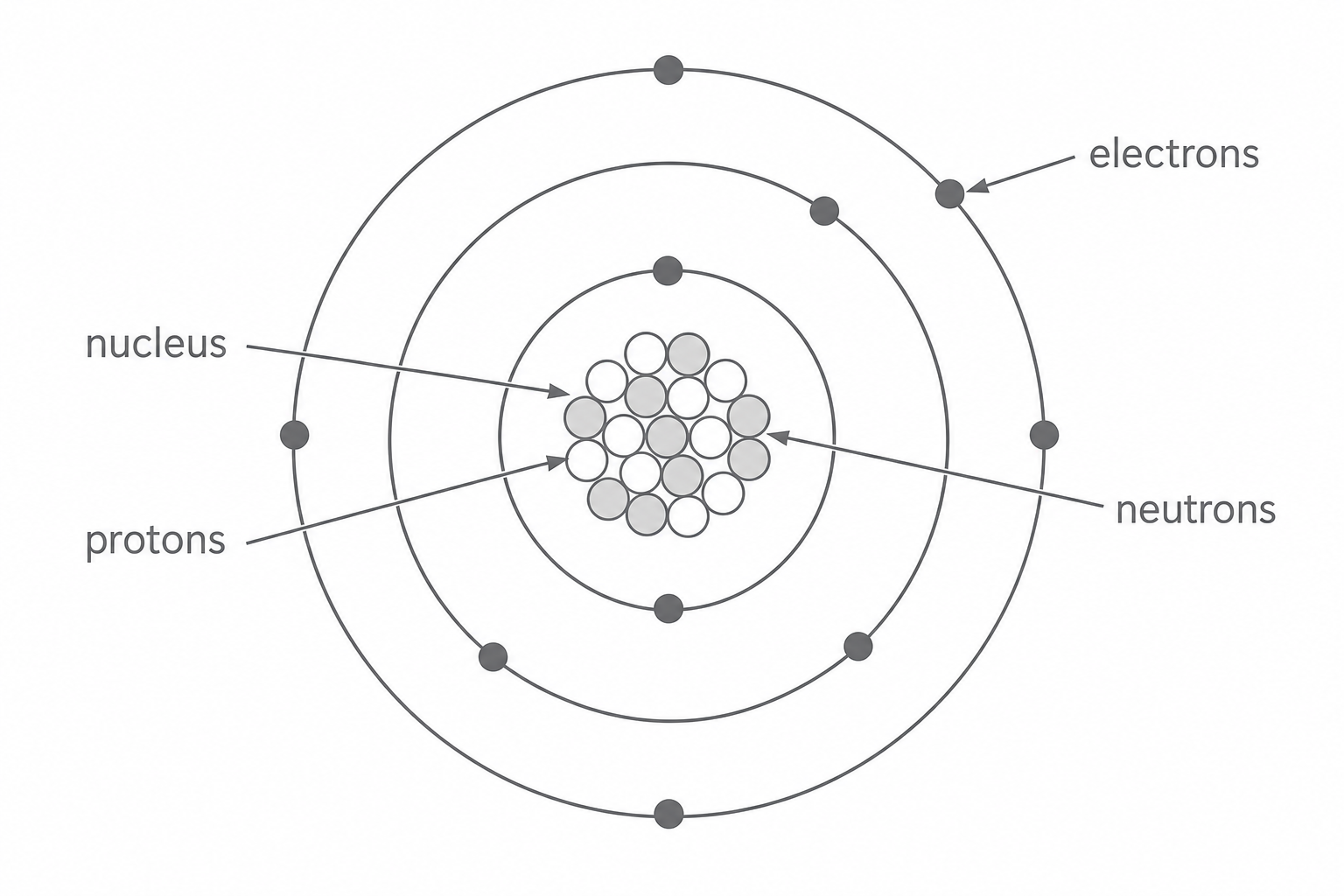
The nucleus is small compared with the whole atom, but it contains almost all the mass. The electrons occupy the surrounding space and are the particles that are gained, lost or rearranged when atoms form ions or bonds.
That separation prevents a lot of later mistakes. If a particle becomes an ion, its number of electrons changes; its number of protons does not. If two atoms are different elements, their nuclei must contain different numbers of protons.
Relative Mass and Charge
Pearson will often expect you to use relative values rather than masses in kilograms or charges in coulombs. The word relative means the values are compared on a convenient scale.
| Particle | Location | Relative charge | Relative mass |
|---|---|---|---|
| Proton | Nucleus | +1 | 1 |
| Neutron | Nucleus | 0 | 1 |
| Electron | Outside nucleus | -1 | about 1/1836 |
For most particle-counting questions, the electron's mass is treated as negligible compared with a proton or neutron. That is why mass number counts protons plus neutrons, not electrons.
Charge is different. Electrons have very small mass, but their charge has the same size as a proton's charge and the opposite sign. A neutral atom has equal numbers of protons and electrons, so the positive and negative charges cancel.
Worked example: a neutral sodium atom has 11 protons, 12 neutrons and 11 electrons.
| Contribution | Calculation | Result |
|---|---|---|
| Nuclear mass count | 11 + 12 | 23 |
| Total relative charge | 11(+1) + 12(0) + 11(-1) | 0 |
The mass is almost entirely from the 23 nuclear particles. The charge is zero because 11 positive proton charges are balanced by 11 negative electron charges.
Atomic Number and Mass Number
Two whole-number labels control the counting:
| Symbol | Name | Meaning |
|---|---|---|
Z | Atomic number, or proton number | Number of protons in the nucleus |
A | Mass number | Number of protons plus neutrons in the nucleus |
The atomic number identifies the element. Carbon atoms have 6 protons; magnesium atoms have 12 protons; chlorine atoms have 17 protons. If the proton number changes, the element changes.
The mass number tells you the total number of nuclear particles:
mass number = protons + neutrons
neutrons = mass number - atomic number
A common notation places mass number at the upper left and atomic number at the lower left. In plain text, this lesson writes that as ^{A}_{Z}X.
For example, in ^{27}_{13}Al, the atomic number is 13 and the mass number is 27.
Worked example: determine the protons, neutrons and electrons in a neutral ^{27}_{13}Al atom.
| Step | Reasoning | Value |
|---|---|---|
| Protons | atomic number Z | 13 |
| Neutrons | A - Z = 27 - 13 | 14 |
| Electrons | neutral atom, so electrons = protons | 13 |
The chemical interpretation is that this is aluminium because it has 13 protons. The mass number 27 is not "27 electrons"; it is 13 protons plus 14 neutrons.
Atoms and Ions
For an atom or ion, count the nucleus first. The charge only changes the electron count.
protons = atomic number
neutrons = mass number - atomic number
electrons in a neutral atom = atomic number
For ions:
electrons in a positive ion = atomic number - positive charge
electrons in a negative ion = atomic number + size of negative charge
That works because positive ions have lost electrons and negative ions have gained electrons. Protons stay in the nucleus; ordinary chemical ion formation does not change the number of protons.
Worked example 1: determine the particles in ^{40}_{20}Ca^{2+}.
| Particle | Route | Number |
|---|---|---|
| Protons | Z = 20 | 20 |
| Neutrons | A - Z = 40 - 20 | 20 |
| Electrons | 20 - 2, because the ion is 2+ | 18 |
The 2+ charge means the calcium particle has two fewer electrons than a neutral calcium atom. It does not mean two extra protons.
Worked example 2: determine the particles in ^{35}_{17}Cl^-.
| Particle | Route | Number |
|---|---|---|
| Protons | Z = 17 | 17 |
| Neutrons | A - Z = 35 - 17 | 18 |
| Electrons | 17 + 1, because the ion is 1- | 18 |
The chloride ion has one more electron than a neutral chlorine atom, giving one more negative charge than positive charge overall.
Molecules and Formula Ions
A molecule contains more than one atom joined together. To determine the total particles in a molecule, count each atom and then multiply by the formula subscripts.
For a neutral molecule:
total protons = sum of all proton counts
total neutrons = sum of all neutron counts
total electrons = total protons
Worked example: determine the total protons, neutrons and electrons in a neutral molecule written as ^{12}_{6}C^{16}_{8}O_2.
| Atom in formula | Number of atoms | Protons per atom | Neutrons per atom | Total protons | Total neutrons |
|---|---|---|---|---|---|
^{12}_{6}C | 1 | 6 | 12 - 6 = 6 | 6 | 6 |
^{16}_{8}O | 2 | 8 | 16 - 8 = 8 | 16 | 16 |
| Total | 22 | 22 |
The molecule is neutral, so the total number of electrons is also 22.
For a formula ion, do the same nucleus count first, then adjust the total electrons for the overall charge. For ^{14}_{7}N^{1}_{1}H_4^+, there are 7 + 4(1) = 11 protons and (14 - 7) + 4(1 - 1) = 7 neutrons. A neutral collection of those atoms would have 11 electrons, but the + charge means one electron has been lost, so the ion has 10 electrons.
The useful habit is to adjust electrons after you have counted the atoms in the formula. Do not apply the charge separately to every atom unless the notation explicitly gives separate ions.
Pearson Counting Route
When Pearson uses the command word determine, the answer should show the quantitative route from the information given. For this lesson, the route is short but must be clean.
| What you are given | What to do | Why it works |
|---|---|---|
Atomic number Z | Use it as the proton count | Atomic number means proton number |
Mass number A | Subtract Z to find neutrons | A = protons + neutrons |
| Neutral atom or molecule | Set electrons equal to protons | Total charge is zero |
| Positive ion | Subtract the positive charge from electrons | Positive ions have lost electrons |
| Negative ion | Add the size of the negative charge to electrons | Negative ions have gained electrons |
| Molecular formula | Multiply each atom's count by its subscript | Subscripts show how many atoms are present |
The main errors all come from counting the right particles in the wrong place. Mass number is not relative atomic mass in this lesson; it is a whole-number count of protons plus neutrons for the stated particle. Charge is not a proton instruction; it is usually an electron instruction. A formula subscript multiplies the atom immediately before it.
Worked example: determine the total protons, neutrons and electrons in ^{16}_{8}O^{2-}.
Protons: Z = 8.
Neutrons: A - Z = 16 - 8 = 8.
Electrons: neutral oxygen would have 8 electrons, and 2- means two extra electrons, so 8 + 2 = 10.
Sense check: 8 protons give +8; 10 electrons give -10; the overall charge is -2, matching the formula.