4B.12-4B.14 - Chlorine, Halides And Halogen Predictions
This lesson uses oxidation numbers to make sense of chlorine reactions with water and alkali, the formation and reactions of halides, and the predictions that follow from Group 7 trends. It deliberately leaves the aqueous displacement pattern of Cl2, Br2 and I2 to the previous lesson, and the wider carbonate, sulfate and ammonium ion analysis menu to the next lesson. The mark-earning skill is to connect observations and equations to redox change, reducing ability, precipitation evidence and trend-based prediction.
Use Oxidation Numbers Before Memorising Reactions
Chlorine can look like several different chemicals in one topic: a poisonous green gas, a water-treatment reagent, bleach, chloride salts and chlorate(V) salts. The unifying idea is not the name of the product; it is the oxidation number of chlorine.
In elemental chlorine, Cl2, each chlorine atom has oxidation number 0. In chloride, Cl^-, chlorine is -1. In chlorate(I), ClO^-, chlorine is +1 because oxygen is -2 and the overall ion charge is -1. In chlorate(V), ClO3^-, chlorine is +5 because three oxygens contribute -6, so chlorine must be +5 to give the -1 ion charge.
[DIAGRAM: asset_name: Chlorine Disproportionation Oxidation Numbers; asset_slug: edexcel_a_level_chemistry_l022_chlorine_disproportionation_oxidation_numbers; recommended_method: image_gen; description: Oxidation-number map showing chlorine in Cl2 changing to chloride, chlorate(I), and chlorate(V) products under water, cold sodium hydroxide, and hot alkali conditions.]
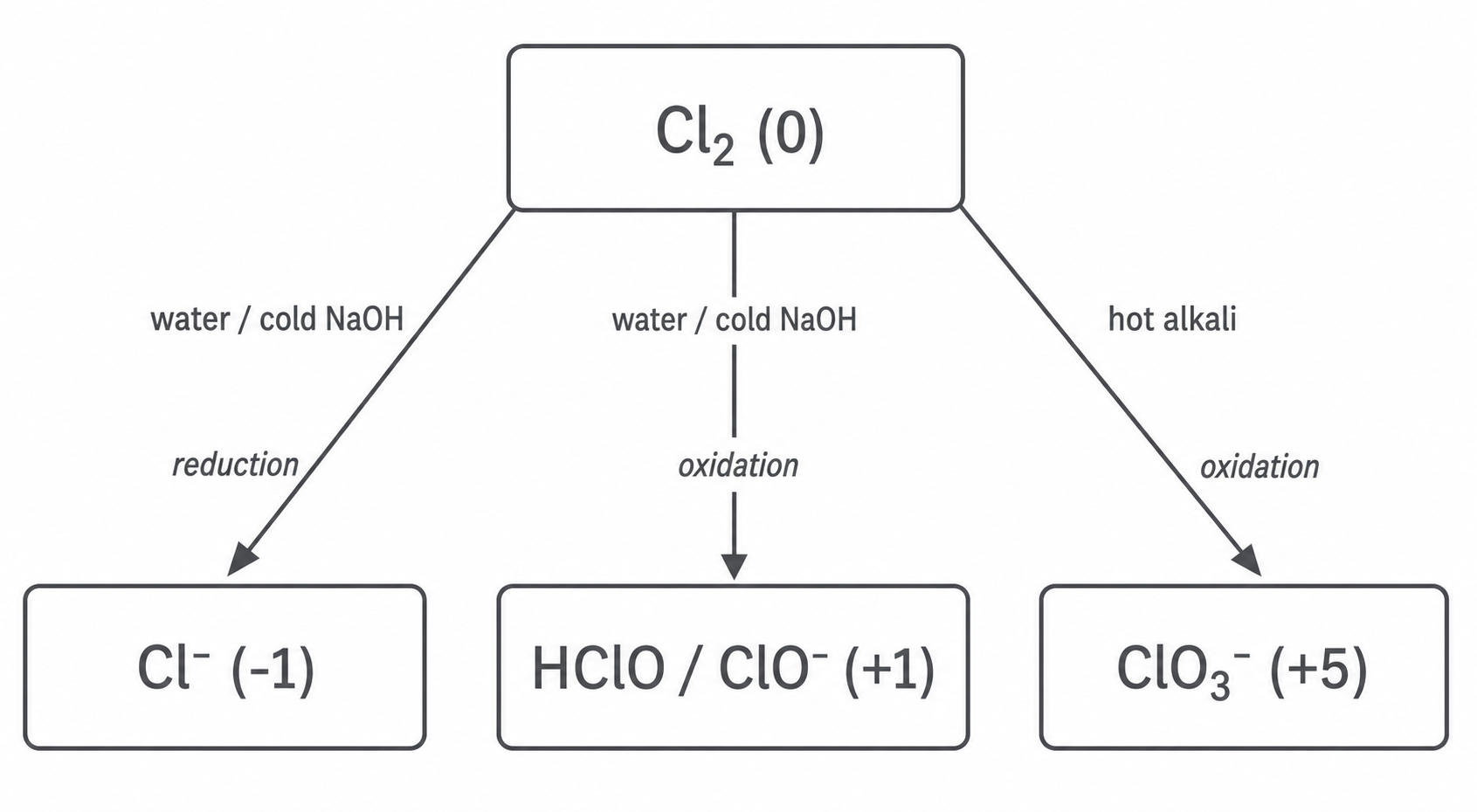
The diagram writes the +1 chlorine product as HClO / ClO^- because water gives chloric(I) acid, HClO, while alkaline conditions give the chlorate(I) ion, ClO^-.
If one element is both oxidised and reduced in the same reaction, the reaction is called disproportionation. Chlorine does this in water and in alkali:
0 -> -1is reduction because chlorine gains electrons.0 -> +1or0 -> +5is oxidation because chlorine loses electrons.
Worked example: identify the redox change in cold dilute sodium hydroxide
For the ionic equation:
Cl2 + 2OH^- -> Cl^- + ClO^- + H2O
Start with oxidation numbers:
Cl in Cl2     = 0
Cl in Cl^-    = -1
Cl in ClO^-   = +1
One chlorine atom is reduced from 0 to -1; the other is oxidised from 0 to +1. The same element, chlorine, has moved in two opposite redox directions, so this is disproportionation.
Feynman diagnostic
Explain disproportionation to a younger student without using the word "disproportionation". A strong explanation would say: "The same element starts in one oxidation state, then some atoms go to a lower oxidation state while other atoms go to a higher oxidation state." A fragile explanation says "chlorine reacts with itself"; that misses the mark because Pearson credit comes from the oxidation-number changes.
Chlorine With Water And Alkali
The important chlorine reactions in this lesson are not isolated facts. They are three versions of the same redox story, with the conditions deciding which oxygen-containing chlorine product is formed.
Chlorine with water
Chlorine reacts reversibly with water:
Cl2 + H2O <=> HCl + HClO
or, showing ions in acidic solution:
Cl2 + H2O <=> H^+ + Cl^- + HClO
The chlorine in HCl is -1; the chlorine in HClO is +1. This is disproportionation. The HClO formed is chloric(I) acid, often called hypochlorous acid, and it is the species mainly responsible for killing microorganisms in water treatment.
Water treatment therefore needs chemical judgement, not just recall. Chlorine is useful because it forms oxidising species that disinfect water. It must be controlled because chlorine and its oxidising products are hazardous at high concentration and can react with organic material in water.
Chlorine with cold dilute sodium hydroxide: bleach
Cold, dilute aqueous sodium hydroxide gives sodium chloride and sodium chlorate(I), commonly called sodium hypochlorite:
Cl2 + 2NaOH -> NaCl + NaClO + H2O
The ionic equation makes the redox pattern clearer:
Cl2 + 2OH^- -> Cl^- + ClO^- + H2O
NaClO is the active compound in many bleaches. It contains chlorine in oxidation state +1, so it is an oxidising agent.
Chlorine with hot alkali
Hot alkali pushes the oxidation further to chlorate(V):
3Cl2 + 6NaOH -> 5NaCl + NaClO3 + 3H2O
The ionic version is:
3Cl2 + 6OH^- -> 5Cl^- + ClO3^- + 3H2O
Here most chlorine atoms are reduced to Cl^-, while one chlorine atom in every six is oxidised to ClO3^-. That is why the balanced equation contains 5Cl^- for every ClO3^-.
Common-error contrast
Do not describe the cold alkali and hot alkali reactions as simple neutralisation. Sodium hydroxide is present, but the mark-earning chemistry is the redox change in chlorine. A neutralisation answer would not explain why Cl^-, ClO^- or ClO3^- appear.
Guided practice
Bromine can show analogous reactions. Complete the cold dilute alkali pattern for Br2:
Br2 + 2OH^- -> ____ + ____ + H2O
Answer:
Br2 + 2OH^- -> Br^- + BrO^- + H2O
The oxidation numbers are the same pattern as chlorine: bromine is reduced from 0 to -1 and oxidised from 0 to +1.
Halogens Oxidise Group 1 And Group 2 Metals
When a halogen reacts with a Group 1 or Group 2 metal, the halogen acts as an oxidising agent. The metal atoms lose electrons and form cations; the halogen molecules gain electrons and form halide ions.
For a Group 1 metal:
2Na + Cl2 -> 2NaCl
Oxidation numbers:
Na: 0 -> +1
Cl: 0 -> -1
Sodium has been oxidised because its oxidation number increases. Chlorine has been reduced because its oxidation number decreases. Chlorine is therefore the oxidising agent.
For a Group 2 metal:
Mg + Cl2 -> MgCl2
Oxidation numbers:
Mg: 0 -> +2
Cl: 0 -> -1
The same redox roles apply. Magnesium is oxidised, chlorine is reduced, and chlorine is the oxidising agent.
The analogous equations use the same structure with other halogens:
2K + Br2 -> 2KBr
Ca + I2 -> CaI2
The halogen trend from the previous lesson still matters. Fluorine is the strongest oxidising halogen; iodine is weaker; astatine is predicted to be weaker still. In this row, though, Pearson is usually looking for the oxidation-number explanation inside the metal-halogen reaction.
Worked example: calcium and bromine
Write the equation for calcium reacting with bromine and identify the oxidising agent.
Equation:
Ca + Br2 -> CaBr2
Calcium changes from 0 to +2, so calcium is oxidised. Bromine changes from 0 to -1, so bromine is reduced. Bromine is the oxidising agent because it causes calcium to lose electrons.
Concentrated Sulfuric Acid Shows Reducing Ability
Solid Group 1 halides react with concentrated sulfuric acid to produce hydrogen halides. This is also used to show the trend in reducing ability of the hydrogen halides.
The first step is an acid-base reaction:
NaCl + H2SO4 -> NaHSO4 + HCl
NaBr + H2SO4 -> NaHSO4 + HBr
NaI + H2SO4 -> NaHSO4 + HI
For fluoride and chloride, this first step is normally the main reaction in this context. Hydrogen fluoride and hydrogen chloride are not strong enough reducing agents to reduce concentrated sulfuric acid under these conditions.
Hydrogen bromide and hydrogen iodide are stronger reducing agents. They can reduce sulfur in sulfuric acid while the halide ion is oxidised to the halogen.
For bromide:
H2SO4 + 2HBr -> Br2 + SO2 + 2H2O
The bromine changes from -1 in HBr to 0 in Br2, so bromide is oxidised. Sulfur changes from +6 in H2SO4 to +4 in SO2, so sulfur is reduced. This shows that HBr is a reducing agent.
For iodide, reduction can go further. Possible sulfur-containing products include SO2, S and H2S:
H2SO4 + 2HI -> I2 + SO2 + 2H2O
H2SO4 + 6HI -> 3I2 + S + 4H2O
H2SO4 + 8HI -> 4I2 + H2S + 4H2O
The pattern is:
HF < HCl < HBr < HI
in increasing reducing ability.
The reason is linked to the hydrogen-halogen bond and the halide ion. Down Group 7, the H-X bond becomes weaker and the halide ion is larger, so it is more easily oxidised to X2. That is why iodide is a much stronger reducing agent than chloride.
Worked example: explaining a bromide result
A student adds concentrated sulfuric acid to solid potassium bromide. Brown fumes and a choking acidic gas are observed. Explain the redox chemistry.
The brown fumes indicate Br2. Bromide ions in HBr have been oxidised from -1 to 0. Sulfur in sulfuric acid has been reduced from +6 to +4 in SO2. Therefore hydrogen bromide is acting as a reducing agent, and the result shows that reducing ability has increased compared with hydrogen chloride.
Common-error contrast
Do not say "bromide is a stronger oxidising agent down the group". The halide ion is the reducing species. The halogen molecule, such as Br2, is the oxidising species. Down the group, halogen molecules become weaker oxidising agents, while halide ions become stronger reducing agents.
Halide Tests And Hydrogen Halide Reactions
The silver nitrate test turns invisible aqueous halide ions into visible evidence. Aqueous Cl^-, Br^- and I^- react with silver ions to form insoluble silver halide precipitates:
Ag^+ + Cl^- -> AgCl(s)
Ag^+ + Br^- -> AgBr(s)
Ag^+ + I^- -> AgI(s)
[DIAGRAM: asset_name: Halide Precipitation Ammonia Tests; asset_slug: edexcel_a_level_chemistry_l022_halide_precipitation_ammonia_tests; recommended_method: image_gen; description: Three-lane halide test schematic showing silver chloride, silver bromide, and silver iodide precipitates and their solubility in dilute or concentrated ammonia.]
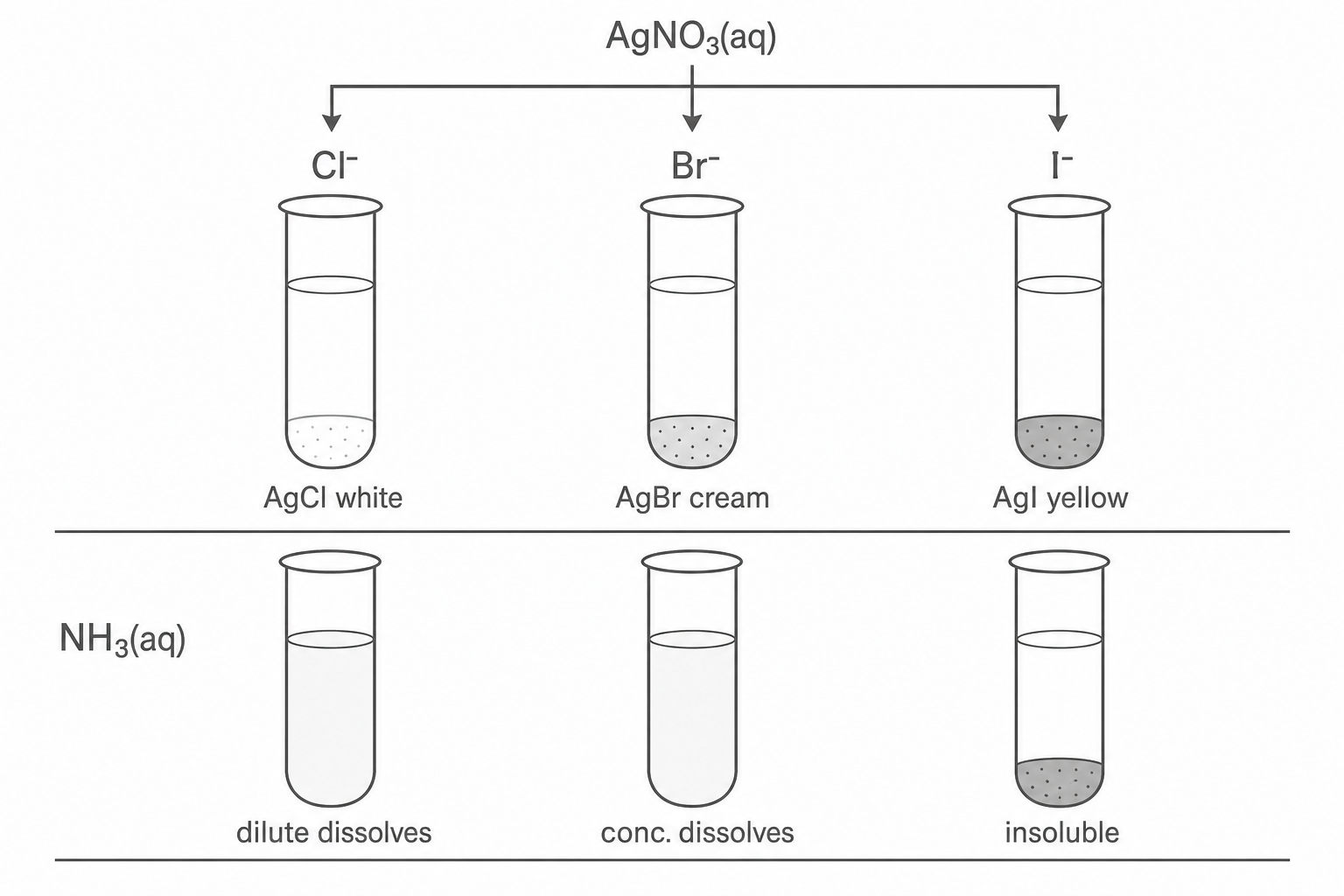
The usual observations are:
| Ion tested | Silver nitrate observation | With aqueous ammonia |
|---|---|---|
Cl^- | white precipitate of AgCl | dissolves in dilute ammonia |
Br^- | cream precipitate of AgBr | dissolves in concentrated ammonia |
I^- | yellow precipitate of AgI | insoluble in ammonia |
The ammonia step is useful because the precipitate colours can be hard to distinguish, especially cream versus pale yellow. Ammonia forms soluble diamminesilver(I) complexes with AgCl and, less readily, with AgBr:
AgCl(s) + 2NH3(aq) -> [Ag(NH3)2]^+(aq) + Cl^-(aq)
AgI is too insoluble for ammonia to dissolve in this test.
In practical work, the solution is often acidified with dilute nitric acid before adding silver nitrate. This removes ions such as carbonate that could also form precipitates with silver ions. The specified halide evidence in this lesson, however, is the silver nitrate precipitate followed by the ammonia solubility test.
Hydrogen halides also have two simple reactions in this row.
With ammonia:
HCl(g) + NH3(g) -> NH4Cl(s)
HBr(g) + NH3(g) -> NH4Br(s)
HI(g) + NH3(g) -> NH4I(s)
The solid ammonium halides form white fumes or a white smoke when the gases meet.
With water, hydrogen halides form acids:
HCl(g) + H2O(l) -> H3O^+(aq) + Cl^-(aq)
HBr(g) + H2O(l) -> H3O^+(aq) + Br^-(aq)
HI(g) + H2O(l) -> H3O^+(aq) + I^-(aq)
The key representation shift is from gas molecule to aqueous ions. A hydrogen halide gas is covalent, but in water it donates a proton and produces hydrated hydrogen ions and halide ions.
Worked example: deducing a halide
An unknown aqueous halide is acidified with dilute nitric acid. Silver nitrate solution gives a cream precipitate. Dilute ammonia has little effect, but concentrated ammonia dissolves the precipitate. Deduce the halide ion.
The cream precipitate suggests AgBr. The fact that it dissolves only in concentrated ammonia confirms Br^-. The unknown contains bromide ions.
Feynman diagnostic
Explain why adding ammonia is not just "making the mixture alkaline". The useful effect is complex formation with Ag^+, which can pull some silver halides into solution. If a student says "ammonia neutralises the precipitate", they are not describing the chemistry that distinguishes chloride, bromide and iodide.
Predict Fluorine And Astatine From Trends
Pearson can ask about fluorine and astatine even when the main taught reactions use chlorine, bromine and iodine. The safe method is to state the relevant trend first, then apply it to the new element.
Use this prediction frame:
position in Group 7
-> atomic radius, shielding and electronegativity
-> oxidising ability of X2 or reducing ability of X^-
-> predicted reaction or observation
Fluorine predictions
Fluorine is at the top of Group 7. It is very small and very electronegative, so F2 is the strongest oxidising halogen. Fluoride ions, F^-, are the weakest reducing halide ions.
Consequences:
F2reacts extremely readily as an oxidising agent.F^-is not expected to reduce concentrated sulfuric acid.HFis not expected to show the reducing behaviour seen forHBrandHI.AgFis soluble, so fluoride does not fit the same silver nitrate precipitate pattern as chloride, bromide and iodide.- Fluorine is normally assigned oxidation number
-1in its compounds, so positive fluorine oxidation states analogous toClO^-orClO3^-are not a good prediction.
A useful contrast is fluorine with water. Chlorine disproportionates in water to give chloride and chloric(I) acid, but fluorine is such a strong oxidising agent that it oxidises water:
2F2 + 2H2O -> 4HF + O2
Astatine predictions
Astatine is below iodine. It is predicted to have a larger atomic radius, lower electronegativity and weaker oxidising ability than iodine. Astatide ions, At^-, would be predicted to be very strong reducing agents.
Consequences:
At2would be a weaker oxidising agent thanI2.At^-andHAtwould be predicted to reduce concentrated sulfuric acid at least as readily as iodide and hydrogen iodide.- Silver astatide,
AgAt, would be predicted to be a very insoluble silver halide, likely less soluble thanAgI. - Astatine is rare and radioactive, so A level predictions are trend arguments rather than routine bench observations.
Worked example: predict a silver nitrate result for astatide
Question: Predict what would happen when aqueous silver nitrate is added to a solution containing At^-, then aqueous ammonia is added.
Trend route: from Cl^- to Br^- to I^-, silver halides become less soluble and dissolve less readily in ammonia. Astatide is below iodide, so AgAt is predicted to be even less soluble than AgI. Therefore a precipitate would be expected, and it would probably be insoluble in ammonia.
Pearson-style recap
For this lesson, a strong answer does not list isolated observations. It moves from equation to oxidation number, from precipitate to confirmatory ammonia evidence, or from position in Group 7 to a justified prediction. That is the difference between remembering halogen facts and using halogen chemistry.