2A.22-2B.23 - Metallic Bonding And Giant Lattices
This lesson defines metallic bonding and uses it to place solid metals in the wider family of giant lattices. It deliberately leaves detailed simple molecular structures, carbon allotrope detail, and full property prediction to the following lessons, while giving enough particle-level language to make later explanations work. The Pearson Edexcel 9CH0 skill is to move cleanly from observed bulk behaviour to particles, electrons, structure, and the force being overcome.
The Metal Puzzle
A strip of copper conducts electricity as a solid, can be bent into a different shape, and does not consist of separate copper molecules. Those observations are a useful way into the model, because a definition of metallic bonding only earns marks when the particles and electrons are named correctly.
[DIAGRAM: asset_name: Metallic Lattice Model; asset_slug: edexcel_a_level_chemistry_l014_metallic_lattice_model; recommended_method: image_gen; description: Monochrome particle model of a giant metallic lattice, showing positive metal ions in a regular arrangement with delocalised electrons spread between them.]
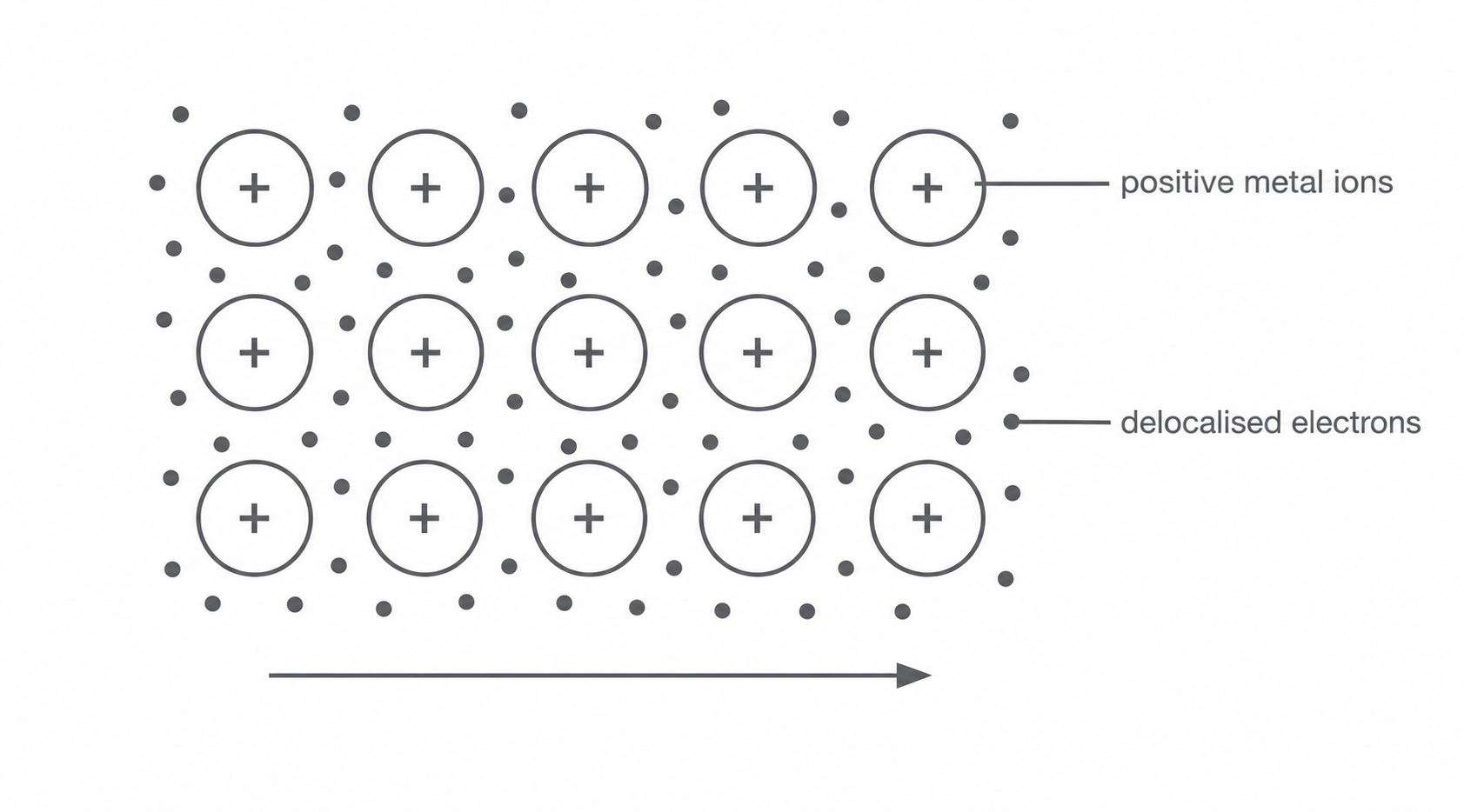
In a solid metal, the outer electrons are not fixed to one atom or shared between one pair of atoms. They are delocalised: they can be treated as belonging to the whole lattice. The remaining positive metal ions occupy regular positions in a giant metallic lattice.
Metallic bonding is the strong electrostatic attraction between the positive metal ions and the delocalised electrons. The word electrostatic matters because it tells you the attraction is between opposite charges. The word delocalised matters because it stops you accidentally describing covalent bonding, where a shared pair is localised between two nuclei.
Observation to model
| Observation | Particle-level interpretation |
|---|---|
| A metal conducts electricity as a solid | Delocalised electrons can move through the lattice and carry charge. |
| A metal is usually malleable | Layers of positive ions can shift while attraction to the delocalised electrons is maintained. |
| A metal has a regular solid structure | The positive metal ions are arranged in a giant lattice, not in separate molecules. |
The improvement is not cosmetic. Atoms is too vague because the bonding model requires charged metal ions and mobile delocalised electrons.
Building The Metallic Bond Model
The model has three pieces that should appear in a good explanation.
- The particles are positive metal ions.
- The electrons are delocalised through the whole structure.
- The force is a strong electrostatic attraction between those oppositely charged parts.
Do not imagine the delocalised electrons as a separate liquid poured around the ions. It is a model for electron density spread through the solid. The important A level idea is that the electrons are not locked into a single covalent bond or held by one individual metal atom.
Worked example: turning a definition into an explanation
Question: Solid aluminium is a good electrical conductor. Use metallic bonding to explain this observation.
A strong answer needs a route, not just a keyword:
- Aluminium is a metal and forms a giant metallic lattice.
- The lattice contains positive metal ions and delocalised electrons.
- The delocalised electrons are mobile.
- When a potential difference is applied, these electrons can move through the solid and carry charge.
Model answer: Solid aluminium conducts electricity because it contains delocalised electrons that are free to move through its giant metallic lattice. These mobile electrons carry charge through the solid.
The key mark-earning link is delocalised electrons -> mobile charge carriers. Saying only "it has metallic bonding" is not enough, because it does not explain the property.
Feynman diagnostic
Explain metallic bonding to a younger student without using the phrase "atoms share electrons".
Diagnostic trap: if your explanation says each metal atom shares electrons with a neighbouring metal atom, you have slipped into a covalent-bond model. The safer explanation is: positive metal ions are held together by attraction to electrons that are spread through the whole metal lattice.
Guided practice
Complete the explanation:
Solid sodium can conduct electricity because its structure contains ______ electrons. These electrons are ______ and can carry ______ through the lattice.
Answer
Solid sodium can conduct electricity because its structure contains delocalised electrons. These electrons are mobile and can carry charge through the lattice.
Giant Lattices Are Structure Types
Giant lattice describes the scale and arrangement of the structure. It means a repeating three-dimensional arrangement that extends throughout the solid. It does not, by itself, tell you whether the bonding is ionic, covalent, or metallic.
Edexcel names three giant-lattice families in this row.
| Giant lattice family | Particles or building units | Main bonding model | Examples in scope |
|---|---|---|---|
| Giant ionic lattice | Oppositely charged ions | Strong electrostatic attraction between ions | Ionic solids such as sodium chloride |
| Giant covalent lattice | Atoms joined in a continuous network | Strong covalent bonds throughout the network | Diamond, graphite, silicon(IV) oxide |
| Giant metallic lattice | Positive metal ions and delocalised electrons | Strong electrostatic attraction between metal ions and delocalised electrons | Solid metals such as sodium, magnesium, aluminium, copper |
The first common error is to treat giant as if it means "large molecule". It does not. A giant ionic lattice is not one big molecule of sodium chloride, and a giant metallic lattice is not a molecule of copper. The structure is a continuous solid arrangement.
The second common error is to mix up bonding type and structure type. For example, metallic can describe both the bonding and the lattice family in a solid metal. For silicon(IV) oxide, the bonding is covalent and the structure is giant covalent. For sodium chloride, the bonding is ionic and the structure is a giant ionic lattice.
Notice that this check asks for structure classification, not detailed property prediction. Property prediction is built properly in the later structure-property lesson.
Using The Model Without Overreaching
Although this lesson is mainly about defining and classifying, Pearson questions often reward concise links between a structure and an observation. Use the metallic model carefully: name the relevant particles, state whether they can move, then link that to the observation.
Conductivity contrast
Solid metals conduct because they contain mobile delocalised electrons. Solid ionic compounds usually do not conduct because their ions are fixed in position in the solid lattice. When an ionic compound is molten or dissolved in water, ions can move, so charge can be carried by ions rather than electrons.
This contrast is a useful guardrail: metals conduct as solids because electrons are mobile; ionic solids conduct only when ions are mobile.
Malleability contrast
Metals can often be hammered or drawn into wires because the positive metal ions can shift relative to each other while the delocalised electrons still attract the ions. A brittle ionic lattice is different: shifting layers can bring ions with the same charge next to each other, causing repulsion and fracture.
This is a model-level explanation, not a full materials-science account. For 9CH0, the mark-earning idea is that metallic bonding is non-directional attraction between metal ions and delocalised electrons, so the lattice can be distorted without separating into neutral molecules.
Worked example: compare two explanations
Question: Explain why copper can conduct electricity when solid.
Weak answer: Copper has ions, so electricity flows.
Why it fails: it does not identify the charge carrier. Ions in a solid metal lattice are not moving through the wire as the current.
Improved answer: Copper has a giant metallic lattice containing positive metal ions and delocalised electrons. The delocalised electrons are mobile and can move through the solid, carrying charge.
Pearson-Style Reasoning
When a question asks you to state, describe, or explain in this topic, tune the amount of reasoning to the command word.
| Command style | What the answer must do |
|---|---|
| State what is meant by metallic bonding | Give the definition with metal ions, delocalised electrons, and electrostatic attraction. |
| Describe the structure of a solid metal | Name a giant metallic lattice of positive metal ions with delocalised electrons. |
| Explain a metallic property | Link the metallic model to the observation, such as mobile delocalised electrons for conductivity. |
| Classify a solid lattice | Use the particle and bonding model to name giant ionic, giant covalent, or giant metallic. |
Worked example: classification and explanation
Question: A solid contains particles in a regular repeating structure. It conducts electricity when solid and can be shaped into a wire. Deduce the type of giant lattice present and justify your answer.
Route:
Regular repeating structuresuggests a lattice.Conducts electricity when solidpoints to mobile charge carriers in the solid.Can be shaped into a wireis consistent with layers shifting in a metallic lattice.- The charge carriers in a solid metal are delocalised electrons.
Model answer: The solid is a giant metallic lattice. It conducts when solid because it contains mobile delocalised electrons that can carry charge. Its ability to be shaped into a wire is also consistent with metallic bonding, because positive metal ions can shift while remaining attracted to the delocalised electrons.
Pearson-aware recap
For rows 2A.22-2B.23, the core skill is precise classification. Metallic bonding is not "atoms sticking together"; it is strong electrostatic attraction between positive metal ions and delocalised electrons. Giant lattices can be ionic, covalent, or metallic, so always name both the structure and the bonding model before explaining an observation.