2B.24-2B.25 - Simple Molecular And Carbon Structures
This lesson fixes the language used to describe covalently bonded solids: some contain separate molecules, while others are continuous carbon networks. It covers simple molecular structures such as iodine, I2, and ice, H2O, then compares the different structures formed by carbon atoms in diamond, graphite and graphene. The next lesson uses these structural ideas to predict properties from data and other information; here the priority is recognising the structure accurately before explaining with it.
Why The Structure Label Matters
A student sees the word "covalent" and writes "simple molecular" for every covalently bonded substance. That answer works for iodine and ice, but it fails badly for diamond and graphite. The useful question is not just "is there covalent bonding?" but "what particles or atoms are joined into one unit?"
For Edexcel Topic 2, separate these three ideas:
- Bonding type: the attraction holding atoms together, such as covalent bonding.
- Structure: the overall arrangement of particles or atoms, such as simple molecular or giant covalent.
- Forces between units: the attractions between molecules or layers, where relevant.
A simple molecular substance contains discrete molecules. Each molecule has covalent bonds inside it, but neighbouring molecules are not joined by covalent bonds. By contrast, a giant covalent structure is a continuous network of atoms joined by covalent bonds.
The mark-earning move is to name the particles first. If the particles are molecules, you can then discuss intermolecular forces. If the structure is a continuous network of atoms, there are no separate molecules to pull apart.
Simple Molecular Solids
[DIAGRAM: asset_name: Simple Molecular Solids; asset_slug: edexcel_a_level_chemistry_l015_simple_molecular_solids; recommended_method: image_gen; description: Monochrome schematic comparing solid iodine as separate I2 molecules and ice as separate H2O molecules, with dashed lines between molecules and solid covalent bonds within molecules.]
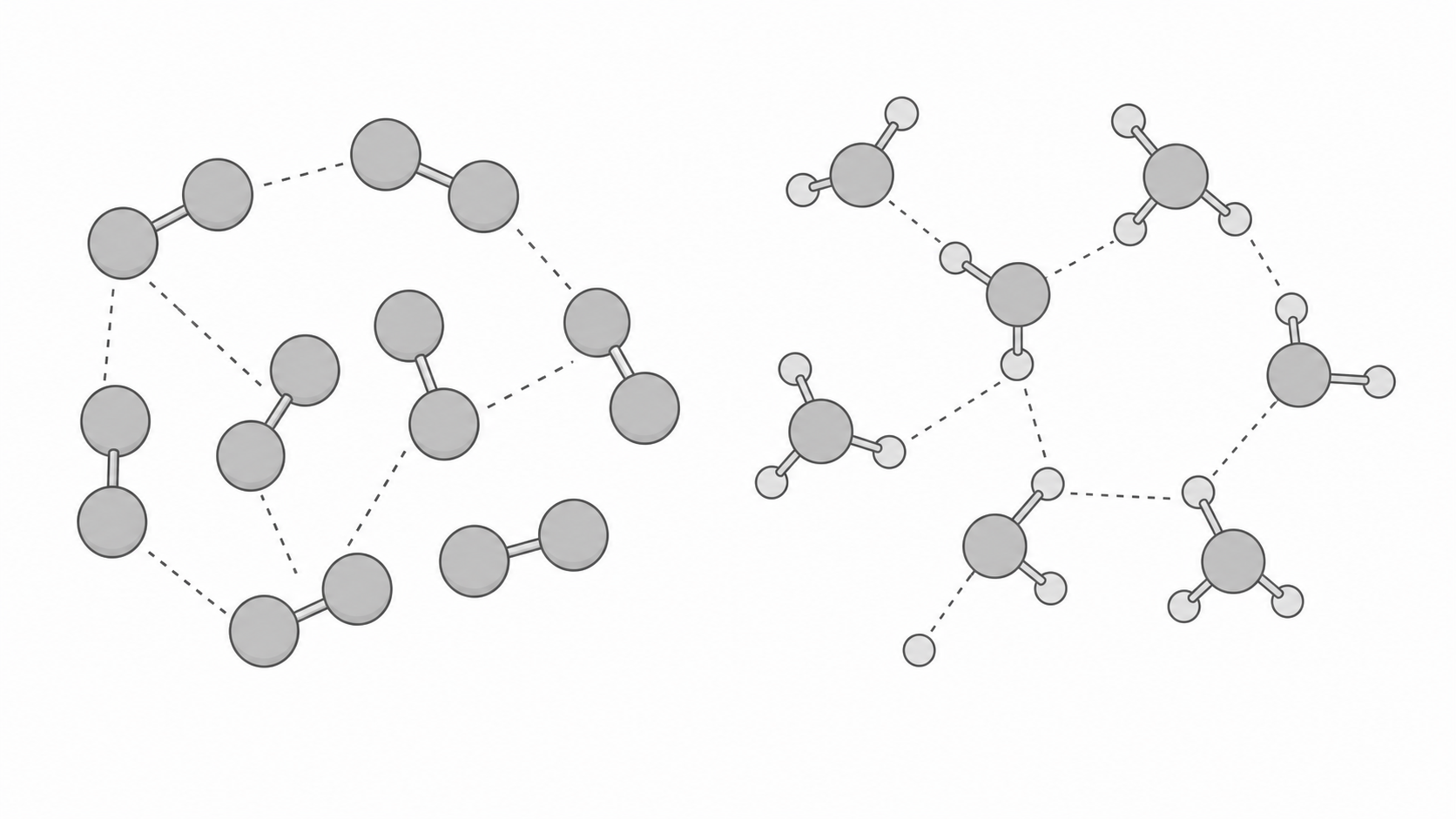
Iodine and ice are both examples of covalently bonded substances with simple molecular structures. The phrase sounds slightly odd for ice because the molecules form an ordered crystal, but the important unit is still the H2O molecule.
In solid iodine, each I2 molecule contains a covalent bond between two iodine atoms. The separate I2 molecules are attracted to one another by London forces, not by covalent bonds between molecules. When the physical state changes, the I-I covalent bond inside each molecule is not the bond being broken.
In ice, each H2O molecule contains two O-H covalent bonds. The H2O molecules are held to neighbouring H2O molecules by hydrogen bonds, which are intermolecular forces. Hydrogen bonding is stronger than London forces, but it is still not the same as a covalent bond joining all the oxygen and hydrogen atoms into one giant covalent lattice.
The common error is to see many dashed or drawn connections in a diagram of ice and call it a giant covalent structure. That loses the particle-level idea: the covalent units are still individual H2O molecules.
Feynman diagnostic
Explain this to a younger student in two sentences: "Ice has many hydrogen bonds in a crystal, but ice is still simple molecular." Your explanation must use the words molecule, covalent bond and intermolecular force.
One strong version
Ice is made of H2O molecules, and each molecule has covalent O-H bonds inside it. The attractions between different H2O molecules are hydrogen bonds, which are intermolecular forces, so the structure is simple molecular rather than a giant covalent network.
Carbon Forms Different Structures
[DIAGRAM: asset_name: Carbon Allotropes; asset_slug: edexcel_a_level_chemistry_l015_carbon_allotropes; recommended_method: image_gen; description: Monochrome schematic showing diamond as a three-dimensional carbon network, graphite as stacked hexagonal carbon layers, and graphene as a single hexagonal carbon sheet.]
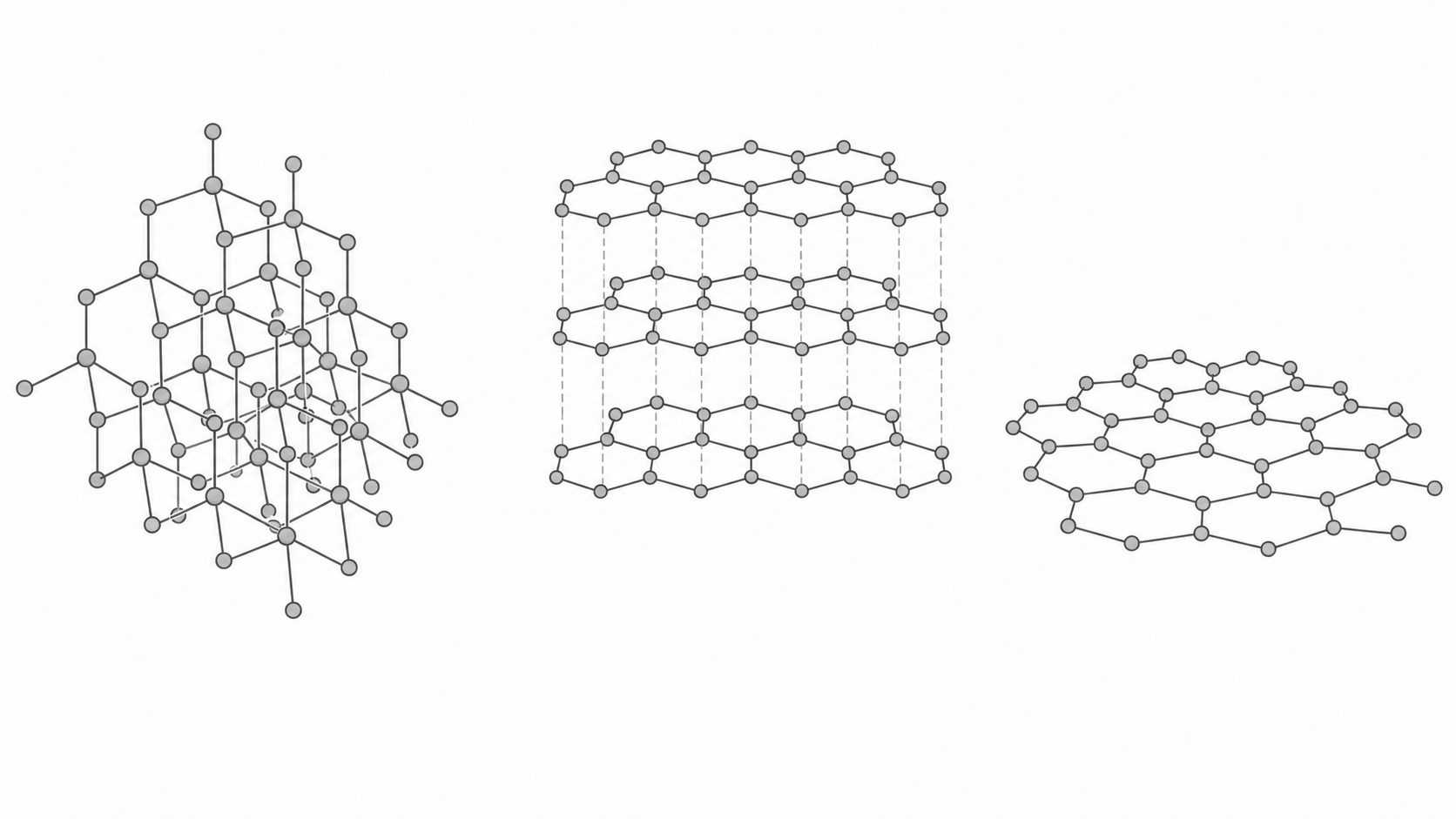
Carbon atoms can form different structures because each carbon atom can make several covalent bonds to other carbon atoms. The structures in this lesson are all made from carbon atoms, but the atoms are connected in different ways.
Diamond
Diamond is a giant covalent structure. Each carbon atom is covalently bonded to four other carbon atoms in a three-dimensional tetrahedral network. There are no separate carbon molecules in diamond; the covalent network extends through the crystal.
Graphite
Graphite is also a giant covalent structure, but the arrangement is layered. Each carbon atom is covalently bonded to three other carbon atoms in flat hexagonal sheets. The sheets are stacked on top of one another, with much weaker attractions between layers than the covalent bonds within a layer.
Graphene
Graphene is a single layer of carbon atoms arranged in a hexagonal sheet. It is easiest to think of graphene as one layer from graphite, not as a stack of layers. Each carbon atom is bonded to three other carbon atoms within the sheet, and the sheet is one atom thick.
Notice the careful distinction: diamond, graphite and graphene are not different because the atoms are different. They are different because the same carbon atoms are arranged and bonded in different structures.
Worked Classification
When a Pearson-style prompt asks you to identify a structure, do not start with a property. Start with the structural evidence given.
Worked example
A student is given four descriptions:
- A: separate I2 units in a solid.
- B: carbon atoms in a three-dimensional network, each bonded to four other carbon atoms.
- C: H2O units arranged in a crystal, with attractions between neighbouring units.
- D: a single sheet of carbon atoms in a hexagonal arrangement.
Classify A-D as simple molecular, diamond, ice or graphene.
Step 1: identify the repeated unit
A contains separate I2 units, so the repeated unit is a molecule. C contains H2O units, so the repeated unit is also a molecule. B and D contain carbon atoms joined into networks or sheets, not separate molecules.
Step 2: match the named examples
A is solid iodine, so it is simple molecular. C is ice, so it is simple molecular. B matches diamond because each carbon atom is bonded to four other carbon atoms in a three-dimensional network. D matches graphene because it is a single hexagonal sheet.
Final answer
A is simple molecular iodine. B is diamond. C is simple molecular ice. D is graphene.
Chemical interpretation
The same word "covalent" appears in both simple molecular and giant covalent examples. The distinction comes from whether the covalent bonds make a separate molecule or a continuous structure.
Guided practice
A solid contains only carbon atoms. The atoms are arranged in several parallel hexagonal layers. Within each layer, each carbon atom is bonded to three other carbon atoms.
- Name the structure.
- State one piece of structural evidence that supports your answer.
- Explain why it is not graphene.
Answer
- Graphite.
- It has several stacked hexagonal layers of carbon atoms, with each carbon bonded to three others within a layer.
- Graphene is a single carbon layer; this solid contains several layers.
Common Error Contrast
The most damaging error in this lesson is treating every visible line in a structure diagram as the same kind of bond. Pearson questions often reward the distinction between covalent bonds, intermolecular forces and layer attractions.
| Tempting answer | Why it is tempting | Better reasoning |
|---|---|---|
| Ice is giant covalent because the molecules form a crystal | The diagram may look like a network | The covalent bonds are inside H2O molecules; the forces between molecules are hydrogen bonds |
| Iodine is atomic because iodine is an element | The substance contains only iodine atoms | Solid iodine contains I2 molecules, so its structure is simple molecular |
| Graphite and graphene are the same structure | Both contain hexagonal carbon sheets | Graphene is one sheet; graphite is a stack of sheets |
| Diamond is simple molecular because it is covalent | Covalent often reminds students of molecules | Diamond has a continuous three-dimensional covalent network, not separate molecules |
Pearson-Style Recap
For 2B.24, you need to recognise that covalently bonded substances such as iodine, I2, and ice, H2O, are simple molecular. That means covalent bonds are within the molecules, and the attractions between molecules are intermolecular forces.
For 2B.25, you need to know the different structures formed by carbon atoms. Diamond is a three-dimensional giant covalent network, graphite is stacked hexagonal layers, and graphene is a single hexagonal layer.
When a question says state, give the structure name directly. When it says explain, add the reason: identify the units present, say where the covalent bonds are, and distinguish those bonds from forces between molecules or layers. The next lesson turns this recognition into predictions about melting temperature, boiling temperature, conductivity and solubility.