1.23-1.26 - Periodicity And Element Properties
This lesson covers Edexcel 9CH0 spec points 1.23-1.26: electronic configuration as the driver of chemical properties, periodicity as a repeating pattern across periods, Period 2 and 3 trends in melting and boiling temperatures, Period 2 and 3 first ionisation energy trends, and the use of data such as configurations, atomic radii, temperatures and first ionisation energies to illustrate those patterns. It leaves the detailed bonding models of ionic, covalent, metallic and intermolecular forces to Topic 2, but it uses the minimum structure-and-bonding language needed to explain the Period 2 and 3 data. The point is to turn a table of numbers into chemical reasoning: where the outer electrons are, how strongly they are held, and what kind of particles or structures the element forms.
From Configuration To Periodicity
The periodic table is not just a list in atomic-number order. It is a repeating pattern caused by electrons filling shells and subshells in a repeating way.
The chemical properties of an element are mainly controlled by its outer-shell electronic configuration. Those outer electrons are the electrons gained, lost or shared when atoms react. Elements with similar outer configurations therefore tend to have similar chemical properties.
For example:
| Element | Electronic configuration | Outer-shell pattern | Chemical link |
|---|---|---|---|
| Lithium | 1s^2 2s^1 | one outer s electron | Group 1 metal |
| Sodium | 1s^2 2s^2 2p^6 3s^1 | one outer s electron | Group 1 metal |
| Beryllium | 1s^2 2s^2 | two outer s electrons | Group 2 metal |
| Magnesium | 1s^2 2s^2 2p^6 3s^2 | two outer s electrons | Group 2 metal |
Lithium and sodium do not have the same number of occupied shells, so their atoms are different sizes. But both have one outer s electron, so both tend to lose one electron in many reactions and form 1+ ions. That is the configuration-property link in action.
Periodicity means a repeating pattern across different periods. When Period 2 goes from lithium to neon, the outer shell fills from 2s^1 to 2s^2 2p^6. When Period 3 goes from sodium to argon, the same kind of outer-shell pattern repeats from 3s^1 to 3s^2 3p^6.
So the period number changes the shell being filled, but the group pattern repeats:
Period 2: Li    Be    B        C        N        O        F        Ne
Outer:    2s1   2s2   2s2 2p1 2s2 2p2 2s2 2p3 2s2 2p4 2s2 2p5 2s2 2p6

Period 3: Na    Mg    Al       Si       P        S        Cl       Ar
Outer:    3s1   3s2   3s2 3p1 3s2 3p2 3s2 3p3 3s2 3p4 3s2 3p5 3s2 3p6
That repeating outer-electron pattern is why the graph of a property across Period 3 often has a shape similar to the graph across Period 2, even though the exact values differ.
Using Periodic Data Without Guessing
Edexcel can ask you to illustrate periodicity using supplied data. That means you need to do more than recognise a memorised trend; you need to connect a pattern in the numbers to electronic structure, atomic size, bonding or structure.
A useful route for a data question is:
- Identify the period and the property being compared.
- Describe the pattern in the data, including any exception.
- Link the pattern to a chemical model: outer configuration, nuclear charge, shielding, radius, structure or bonding.
- Use the exact species words correctly: atom, ion, molecule, lattice, covalent bond, metallic bond or intermolecular force.
Consider rounded Period 3 data often used for trend reasoning:
| Element | Outer configuration | Typical atomic radius trend / pm | First ionisation energy / kJ mol^-1 |
|---|---|---|---|
| Na | 3s^1 | 186 | 496 |
| Mg | 3s^2 | 160 | 738 |
| Al | 3s^2 3p^1 | 143 | 578 |
| Si | 3s^2 3p^2 | 117 | 787 |
| P | 3s^2 3p^3 | 110 | 1012 |
| S | 3s^2 3p^4 | 104 | 1000 |
| Cl | 3s^2 3p^5 | 99 | 1251 |
| Ar | 3s^2 3p^6 | use supplied definition | 1521 |
Across Period 3 from sodium to chlorine, the atomic radius generally decreases. The number of protons increases, but electrons are added to the same main shell. Shielding does not increase much, so the outer electrons are pulled closer to the nucleus.
Argon is a useful caution. Different data books may use different radius definitions for noble gases because they do not usually form ordinary covalent bonds. In an exam, always use the definition in the data heading rather than forcing one radius scale onto every element.
The first ionisation energy generally increases across the period, but it has dips at aluminium and sulfur. Those dips are not random: aluminium starts the 3p subshell, and sulfur has a paired 3p electron. You will unpack those in the ionisation-energy part.
Worked example: describe the atomic-radius trend from Na to Cl
The data show a decrease from 186 pm for sodium to 99 pm for chlorine. Across the period, proton number increases, and the added electrons enter the same main shell. Shielding remains similar, so the attraction between the nucleus and the outer electrons increases. The outer electrons are pulled closer to the nucleus, so the atomic radius decreases.
The mark-earning step is the chain: more protons + similar shielding -> stronger attraction -> smaller radius.
Melting And Boiling: Structure Decides The Pattern
Melting and boiling temperatures across Period 3 do not follow a simple left-to-right increase. They depend strongly on the structure of the element and the forces or bonds that must be overcome.
[DIAGRAM: asset_name: Period3 Structure Types; asset_slug: edexcel_a_level_chemistry_l007_period3_structure_types; recommended_method: image_gen; description: Monochrome schematic comparing three Period 3 structure families: metallic lattice with delocalised electrons, giant covalent network, and separated simple molecular or atomic particles with weak intermolecular attractions.]
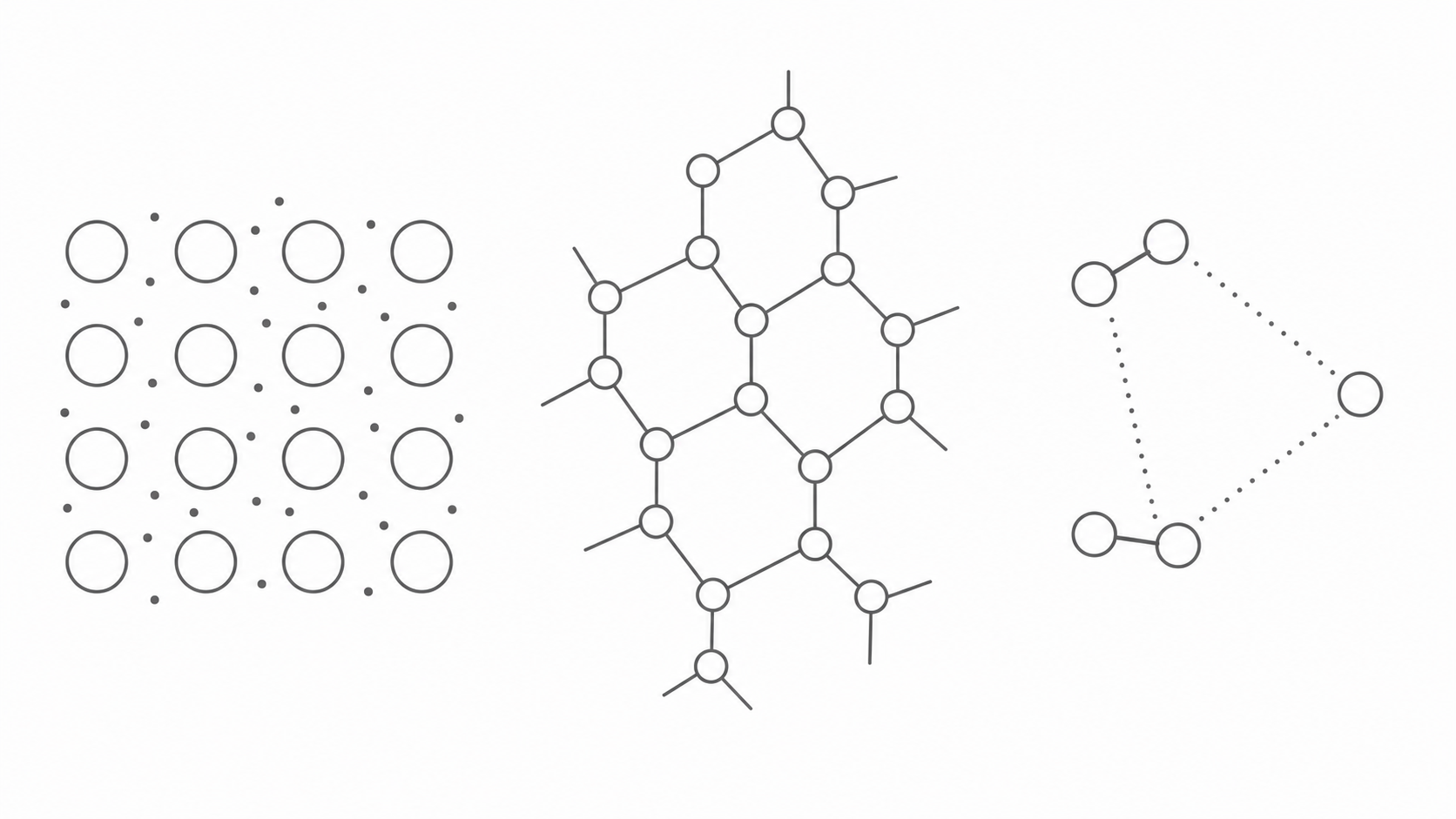
Rounded Period 3 data show the pattern:
| Element | Main structure idea | Melting temperature / deg C | Boiling temperature / deg C |
|---|---|---|---|
| Na | metallic lattice | 98 | 883 |
| Mg | metallic lattice | 650 | 1091 |
| Al | metallic lattice | 660 | 2519 |
| Si | giant covalent network | 1414 | 3265 |
| P | simple molecular, P4 | 44 | 280 |
| S | simple molecular, S8 | 115 | 445 |
| Cl | simple molecular, Cl2 | -101 | -34 |
| Ar | monatomic atoms | -189 | -186 |
From sodium to aluminium, the elements are metals. Their atoms form metallic lattices with delocalised electrons. The metallic bonding generally becomes stronger from sodium to aluminium because there are more delocalised outer electrons and the metal ions have greater charge density. More energy is needed to overcome the metallic bonding.
Silicon has a much higher melting and boiling temperature because it forms a giant covalent network. Many strong covalent bonds must be broken to melt or boil silicon. This is a structure-property explanation, not just a statement that silicon is "in the middle".
Phosphorus, sulfur, chlorine and argon have much lower melting and boiling temperatures because they exist as simple molecules or separate atoms. The covalent bonds inside P4, S8 and Cl2 molecules are not broken during melting or boiling. The forces overcome are intermolecular forces between molecules, or weak attractions between argon atoms.
The sulfur value is higher than the phosphorus value mainly because S8 molecules are larger than P4 molecules. Larger molecules have more electrons and stronger London forces, so more energy is needed to separate them.
Worked example: explain why silicon has a much higher boiling temperature than chlorine
Silicon has a giant covalent structure. To boil silicon, many strong covalent bonds in the network must be broken, which requires a large amount of energy. Chlorine exists as simple Cl2 molecules. To boil chlorine, only weak London forces between Cl2 molecules need to be overcome; the covalent bond within each Cl2 molecule is not broken. Therefore silicon has a much higher boiling temperature than chlorine.
The tempting error is to say "chlorine has covalent bonds, so it should have a high boiling temperature". The correction is to identify which forces are overcome during boiling.
First Ionisation Energy Across Periods
First ionisation energy is the energy needed to remove one electron from each atom in one mole of gaseous atoms:
X(g) -> X+(g) + e-
Across Period 2 and Period 3, the first ionisation energy generally increases. Proton number increases across the period, while the added electrons enter the same main shell. Shielding changes only slightly, so the outer electron is more strongly attracted to the nucleus and more energy is needed to remove it.
The graph is not a perfect straight line. Edexcel can give data, or expect recall of the plot shape, especially the dips at Group 13 and Group 16.
| Comparison | Data pattern | Electronic explanation |
|---|---|---|
| Be to B, or Mg to Al | first ionisation energy drops | the electron removed from B or Al is in a p subshell, which is higher in energy and easier to remove than the previous s electron |
| N to O, or P to S | first ionisation energy drops | O or S has a paired p electron; repulsion within the paired orbital makes one electron easier to remove |
Use Period 3 to see both exceptions:
Mg: [Ne] 3s^2          first IE about 738 kJ mol^-1
Al: [Ne] 3s^2 3p^1    first IE about 578 kJ mol^-1
Aluminium has more protons than magnesium, so a simple "more protons means higher ionisation energy" answer would predict the wrong result. The electron removed from aluminium is a 3p electron, which is easier to remove than magnesium's 3s electron. That subshell effect outweighs the increase in nuclear charge for this comparison.
Now compare phosphorus and sulfur:
P: [Ne] 3s^2 3p^3     first IE about 1012 kJ mol^-1
S: [Ne] 3s^2 3p^4     first IE about 1000 kJ mol^-1
In phosphorus, the three 3p electrons occupy separate 3p orbitals. In sulfur, one 3p orbital contains a pair of electrons. Repulsion between the paired electrons makes it slightly easier to remove one electron, so sulfur has a slightly lower first ionisation energy than phosphorus.
Worked example: explain why neon has a higher first ionisation energy than fluorine
Neon has one more proton than fluorine, and the outer electron is still in the second shell. The shielding is similar because no new inner shell is added. The outer electron in neon is therefore more strongly attracted to the nucleus, so more energy is needed to remove it. Neon also has a full outer shell, but the mark-earning trend explanation is still based on nuclear charge, shielding, distance and attraction.
Putting The Trends Together
The strongest answers combine data description with explanation. They do not jump straight from a number to a memorised conclusion.
Worked example: use data to identify the key structure and explain the trend
A question gives this Period 3 data:
| Element | Melting temperature / deg C | First ionisation energy / kJ mol^-1 | Outer configuration |
|---|---|---|---|
| A | 650 | 738 | 3s^2 |
| B | 660 | 578 | 3s^2 3p^1 |
| C | 1414 | 787 | 3s^2 3p^2 |
Step 1: use the configurations.
3s^2 is magnesium, 3s^2 3p^1 is aluminium, and 3s^2 3p^2 is silicon.
Step 2: use the melting data.
Silicon has a much higher melting temperature than magnesium or aluminium. This suggests a different structure, not merely a slightly stronger version of metallic bonding.
Step 3: explain the structure.
Silicon has a giant covalent structure, so many strong covalent bonds must be broken to melt it. Magnesium and aluminium have metallic structures, so melting involves overcoming metallic bonding in a lattice.
Step 4: explain the ionisation-energy exception.
Aluminium has a lower first ionisation energy than magnesium because the electron removed from aluminium is in the 3p subshell. That electron is easier to remove than the 3s electron removed from magnesium.
A complete answer would read:
C is silicon because its outer configuration is
3s^2 3p^2and its very high melting temperature is consistent with a giant covalent structure. Many strong covalent bonds must be broken to melt silicon. B is aluminium; its first ionisation energy is lower than A, magnesium, because the electron removed from aluminium is in a3psubshell, which is easier to remove than magnesium's3selectron.
Notice the Pearson habit: the answer uses the data, identifies the model, and then explains using the model. It does not just name the element and stop.
Common-error contrast
-
Weak: "Silicon has a high melting point because it is covalent."
-
Strong: "Silicon has a giant covalent structure, so many strong covalent bonds must be broken."
-
Weak: "Aluminium has lower first ionisation energy because it is bigger."
-
Strong: "Aluminium's removed electron is in a
3psubshell, which is easier to remove than magnesium's3selectron."
Pearson-style recap: periodicity is a repeating pattern caused by repeating outer electronic configurations; atomic-radius and ionisation-energy trends are explained using nuclear charge, shielding, distance and subshell/orbital occupancy; melting and boiling trends are explained by structure and the forces or bonds overcome. When a question supplies data, describe the pattern first, then give the particle-level or electronic reason.