1.16-1.22 - Orbitals And Electronic Configurations
This lesson covers Edexcel 9CH0 spec points 1.16-1.22: shell capacities, orbitals, s- and p-orbital shapes, s/p/d subshell capacities, electron-in-box filling, electronic configurations of atoms and selected ions up to Z = 36, and classification into s-, p- and d-block elements. It deliberately stops before the next lesson's periodicity explanations in 1.23-1.26, although you will see why electronic configuration is the evidence those explanations use. The point is not to recite strings of symbols; it is to translate where electrons are into predictions about atoms, ions and periodic-table position.
Shells, Subshells And Electron Addresses
A chemist can often tell where an element belongs from a compact electron address such as 1s^2 2s^2 2p^6 3s^2. That address has three layers:
- the number, such as
3, names the shell or principal energy level - the letter, such as
sorp, names the subshell - the superscript, such as
^2, counts electrons in that subshell
The first four quantum shells can hold these maximum numbers of electrons:
| Shell | Maximum electrons | Subshell capacity idea |
|---|---|---|
| 1 | 2 | 1s only |
| 2 | 8 | 2s and 2p |
| 3 | 18 | 3s, 3p and 3d |
| 4 | 32 | 4s, 4p, 4d and 4f |
The maximum capacity is not the same as the order electrons fill in real ground-state atoms. A GCSE-style shell diagram for calcium may look like 2,8,8,2, but that does not mean the third shell can only hold 8 electrons. It means that, for calcium, electrons enter 4s before the 3d subshell starts filling.
Common-error contrast
The tempting shortcut is "shell 3 holds 8". The A-level correction is "shell 3 can hold 18, but 3d is not occupied until after 4s has filled in the early period-4 atoms."
Orbitals And Subshell Capacities
An orbital is a region within an atom that can hold up to two electrons. If two electrons are in the same orbital, they must have opposite spins, often shown as one upward arrow and one downward arrow in a box.
[DIAGRAM: asset_name: S And P Orbitals; asset_slug: edexcel_a_level_chemistry_l006_s_and_p_orbitals; recommended_method: image_gen; description: Monochrome schematic showing a spherical s orbital and a dumbbell-shaped p orbital, each with a central nucleus point.]
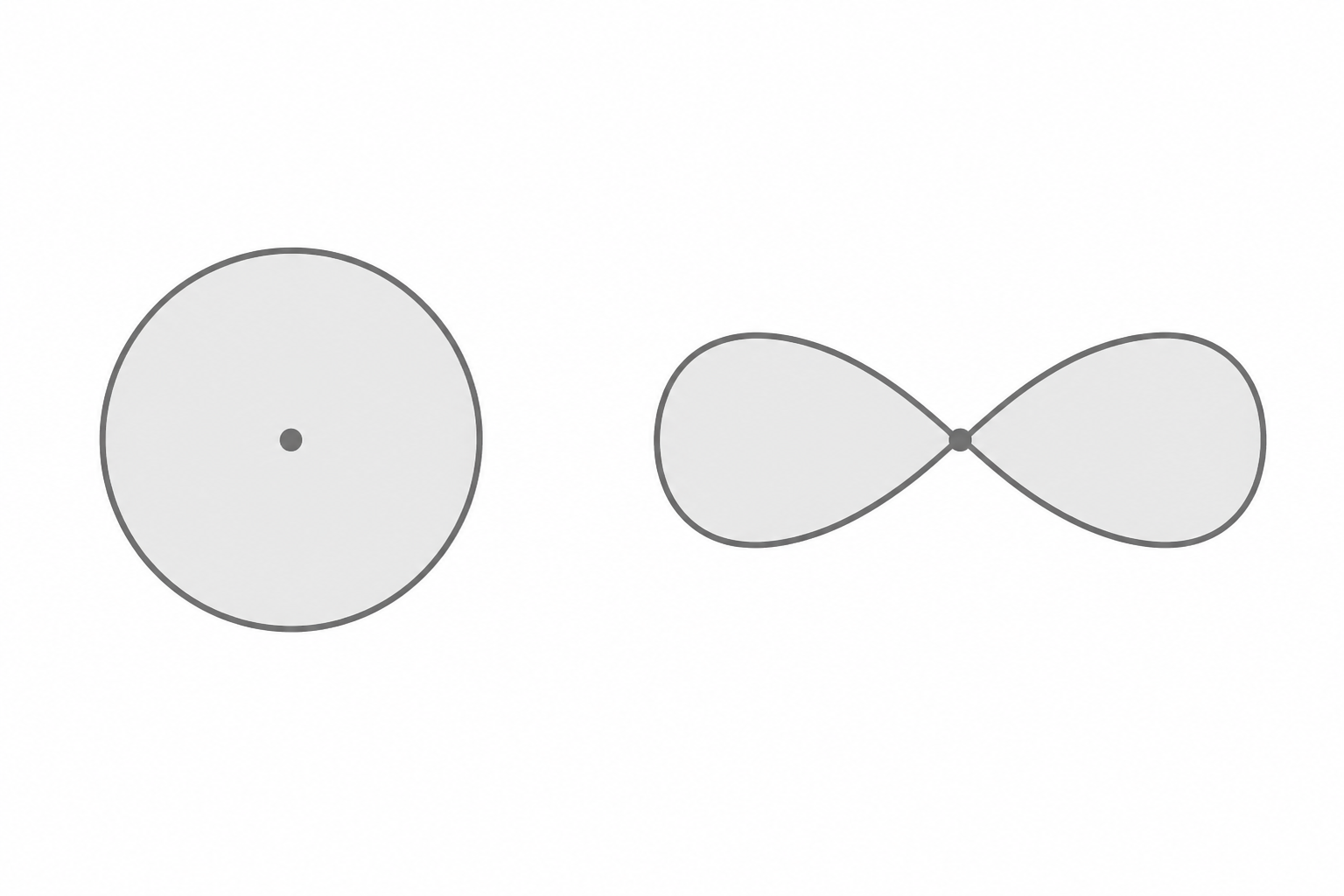
For this specification, you need the shapes of s and p orbitals:
- an s orbital is spherical
- a p orbital is dumbbell-shaped, with two lobes on opposite sides of the nucleus
You also need the number of electrons that occupy each type of subshell:
| Subshell | Number of orbitals in the subshell | Maximum electrons |
|---|---|---|
| s | 1 | 2 |
| p | 3 | 6 |
| d | 5 | 10 |
The capacity follows from "one orbital holds up to two electrons". A p subshell has three p orbitals, so it can hold 3 x 2 = 6 electrons. A d subshell has five d orbitals, so it can hold 5 x 2 = 10 electrons. You do not need d-orbital shapes in this lesson, but you do need the d-subshell capacity because configurations up to krypton include 3d.
Filling Orbitals Without Losing Electrons
For ground-state configurations up to Z = 36, use this filling order:
1s -> 2s -> 2p -> 3s -> 3p -> 4s -> 3d -> 4p
Two filling rules do a lot of mark-earning work:
- electrons fill orbitals in the same subshell singly before pairing
- two electrons in the same orbital must have opposite spins
In electron-in-box notation, each box is one orbital. The three boxes of a p subshell have the same energy, so electrons spread out before they pair.
For nitrogen, Z = 7, so there are 7 electrons:
1s  [↑↓]
2s  [↑↓]
2p  [↑] [↑] [↑]
This is 1s^2 2s^2 2p^3. The 2p electrons are not drawn as [↑↓] [↑] [ ], because pairing starts only after each orbital in that subshell has one electron.
For oxygen, Z = 8, one more electron is added:
1s  [↑↓]
2s  [↑↓]
2p  [↑↓] [↑] [↑]
This is 1s^2 2s^2 2p^4. The paired electrons in the first 2p box have opposite spins.
Worked example: draw the box notation for sulfur
Sulfur has Z = 16, so a sulfur atom has 16 electrons. Fill in order:
1s^2 2s^2 2p^6 3s^2 3p^4
The boxes are:
1s  [↑↓]
2s  [↑↓]
2p  [↑↓] [↑↓] [↑↓]
3s  [↑↓]
3p  [↑↓] [↑] [↑]
The chemical interpretation is that sulfur has six outer-shell electrons in shell 3: two in 3s and four in 3p. That outer-shell pattern will matter later when explaining periodic properties and bonding, but here the mark-earning point is the correct filling and pairing.
Predicting Atom Configurations Up To Krypton
For a neutral atom, the number of electrons equals the atomic number, Z. The method is mechanical, but the checking is chemical:
- Count electrons from
Z. - Fill subshells in the order
1s, 2s, 2p, 3s, 3p, 4s, 3d, 4p. - Stop when the electron total equals
Z. - Check the last occupied subshell against the element's periodic-table position.
Worked example: selenium, Z = 34
Start with 34 electrons and fill:
1s^2 2s^2 2p^6 3s^2 3p^6 4s^2 3d^10 4p^4
Count the electrons:
2 + 2 + 6 + 2 + 6 + 2 + 10 + 4 = 34
Selenium is in the p-block, and the configuration ends in 4p^4, so the periodic-table check agrees.
For longer configurations, noble-gas shorthand is a useful working check:
[Ar] 4s^2 3d^10 4p^4
When a question asks for 1s notation, the full form is safest unless the question or mark scheme clearly allows shorthand.
Chromium and copper caution
The simple filling pattern predicts most atoms up to krypton, but chromium and copper are the important period-4 exceptions:
Cr: [Ar] 4s^1 3d^5
Cu: [Ar] 4s^1 3d^10
These arrangements are associated with especially stable half-filled or full 3d subshells. Pearson has assessed the copper exception directly, so do not write copper as [Ar] 4s^2 3d^9.
Ions And Blocks
For ions, change the electron count before writing the configuration.
- A positive ion has lost electrons.
- A negative ion has gained electrons.
- Edexcel 1.21 asks for ions only for s- and p-block elements up to
Z = 36.
For s- and p-block ions, electrons are removed from or added to the outer shell. That usually means the highest principal shell number, such as shell 3 before shell 2.
Worked example: magnesium ion, Mg^2+
Magnesium has Z = 12, so neutral magnesium is:
1s^2 2s^2 2p^6 3s^2
Mg^2+ has lost two electrons, so it has 10 electrons:
1s^2 2s^2 2p^6
The two lost electrons came from the 3s subshell, because that is the outer occupied subshell in magnesium.
Worked example: chloride ion, Cl^-
Chlorine has Z = 17, so neutral chlorine is:
1s^2 2s^2 2p^6 3s^2 3p^5
Cl^- has gained one electron, so it has 18 electrons:
1s^2 2s^2 2p^6 3s^2 3p^6
This is the same electron configuration as argon. It is not the same atom: chloride has 17 protons and a 1- charge.
Block classification is based on the subshell being filled in the atom:
| Block | What is being filled | Examples |
|---|---|---|
| s-block | an s subshell | Na ends 3s^1; Ca ends 4s^2 |
| p-block | a p subshell | O ends 2p^4; Br ends 4p^5 |
| d-block | a d subshell | Fe involves 3d; Cu involves 3d |
Helium is displayed with the noble gases because of its chemical behaviour, but its electron configuration is 1s^2. The block label follows configuration, while group placement also reflects chemical properties.
For transition-metal ions, such as Fe^2+, the specification revisits the issue in Topic 15A. The key later caution is that period-4 transition-metal ions lose 4s electrons before 3d electrons; this lesson's ion-prediction requirement is only for s- and p-block ions.
Pearson-style recap
A configuration answer earns marks by showing the correct electron count, the correct filling order, the correct pairing in boxes, and the correct ion charge handling. Once the notation is right, block classification is quick: look at the subshell being filled, not the total number of shells in the atom.