1.5-1.7 - Isotopes And Relative Masses
This lesson covers Pearson Edexcel 9CH0 spec points 1.5, 1.6 and 1.7: isotopes, relative isotopic mass, relative atomic mass, relative molecular mass and relative formula mass. It deliberately leaves mass-spectrometry abundance calculations, diatomic molecule peak patterns and molecular-ion peaks to 1.8-1.10 in the next lesson. The important A-level move is to stop treating mass numbers as isolated labels and start using relative mass as a comparison scale that lets chemists calculate formula and molecular masses.
Same Element, Different Neutrons
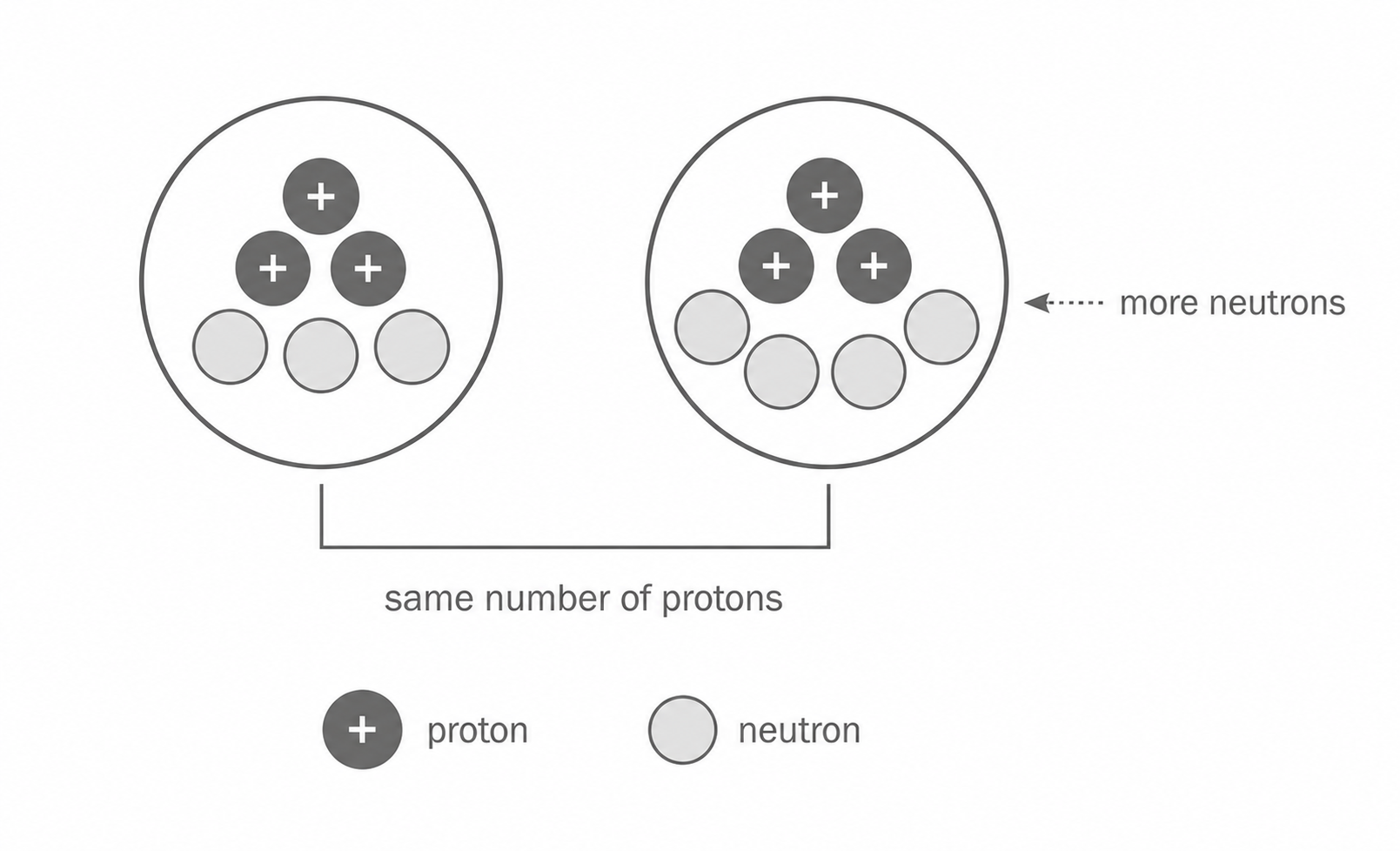
A sample of chlorine can contain atoms with mass number 35 and atoms with mass number 37. Both are chlorine, so both must have 17 protons. The difference is in the number of neutrons.
Isotopes are atoms of the same element with the same number of protons but different numbers of neutrons. Because the proton number is the same, isotopes of an element have the same atomic number and the same electron arrangement if the atoms are neutral. Because the neutron number is different, their mass numbers are different.
[DIAGRAM: asset_name: Isotope Nuclei Comparison; asset_slug: edexcel_a_level_chemistry_l002_isotope_nuclei_comparison; recommended_method: image_gen; description: Monochrome schematic of two isotope nuclei with the same number of protons and a different number of neutrons, plus a legend for proton and neutron.]
Use the notation carefully:
| Symbol | Meaning |
|---|---|
Z or atomic number | number of protons |
A or mass number | number of protons plus neutrons |
| neutron number | A - Z |
For example, carbon-12 and carbon-13 are both carbon isotopes:
| Isotope | Protons | Neutrons | Why it is carbon |
|---|---|---|---|
^12C | 6 | 6 | proton number is 6 |
^13C | 6 | 7 | proton number is 6 |
The tempting error is to say that isotopes are "different forms of atoms with different masses". That is too vague for Edexcel. The mark-earning statement must identify the same number of protons and different numbers of neutrons.
The Carbon-12 Scale
Atoms are far too small for ordinary gram masses to be convenient. Chemists therefore use a relative scale. The reference is carbon-12: one atom of carbon-12 is assigned a relative mass of exactly 12.
That means one relative mass unit is based on:
1/12 of the mass of one atom of carbon-12
Relative masses are ratios, so they have no units. Saying that an atom has a relative isotopic mass of about 16 means its mass is about 16 times 1/12 of the mass of a carbon-12 atom.
Relative isotopic mass compares one atom of a particular isotope with the carbon-12 scale. For example, the relative isotopic mass of ^24Mg refers to one atom of that isotope, not to a natural sample containing several magnesium isotopes.
Relative atomic mass, Ar, is different. It refers to the weighted mean mass of atoms of an element, compared with the same carbon-12 scale. The word mean matters because many elements exist naturally as mixtures of isotopes, so the periodic table value may be a decimal.
| Term | What is being compared with the carbon-12 scale? | Typical use |
|---|---|---|
| relative isotopic mass | one atom of one isotope | ^35Cl or ^37Cl considered separately |
relative atomic mass, Ar | the weighted mean atom of an element | the value from the periodic table, such as Ar(Cl) = 35.5 |
This lesson uses the weighted-mean idea to understand why Ar can be a decimal. The next lesson uses mass-spectrometry data to calculate that weighted mean.
Feynman diagnostic
Explain to a younger student why chlorine can haveAr = 35.5even though a chlorine atom does not contain half a neutron.Check:
35.5is an average for a sample containing different chlorine isotopes. Individual atoms have whole numbers of protons and neutrons; the decimal comes from the mixture, not from one fractional atom.
Using Relative Atomic Mass
Ar values are the numbers you normally take from the periodic table when calculating masses from formulae. At A level, treat them as relative masses of atoms on the carbon-12 scale, not as masses in grams and not as mass numbers.
The difference is visible with chlorine:
| Quantity | Meaning | Value often used |
|---|---|---|
mass number of ^35Cl | protons plus neutrons in one isotope | 35 |
mass number of ^37Cl | protons plus neutrons in one isotope | 37 |
Ar(Cl) | weighted mean for naturally occurring chlorine atoms | 35.5 |
Ar(Cl) being 35.5 does not make chlorine a molecule, and it does not mean every chlorine atom has mass 35.5. It means that when a calculation involves chlorine atoms in a typical sample, the average relative mass per chlorine atom is 35.5.
Worked example: choosing the correct mass value
A student wants to calculate the relative mass contribution of chlorine in HCl. They have these possible numbers:
35, 37, 35.5
For ordinary formula calculations, use Ar(Cl) = 35.5, because the formula is not specifying a single isotope. Hydrogen contributes Ar(H) = 1.0, so:
relative mass contribution from H = 1.0
relative mass contribution from Cl = 35.5
If a question specifically said H^35Cl, then the chlorine isotope would be specified and the isotope mass would be used instead. In most formula calculations at this point, use the periodic-table Ar.
Relative Molecular Mass
Relative molecular mass, Mr, is used for substances made from molecules. In calculations, add the relative atomic masses of all the atoms in one molecule.
The chemical decision comes before the arithmetic: ask whether the formula represents a molecule. Water, carbon dioxide, ammonia and many organic compounds are molecular, so Mr is the right language.
Worked example: water
Calculate the relative molecular mass of water, H2O.
Use:
Ar(H) = 1.0
Ar(O) = 16.0
There are two hydrogen atoms and one oxygen atom in each water molecule:
Mr(H2O) = [2 x Ar(H)] + [1 x Ar(O)]
Mr(H2O) = [2 x 1.0] + 16.0
Mr(H2O) = 18.0
The answer has no unit because it is a relative mass. If the same formula later appears in a mole calculation, 18.0 g mol^-1 would be the molar mass, but this lesson is about the relative value.
Worked example: carbon dioxide
Calculate Mr(CO2).
Ar(C) = 12.0
Ar(O) = 16.0

Mr(CO2) = 12.0 + [2 x 16.0]
Mr(CO2) = 44.0
The subscript applies only to the atom immediately before it. In CO2, there is one carbon atom and two oxygen atoms.
Relative Formula Mass For Giant Structures
Some compounds do not contain separate molecules. Sodium chloride is a giant ionic lattice, not a collection of NaCl molecules. Magnesium oxide is also a giant ionic lattice, and silicon dioxide is a giant covalent structure. For compounds with giant structures, Edexcel expects the term relative formula mass.
Relative formula mass is still found by adding the Ar values shown in the formula. The difference is the chemical meaning of the formula: it represents the simplest ratio or formula unit in the structure, not a separate molecule.
| Substance | Structure type at this level | Better term |
|---|---|---|
CO2 | simple molecular | relative molecular mass, Mr |
H2O | simple molecular | relative molecular mass, Mr |
NaCl | giant ionic lattice | relative formula mass |
MgO | giant ionic lattice | relative formula mass |
SiO2 | giant covalent structure | relative formula mass |
Worked example: sodium chloride
Calculate the relative formula mass of sodium chloride, NaCl.
Ar(Na) = 23.0
Ar(Cl) = 35.5

relative formula mass of NaCl = 23.0 + 35.5
relative formula mass of NaCl = 58.5
Do not call this the mass of one sodium chloride molecule. There are no discrete NaCl molecules in the ionic lattice.
Worked example: magnesium hydroxide
Calculate the relative formula mass of magnesium hydroxide, Mg(OH)2.
The brackets mean there are two OH groups:
Ar(Mg) = 24.3
Ar(O) = 16.0
Ar(H) = 1.0

relative formula mass = 24.3 + 2(16.0 + 1.0)
relative formula mass = 24.3 + 34.0
relative formula mass = 58.3
The mark-earning step is showing that the multiplier outside the bracket applies to both oxygen and hydrogen.
Pearson-Style Recap
The row range is small, but it contains several terms that Pearson can test by asking you to classify, define, calculate or choose precise language.
For state what is meant by isotopes, write the proton-neutron contrast:
atoms of the same element with the same number of protons and different numbers of neutrons
For define relative isotopic mass, anchor the answer to one atom of one isotope and the carbon-12 scale:
mass of one atom of an isotope compared with 1/12 of the mass of one atom of carbon-12
For define relative atomic mass, include the mean and the same carbon-12 reference:
weighted mean mass of atoms of an element compared with 1/12 of the mass of one atom of carbon-12
For calculate relative molecular mass or calculate relative formula mass, the visible route is:
read the formula
count each type of atom
multiply by the correct Ar
add the contributions
use molecular mass for molecules and formula mass for giant structures