2A.10-2A.12 - Molecular Shapes And Bond Angles
This lesson covers Pearson Edexcel 9CH0 spec points 2A.10, 2A.11 and 2A.12: how repulsion between electron pairs around a central atom determines the shapes and bond angles of simple molecules and ions, and how to predict related shapes using electron-pair repulsion theory. It uses dot-and-cross ideas from the previous lesson only as a way to count bonding pairs and lone pairs; it leaves bond polarity and whole-molecule polarity to the next lesson. The mark-earning chain is electron pairs around the central atom -> repulsions -> three-dimensional arrangement -> molecular shape and bond angle.
Why Molecules Have A Shape
Carbon dioxide and water are both small triatomic molecules, but they are not the same shape: CO2 is linear, while H2O is bent. The difference is not the number of atoms. It is the electron pairs around the central atom.
Electron-pair repulsion theory, often called VSEPR, begins with one idea:
Electron pairs in the outer shell of a central atom repel each other and arrange themselves as far apart as possible.
The central atom matters because the shape is described around it. In BeCl2 the central atom is Be; in BCl3 it is B; in CH4, CO2 and simple organic molecules it is usually C. Hydrogen is almost always an outer atom because it can form only one bond.
There are two kinds of electron pair to count around the central atom.
| Pair type | What it means | Effect on shape |
|---|---|---|
| Bonding pair | A shared pair in a covalent bond from the central atom to another atom | Repels other electron pairs and fixes the direction of an attached atom |
| Lone pair | A pair in the outer shell of the central atom not used in bonding | Repels other electron pairs, but is not shown as an attached atom in the molecular shape |
The name of the molecular shape describes the positions of the atoms, not the lone pairs. That is why NH3 is trigonal pyramidal, not tetrahedral, even though there are four electron pairs around nitrogen. One of the four pairs is a lone pair, so only three atoms are attached to the central atom.
For multiple bonds, keep the distinction between a pair count and a direction count. A C=O double bond contains two shared pairs, but both pairs lie between the same two atoms, so for the gross shape around carbon it is treated as one region of electron density in that direction. This is why CO2 has two electron-density directions around carbon and is linear.
Shapes With Only Bonding Pairs
Start with the cleanest cases: every outer electron pair around the central atom is a bonding pair. The repulsions are then as equal as possible, so the ideal shapes and angles are the ones students usually learn first.
[DIAGRAM: asset_name: Electron Domain Geometries; asset_slug: edexcel_a_level_chemistry_l010_electron_domain_geometries; recommended_method: image_gen; description: Monochrome gallery of five electron-domain geometries around a central atom: linear, trigonal planar, tetrahedral, trigonal bipyramidal and octahedral.]
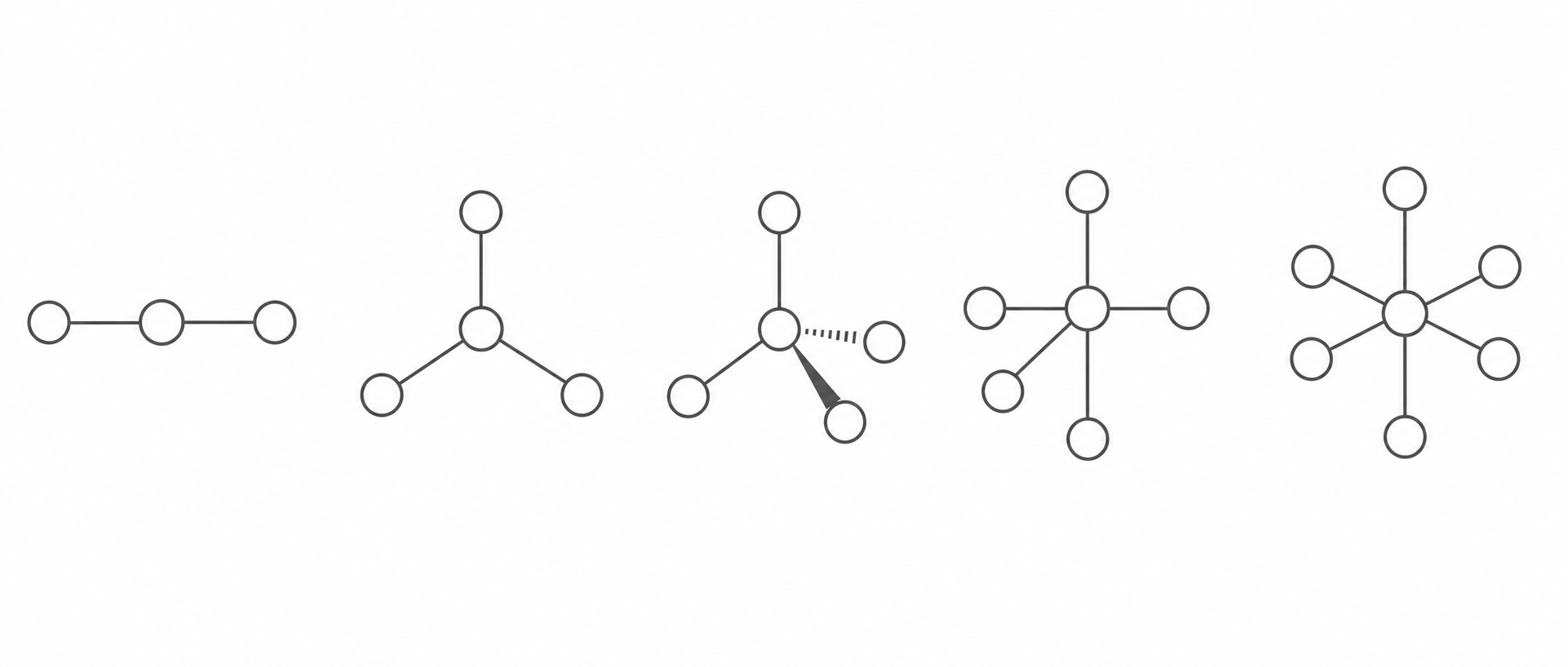
| Electron domains around central atom | Example in this lesson range | Shape | Main bond angles | Reasoning |
|---|---|---|---|---|
| 2 | BeCl2, CO2 | Linear | 180 degrees | Two regions get furthest apart by sitting opposite each other |
| 3 | BCl3 | Trigonal planar | 120 degrees | Three regions spread equally in one plane |
| 4 | CH4, NH4+ | Tetrahedral | 109.5 degrees | Four regions spread equally in three dimensions |
| 5 | PCl5(g) | Trigonal bipyramidal | 90 and 120 degrees; 180 degrees between opposite axial bonds | Three equatorial bonds form a trigonal plane; two axial bonds sit above and below it |
| 6 | SF6(g) | Octahedral | 90 degrees; 180 degrees between opposite bonds | Four bonds form a square plane; two bonds sit above and below it |
Notice two Pearson-sensitive details in that table.
First, NH4+ is tetrahedral. In formation, a lone pair on NH3 can be donated to H+, but once the N-H bond has formed it behaves as an ordinary covalent bond for shape. Around N in NH4+ there are four bonding pairs and no lone pairs.
Second, PCl5 is specified as PCl5(g). The gaseous molecule has trigonal bipyramidal molecules. Solid phosphorus(V) chloride has ionic character and is outside the shape claim being made here.
Worked example: explaining the shape of NH4+
Question: Predict the shape and bond angle of NH4+.
Route:
- The central atom is nitrogen.
- There are four N-H bonds around nitrogen.
- There are no lone pairs on nitrogen in NH4+.
- Four bonding pairs repel equally and arrange tetrahedrally.
Answer: NH4+ is tetrahedral with H-N-H bond angles of about 109.5 degrees. The positive charge does not make the ion flat or pyramidal; the shape follows the four bonding pairs around nitrogen.
How Lone Pairs Change Bond Angles
Lone pairs repel more strongly than bonding pairs. A useful order is:
Lone pair-lone pair repulsion > lone pair-bonding pair repulsion > bonding pair-bonding pair repulsion.
This happens because a bonding pair is attracted by two nuclei, while a lone pair is held mainly near the central atom. The lone pair occupies more space around the central atom, so it pushes bonding pairs closer together. The shape name changes because lone pairs are counted for repulsion but not named as atoms in the molecular shape.
The classic four-pair sequence is the one Edexcel students use constantly.
| Species | Pairs around central atom | Electron-pair arrangement | Molecular shape | Bond angle |
|---|---|---|---|---|
| CH4 | 4 bonding pairs, 0 lone pairs | Tetrahedral | Tetrahedral | 109.5 degrees |
| NH3 | 3 bonding pairs, 1 lone pair | Tetrahedral | Trigonal pyramidal | About 107 degrees |
| H2O | 2 bonding pairs, 2 lone pairs | Tetrahedral | Bent or non-linear | About 104.5 degrees |
The sequence is not "one lone pair removes one atom from the name" in a mechanical way. The reason is still repulsion. NH3 has one lone pair, so the three N-H bonding pairs are pushed slightly closer together than in CH4. H2O has two lone pairs, so the two O-H bonding pairs are pushed even closer together.
The same logic works from other electron-pair arrangements.
| Total electron domains | Lone-pair pattern | Shape examples you may meet | Angle idea |
|---|---|---|---|
| 3 | 2 bonding regions, 1 lone pair | Bent, for example SO2-style molecules | Slightly less than 120 degrees |
| 5 | 4 bonding pairs, 1 lone pair | Seesaw | Angles are compressed from 90 and 120 degrees |
| 5 | 3 bonding pairs, 2 lone pairs | T-shaped | About 90 and 180 degrees, usually slightly compressed |
| 5 | 2 bonding pairs, 3 lone pairs | Linear | 180 degrees |
| 6 | 5 bonding pairs, 1 lone pair | Square pyramidal | Close to 90 degrees, slightly compressed |
| 6 | 4 bonding pairs, 2 lone pairs | Square planar | 90 and 180 degrees |
For five electron domains, lone pairs prefer equatorial positions in a trigonal bipyramidal arrangement. An equatorial lone pair has fewer 90-degree interactions than an axial lone pair, so it gives lower repulsion. You usually do not need exact experimental angles for these extension shapes; you do need the reasoning direction: lone pairs occupy space and compress nearby bond angles.
Common-error contrast
Weak answer: "NH3 is 107 degrees because it has three hydrogens."
Stronger answer: "NH3 has four electron pairs around nitrogen: three bonding pairs and one lone pair. The electron pairs arrange approximately tetrahedrally, but the lone pair repels bonding pairs more strongly, so the H-N-H angle is compressed from 109.5 degrees to about 107 degrees."
A Reliable Prediction Method
For unfamiliar molecules and ions, use a route rather than memory. Pearson questions often ask students to predict the shape of a related species, so the working must show how the shape follows from the electron pairs.
Use this five-step method.
- Choose the central atom. It is usually the atom that can make the most bonds; hydrogen is not central.
- Draw enough of a dot-and-cross or structural diagram to know what is bonded to the central atom.
- Count bonding regions and lone pairs around the central atom. Remember that a double or triple bond counts as one direction of electron density for the shape.
- Use the total number of electron domains to choose the electron-pair arrangement.
- Name the molecular shape from the atoms only, then give the bond angle and any lone-pair compression.
Worked example 1: PF3
Predict the shape and bond angle in PF3.
Phosphorus is the central atom. Phosphorus has five outer-shell electrons and forms three P-F single bonds. That leaves one lone pair on phosphorus, so there are four electron pairs around the central atom: three bonding pairs and one lone pair.
Four electron pairs arrange approximately tetrahedrally. The molecular shape is trigonal pyramidal because only the three P-F bonds are visible in the shape. The F-P-F angle is less than 109.5 degrees because the lone pair repels bonding pairs more strongly than bonding pairs repel each other.
Worked example 2: SO2
Predict the shape around sulfur in SO2 using electron-domain reasoning.
Sulfur is the central atom. The simplest shape model has two S-O bonding regions and one lone pair around sulfur. Three electron domains arrange trigonal planar, but only two bonded atoms are attached to sulfur. The molecular shape is bent, with an O-S-O angle slightly less than 120 degrees because the lone pair compresses the angle between the bonding regions.
This example is a good place to avoid overcounting a double bond. Each S=O direction is one bonding region for the gross shape, even though the bonding description is more detailed than a single shared pair.
Organic transfer
Simple organic molecules use the same rules.
| Organic site | Electron domains around that atom | Local shape | Typical angle |
|---|---|---|---|
| Carbon in CH3CH3 | 4 bonding regions | Tetrahedral | About 109.5 degrees |
| Each carbon in CH2=CH2 | 3 bonding regions | Trigonal planar | About 120 degrees |
| Each carbon in HCCH | 2 bonding regions | Linear | 180 degrees |
| Oxygen in an alcohol, R-O-H | 2 bonding pairs and 2 lone pairs | Bent around oxygen | About 104.5 degrees as a simple VSEPR comparison |
The organic molecule may be larger, but the shape prediction is local: choose one central atom and count electron domains around that atom.
Writing Pearson-Ready Explanations
A strong shape answer is usually short, but it must contain the reasoning chain. The safest sentence pattern is:
central atom pair count -> repulsion arrangement -> molecular shape -> bond angle -> lone-pair effect if present.
Worked Pearson-style explanation: H2O
Prompt: Explain the shape and bond angle in H2O.
Model answer: Oxygen has two bonding pairs and two lone pairs in its outer shell. The four electron pairs repel and arrange approximately tetrahedrally around oxygen. The molecular shape is bent because only the two O-H bonds are part of the visible shape. The H-O-H angle is about 104.5 degrees because two lone pairs repel the bonding pairs more strongly and compress the angle from 109.5 degrees.
That answer earns marks because it does not merely state "water is bent"; it gives the electron-pair reason and the angle change.
Worked Pearson-style explanation: PCl5(g)
Prompt: State the shape and bond angles of PCl5(g).
Model answer: PCl5(g) has five bonding pairs and no lone pairs around phosphorus. The five bonding pairs repel to give a trigonal bipyramidal shape. The equatorial Cl-P-Cl angles are 120 degrees, axial-to-equatorial angles are 90 degrees, and the two axial bonds are 180 degrees apart.
The state symbol matters here because the simple molecular shape is for gaseous PCl5.
Worked Pearson-style explanation: SF6
Prompt: Predict the shape and bond angles in SF6.
Model answer: Sulfur has six S-F bonding pairs and no lone pairs around the central atom. Six bonding pairs repel to an octahedral arrangement. Adjacent F-S-F angles are 90 degrees and opposite F-S-F angles are 180 degrees.
What To Carry Forward
Molecular shape is a model built from electron-pair repulsion, not a list of names. Count the electron domains around the central atom, arrange them to minimise repulsion, name the shape from the atom positions, then adjust the angle when lone pairs are present.
For Edexcel 9CH0, the named examples you should be fluent with are BeCl2 and CO2 as linear, BCl3 as trigonal planar, CH4 and NH4+ as tetrahedral, NH3 as trigonal pyramidal, H2O as bent, PCl5(g) as trigonal bipyramidal, and SF6 as octahedral. You should also be able to transfer the same reasoning to simple related molecules, ions and organic sites.
The next lesson uses this three-dimensional shape idea to decide whether bond dipoles cancel or produce a polar molecule. Do not jump there too early: first make the shape and bond-angle reasoning solid.