2A.7-2A.9 - Covalent Bonding And Dot Cross Diagrams
This lesson covers Pearson Edexcel 9CH0 spec points 2A.7, 2A.8 and 2A.9: the meaning of a covalent bond, dot-and-cross diagrams for covalent substances including dative covalent bonding, and the relationship between covalent bond length and bond strength. It deliberately stops before 2A.10-2A.12, so molecular shapes and bond angles are left for the next lesson. The aim is to make electron-pair diagrams mark-earning: every dot or cross should account for an outer electron, and every strength statement should link to attraction between nuclei and electrons.
The Attraction In A Covalent Bond
Hydrogen chloride is a useful starting problem. Hydrogen has one outer electron and chlorine has seven, but the product is not made of H+ and Cl- ions in the way sodium chloride is made of Na+ and Cl- ions. Instead, H and Cl share one pair of electrons.
A covalent bond is the strong electrostatic attraction between two nuclei and the shared pair of electrons between them. The shared pair is negative, so it is attracted to both positive nuclei. This is why "a covalent bond is sharing electrons" is only a starting phrase; the full A-level definition must include the electrostatic attraction.
[DIAGRAM: asset_name: Covalent Bond Attraction; asset_slug: edexcel_a_level_chemistry_l009_covalent_bond_attraction; recommended_method: image_gen; description: Monochrome schematic showing two nuclei attracted to one shared pair of electrons in a covalent bond.]
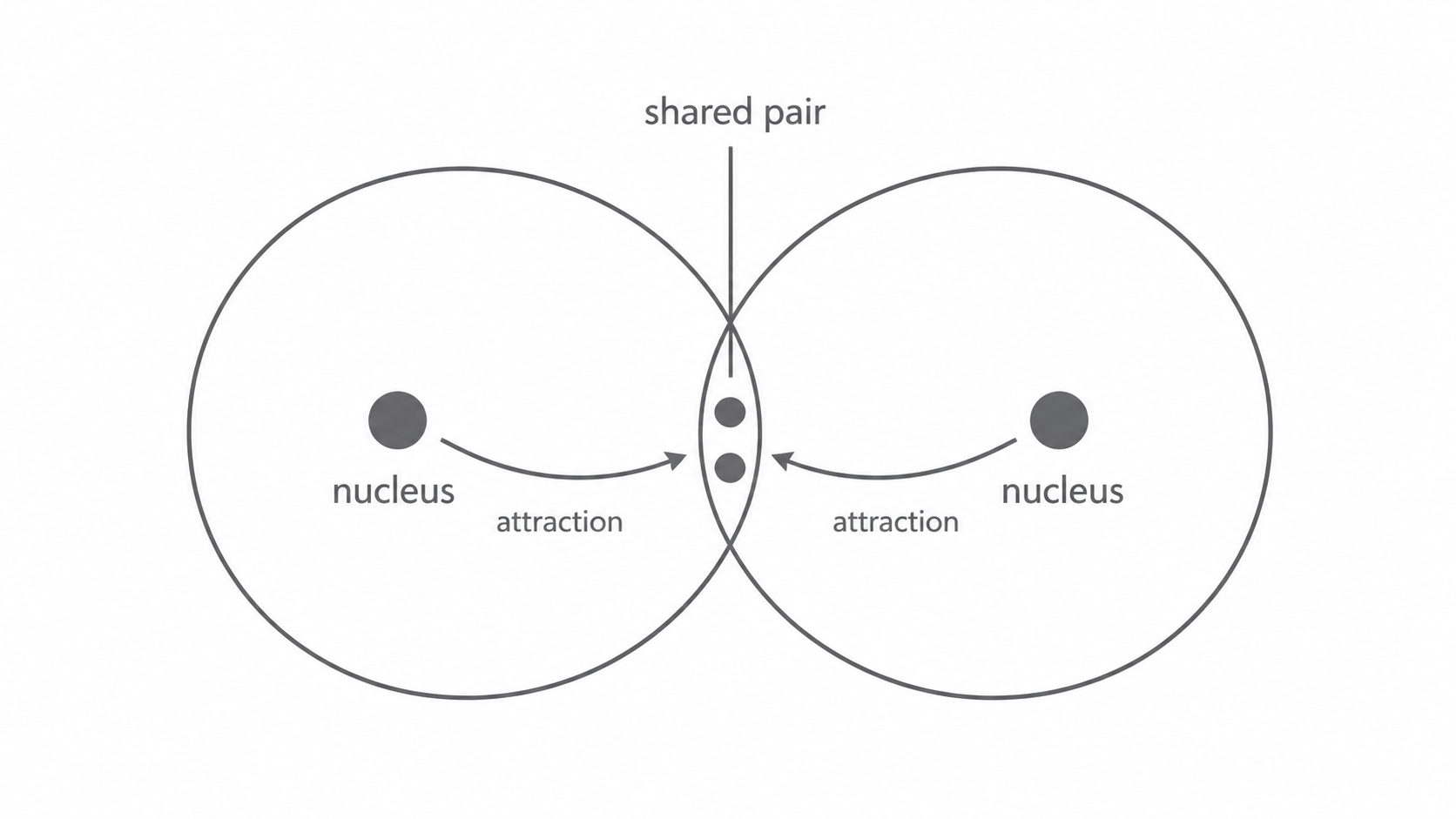
Think of the shared pair as the region of electron density that holds the two nuclei together. If the pair were not attracted to both nuclei, there would be no bonding reason for the atoms to stay close. If the nuclei came too close, nucleus-nucleus repulsion and electron-electron repulsion would rise, so a bond length is a balance point between attractions and repulsions.
Worked example: explain the covalent bond in H2. Each hydrogen atom contributes one electron. The two electrons become one shared pair. That pair is attracted to both hydrogen nuclei, so one H-H covalent bond is formed. The dot-and-cross diagram can use one dot and one cross in the shared pair, but the dot and cross are not different kinds of electron.
A Dot-And-Cross Drawing Routine
Dot-and-cross diagrams are electron-accounting diagrams. They usually show only outer-shell electrons. One symbol tracks electrons from one atom and the other symbol tracks electrons from the other atom; the symbols do not mean different charges, different masses, or stronger and weaker electrons.
Use this routine for a covalent molecule:
- Count the outer electrons for each atom: H has 1, C has 4, N has 5, O has 6 and halogens have 7.
- Place one electron from each atom into each ordinary shared pair.
- Use one shared pair for a single bond, two shared pairs for a double bond and three shared pairs for a triple bond.
- Add remaining outer electrons as lone pairs on the correct atoms.
- Check the outer shell: hydrogen needs 2 electrons; period 2 atoms such as C, N and O usually reach 8 electrons in simple molecules.
[DIAGRAM: asset_name: Single Double Triple Dot Cross; asset_slug: edexcel_a_level_chemistry_l009_single_double_triple_dot_cross; recommended_method: deterministic_chart; description: Dot-and-cross gallery showing H2 with one shared pair, O2 with two shared pairs and two lone pairs on each oxygen, and N2 with three shared pairs and one lone pair on each nitrogen.]
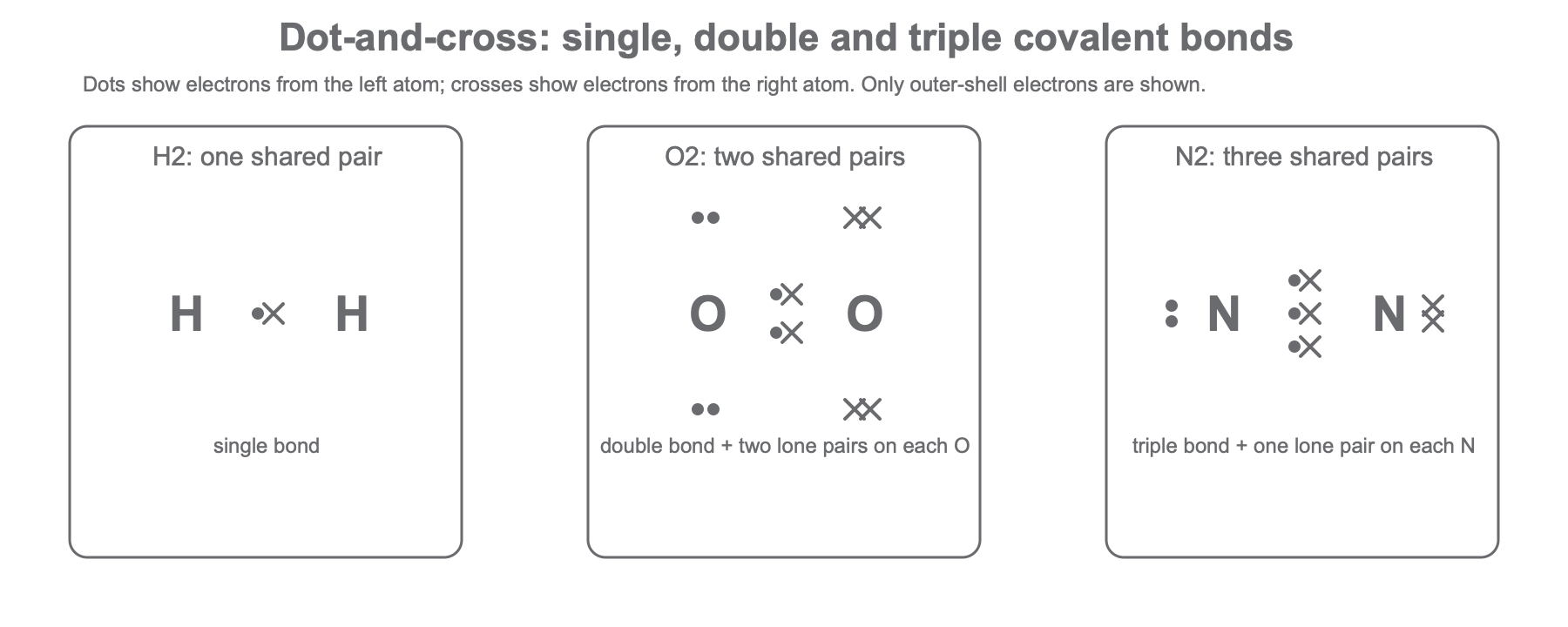
Worked example: draw CO2. Carbon has 4 outer electrons and each oxygen has 6, so the molecule has 16 outer electrons in total. If carbon made only one shared pair with each oxygen, carbon would have only 4 electrons around it and each oxygen would still need another electron. The stable dot-and-cross diagram has O=C=O: carbon shares two pairs with the left oxygen and two pairs with the right oxygen, and each oxygen keeps two lone pairs.
Common error contrast: do not put brackets and charges around neutral molecules such as O2, N2 or CO2. Brackets and charges belong when the whole species is an ion, such as NH4+. In a neutral covalent molecule, the diagram shows shared pairs and lone pairs, not electron transfer to make ions.
Dative Covalent Bonds
A dative covalent bond, also called a coordinate bond, is still a covalent bond: it is a shared pair of electrons attracted to two nuclei. The special feature is how the bond forms. Both electrons in the shared pair are donated by the same atom or ion.
The ammonium ion shows the idea cleanly. Ammonia, NH3, has a lone pair on nitrogen. A hydrogen ion, H+, has no electron to contribute, so nitrogen donates both electrons from its lone pair to form the fourth N-H bond. In a dot-and-cross diagram for NH4+, one N-H shared pair can be shown as two electrons from nitrogen, and the whole ion is placed in brackets with a single positive charge.
[DIAGRAM: asset_name: Dative Bonding Examples; asset_slug: edexcel_a_level_chemistry_l009_dative_bonding_examples; recommended_method: deterministic_chart; description: Monochrome dative bonding schematic showing NH4+ with one donated nitrogen pair and Al2Cl6 with chloride bridge donations to aluminium.]
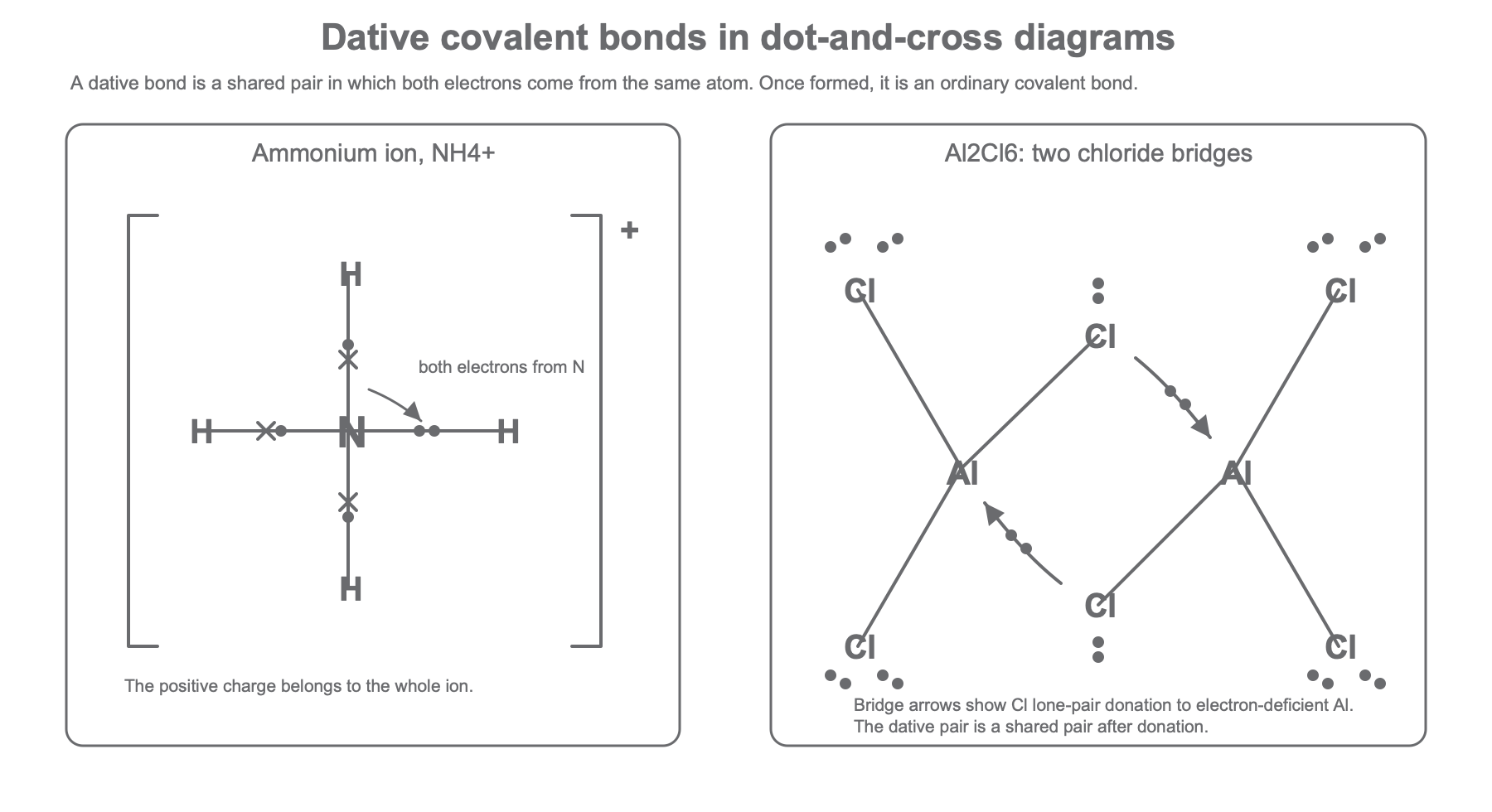
Al2Cl6 is the required aluminium chloride example. Aluminium chloride can be thought of from electron deficiency: in AlCl3, aluminium has only six electrons around it from three Al-Cl bonds. Two AlCl3 units join when a chlorine atom on each unit donates a lone pair to the aluminium atom on the other unit, making two chloride bridges. In a full dot-and-cross answer, each dative bridge must show a pair donated from chlorine to aluminium, and the remaining lone pairs on chlorine atoms must still be accounted for.
Once a dative covalent bond has formed, it is not a weaker or different category of attraction. It is an ordinary covalent bond in the final species. The dot-and-cross diagram remembers electron origin; the bonding model is still attraction between a shared pair and two nuclei.
Bond Length And Bond Strength
Bond length is the distance between the nuclei of two bonded atoms. Bond strength describes how much energy is needed to break that covalent bond, often discussed through bond enthalpy later in the course. For covalent bonds, shorter bonds are generally stronger because the shared electron density is held closer between the two nuclei, giving a stronger attraction.
For the same pair of elements, increasing the number of shared pairs usually shortens and strengthens the bond:
| Bond type | Shared pairs | Relative bond length | Relative bond strength |
|---|---|---|---|
| single bond | 1 | longest | weakest |
| double bond | 2 | shorter | stronger |
| triple bond | 3 | shortest | strongest |
This is not a licence to compare any two unrelated bonds by length alone. Atomic size also matters. A Cl-Cl bond is longer than an H-H bond partly because chlorine atoms are larger, not simply because the bond is "weaker in the same way". The clean Edexcel reasoning is: within a sensible comparison, a shorter covalent bond has stronger attraction and is harder to break.
Worked example: compare C-C, C=C and a carbon-carbon triple bond. The triple bond has three shared pairs, so there is more electron density between the carbon nuclei. The nuclei are held closer together, so the bond is shorter and stronger than C=C, which is shorter and stronger than C-C.
Pearson Drawing Standard
When Pearson asks you to draw a dot-and-cross diagram, the drawing is not judged by artistic style. It is judged by electron accounting. The marker needs to see the right atoms, the right number of shared pairs, the right number of lone pairs where relevant, and the correct charge if the species is an ion.
For a molecule with single, double or triple bonds, make the bond order visible as shared pairs, not just as one, two or three lines. Lines can help structure the drawing, but the dots and crosses earn the electron-accounting credit. For a dative species, make the donated pair visible by using the same symbol twice in the relevant shared pair or by using a clear arrow from the donor lone pair to the acceptor atom when the question allows it.
Use this final checking routine:
- Count total outer electrons before drawing.
- Count the electrons shown after drawing.
- Check each bond: one pair for single, two for double, three for triple.
- Check any dative bond: both electrons in that shared pair come from the donor.
- Check charge: neutral molecules have no whole-species charge; ions such as NH4+ need brackets and the charge.
Pearson-style recap: 2A.7 is the definition of the bond, 2A.8 is the diagram skill, and 2A.9 is the strength-length relationship. The same model links all three: a covalent bond is a shared electron pair attracted to two nuclei; dot-and-cross diagrams show where those electron pairs are; shorter covalent bonds are usually stronger because the attraction is stronger.