1.11-1.14 - First And Successive Ionisation Energies
This lesson covers Edexcel 9CH0 specification points 1.11 to 1.14: defining first and successive ionisation energies, explaining the factors that affect them, and using those factors to explain first ionisation energy trends across a period and down a group. It deliberately leaves the fuller "evidence for shells and sub-shells from ionisation-energy plots" to the next lesson, although we will use one successive-energy graph as a bridge. The reason this matters is that Pearson explanations reward a chain of electrostatic reasoning, not just the words "shielding" or "nuclear charge".
What Ionisation Energy Measures
Ionisation energy is about the work needed to separate a negatively charged electron from the attraction of a positively charged nucleus. The first careful habit is to define the process, not just the idea.
The first ionisation energy of an element is the energy required to remove one electron from each atom in one mole of gaseous atoms, forming one mole of gaseous 1+ ions.
For a general element M:
M(g) -> M+(g) + e-
The state symbol (g) matters because ionisation energy is defined for isolated gaseous atoms, not for atoms inside a solid metal, a molecule, or an aqueous ion. The unit is usually kJ mol^-1, because the definition refers to one mole of atoms.
Successive ionisation energies are the energies needed to remove electrons one after another from the same element's gaseous atoms or ions:
First:   M(g)    -> M+(g)  + e-
Second:  M+(g)   -> M2+(g) + e-
Third:   M2+(g)  -> M3+(g) + e-
Every successive ionisation energy is endothermic. Energy must be supplied because an electron is being pulled away from attraction to the nucleus.
Worked example: write the first and second ionisation energy equations for calcium.
First ionisation energy:   Ca(g)  -> Ca+(g)  + e-
Second ionisation energy:  Ca+(g) -> Ca2+(g) + e-
The second equation starts with Ca+(g), not Ca(g), because the first electron has already been removed.
Why Electrons Are Held More Tightly
Ionisation energy is controlled by the strength of attraction between the nucleus and the electron being removed. Four ideas decide that attraction.
Number of protons: more protons means a greater positive nuclear charge, so the outer electron is attracted more strongly.
Distance from the nucleus: an electron farther from the nucleus is less strongly attracted.
Electron shielding: inner-shell electrons repel outer-shell electrons and reduce the attraction felt by the electron being removed. Shielding does not remove the nuclear charge; it weakens the effective pull on the outer electron.
Sub-shell of the electron removed: electrons in different sub-shells within the same main shell are not held equally strongly. At this stage, the key example is that a 3p electron is generally easier to remove than a 3s electron from a similar atom, and paired p electrons can repel each other enough to make one easier to remove.
The model becomes especially useful when comparing successive ionisation energies. The second ionisation energy of an element is always larger than the first because the second electron is removed from a positive ion. The nucleus has not gained protons, but the remaining electrons are being held by an ion with a greater overall positive charge and usually less electron-electron repulsion.
Worked example: explain why the second ionisation energy of magnesium is greater than its first.
First, name the process:
Mg(g)  -> Mg+(g)  + e-
Mg+(g) -> Mg2+(g) + e-
The second electron is removed from Mg+(g), so it is being removed from a positively charged ion. The remaining electrons are attracted more strongly to the nucleus than in the neutral atom. More energy is therefore required to remove the second electron.
Across A Period
Across a period, the first ionisation energy generally increases. The mark-earning explanation is a comparison of nuclear charge, shielding, distance, and sub-shell.
[DIAGRAM: asset_name: Period3 First Ionisation Energy; asset_slug: edexcel_a_level_chemistry_l004_period3_first_ionisation_energy; recommended_method: matplotlib; description: Line graph of first ionisation energy across Period 3, showing an overall increase from sodium to argon with dips at aluminium and sulfur.]
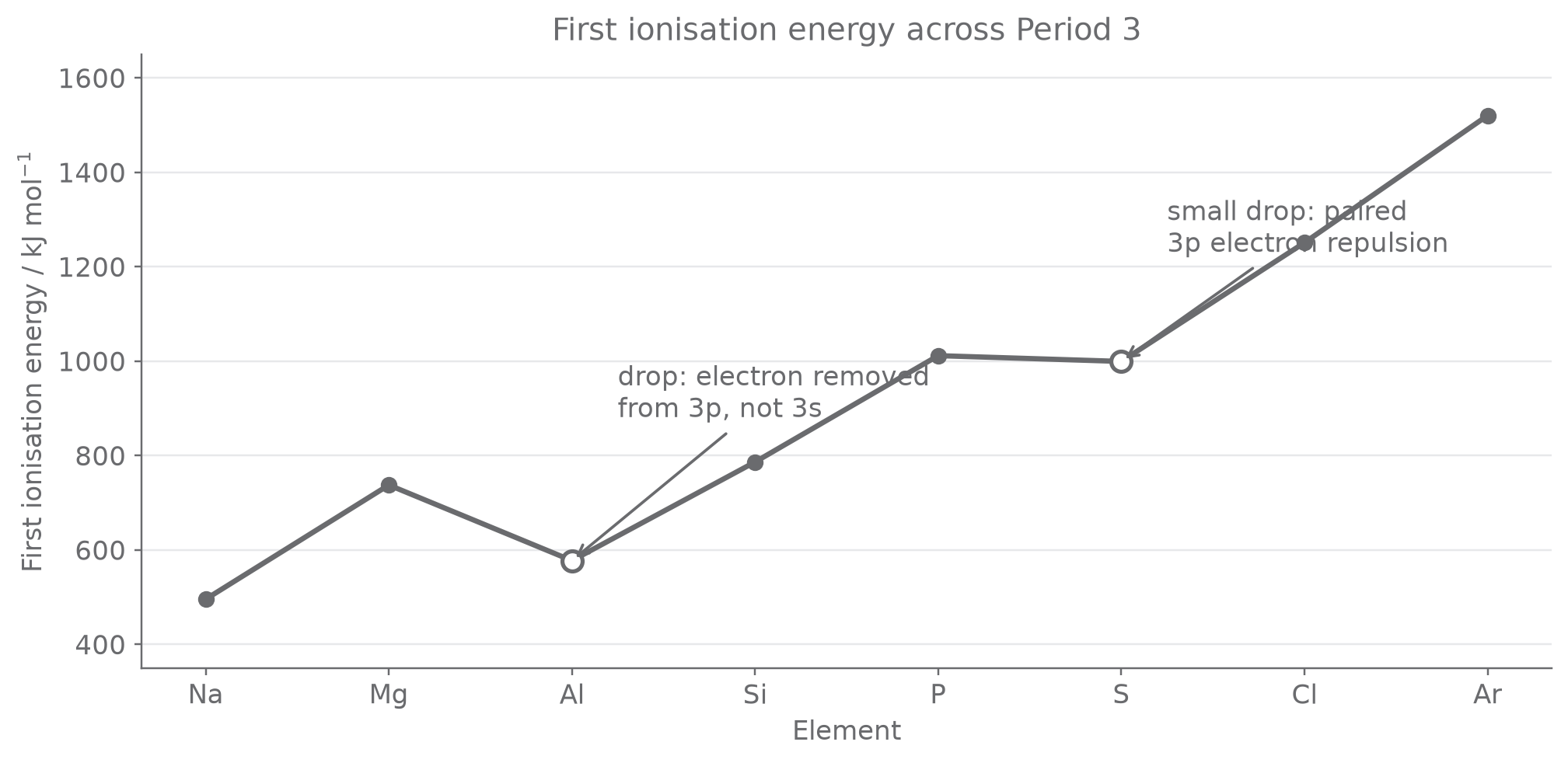
From left to right across a period, proton number increases. Electrons are added to the same main shell, so shielding does not increase much. The outer electron is attracted more strongly and the atomic radius generally decreases, so more energy is needed to remove the first electron.
That gives the overall trend, but Edexcel can also expect students to handle local exceptions when data are supplied.
In Period 3, magnesium has a higher first ionisation energy than aluminium even though aluminium has more protons. The electron removed from aluminium is in a 3p sub-shell, while the electron removed from magnesium is from a 3s sub-shell. The 3p electron is easier to remove, so aluminium's first ionisation energy is lower.
Phosphorus has a slightly higher first ionisation energy than sulfur. In sulfur, the electron removed is paired in a 3p orbital, so there is extra repulsion between the paired electrons. That repulsion makes it slightly easier to remove one of them.
Worked example: explain why silicon has a higher first ionisation energy than aluminium.
Both aluminium and silicon remove an outer electron from the third shell, so the shielding is similar. Silicon has one more proton than aluminium, giving a stronger attraction between the nucleus and the outer electron. Its first ionisation energy is therefore higher.
A Pearson-style explanation should not simply say "silicon is further across the period". It should translate that position into proton number, shielding, attraction, and energy.
Down A Group
Down a group, the first ionisation energy decreases. This is one of the places where "more protons" alone gives the wrong prediction unless it is weighed against distance and shielding.
[DIAGRAM: asset_name: Group1 Down First Ionisation Energy; asset_slug: edexcel_a_level_chemistry_l004_group1_down_first_ionisation_energy; recommended_method: matplotlib; description: Line graph of first ionisation energy down Group 1 from lithium to caesium, showing a decrease as atoms get larger and more shielded.]
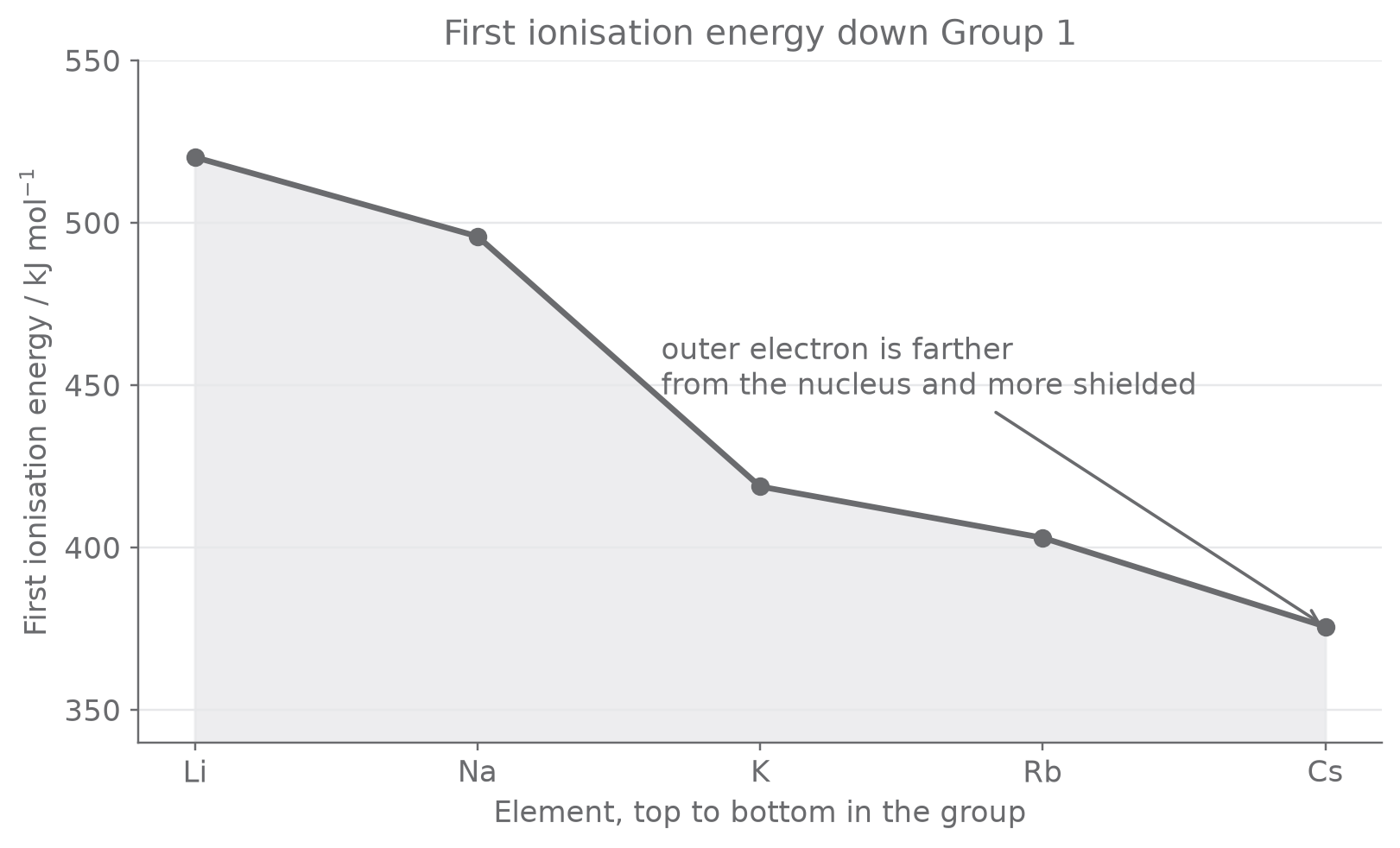
Going down a group, each element has an extra occupied electron shell. The outer electron is farther from the nucleus and is more shielded by inner electrons. Although the nucleus has more protons, the increased distance and shielding outweigh the higher nuclear charge, so the outer electron is removed more easily.
Worked example: explain why potassium has a lower first ionisation energy than sodium.
Potassium's outer electron is in a shell farther from the nucleus than sodium's outer electron. Potassium also has more inner shells, so the outer electron is more shielded. These effects outweigh potassium's greater nuclear charge, so less energy is needed to remove the outer electron from potassium.
Notice the wording: "outweigh" is useful because it shows you have considered both sides of the comparison. Down a group, the increased nuclear charge is real, but it is not the dominant effect for first ionisation energy.
Reading Successive Values Carefully
Successive ionisation energies usually rise as electrons are removed. That is not because new protons appear; it is because each next electron is being removed from an increasingly positive ion.
[DIAGRAM: asset_name: Mg Successive Ionisation Energies; asset_slug: edexcel_a_level_chemistry_l004_mg_successive_ionisation_energies; recommended_method: matplotlib; description: Log-scale line graph of the first twelve successive ionisation energies of magnesium, showing large rises after the second and tenth electrons are removed.]
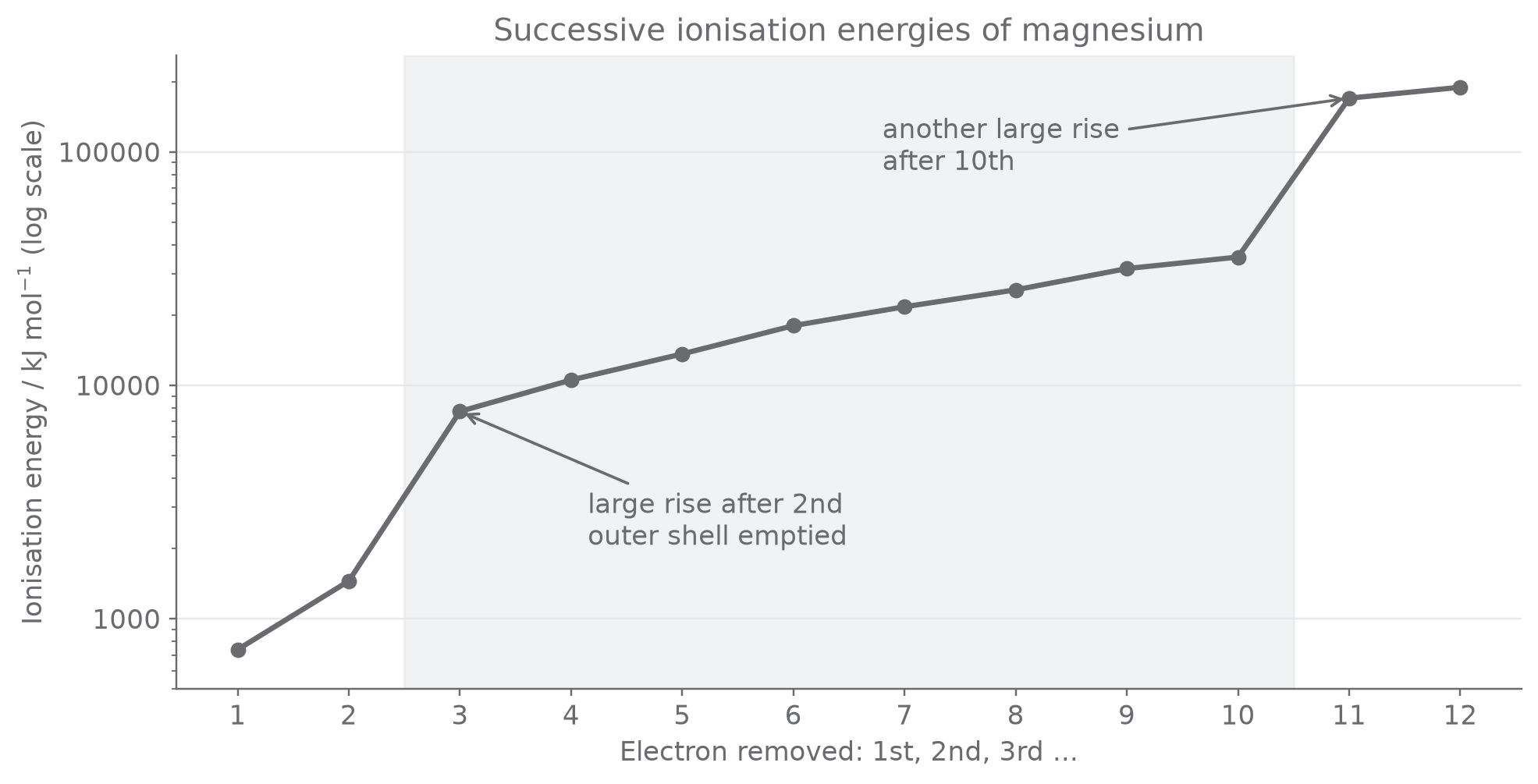
The magnesium graph uses a log scale because the values become very large. This is useful for seeing pattern without letting the largest values squash the smaller ones near the bottom of the graph.
For magnesium, the first two electrons are removed much more easily than the third. After two electrons have been removed, the next electron would come from an inner shell that is closer to the nucleus and much less shielded. A much larger amount of energy is therefore required.
This lesson only needs the careful language of successive ionisation energies and the factors affecting them. The next lesson uses patterns like these more formally as evidence for shells, sub-shells, and the group an element belongs to.
Worked example: calculate the energy needed to form one mole of Mg2+(g) ions from one mole of Mg(g) atoms, using the first two ionisation energies in the graph.
The process requires two electron removals:
Mg(g)  -> Mg+(g)  + e-     737.75 kJ mol^-1
Mg+(g) -> Mg2+(g) + e-    1450.68 kJ mol^-1
Add the two energies:
737.75 + 1450.68 = 2188.43 kJ mol^-1
So the energy required is 2188.43 kJ mol^-1, usually rounded sensibly to 2188 kJ mol^-1 or 2.19 x 10^3 kJ mol^-1 depending on the data precision requested. Chemically, that total is large and positive because both steps remove electrons against attraction to the nucleus.
Pearson-style recap: define ionisation energies with gaseous atoms or ions and correct charges; explain trends by linking nuclear charge, shielding, distance, and sub-shell; and when using successive values, say which ion the electron is being removed from.