2A.13-2A.15 - Electronegativity, Bond Polarity And Molecular Polarity
This lesson explains how electronegativity makes covalent bonds polar, why ionic and covalent bonding are better treated as extremes of a continuum, and how to decide whether a whole molecule is polar. It uses the molecular-shape ideas from lesson 010 only as a prerequisite for dipole cancellation, and it stops before the intermolecular-force consequences taught in lesson 012. This matters in Pearson Edexcel 9CH0 because polarity questions often reward the reasoning chain: electronegativity difference -> bond dipoles -> molecular shape -> net molecular dipole.
The Problem: Polar Bonds Do Not Always Make Polar Molecules
Suppose two molecules both contain polar bonds. One is bent, like H2O. Another is linear, like CO2. It is tempting to say both molecules must be polar because both contain bonds between atoms with different electronegativities, but that skips the spatial step.
In this lesson, keep two levels separate:
- Bond polarity is about one covalent bond and how its bonding electrons are shared.
- Molecular polarity is about the whole molecule and whether all the bond dipoles cancel.
The exam-relevant trap is simple: a molecule can contain polar bonds and still be non-polar overall. Pearson questions often test this by giving a familiar shape, asking for a prediction, and expecting the answer to use both electronegativity and shape.
Quick contrast
Cl2 has a non-polar covalent bond because the two atoms are identical, so they attract the bonding electrons equally. HCl has a polar covalent bond because chlorine attracts the bonding pair more strongly than hydrogen. CO2 has two polar C=O bonds, but the molecule is linear, so the two equal bond dipoles act in opposite directions and cancel.
Electronegativity And Bond Dipoles
Electronegativity is the ability of an atom to attract the bonding electrons in a covalent bond. The definition is deliberately about a bonded atom, not an isolated atom. It asks: once a shared pair exists between two atoms, which atom pulls that pair more strongly?
The Edexcel Data Booklet gives Pauling electronegativities. Useful values for this lesson include H 2.1, C 2.5, N 3.0, O 3.5, F 4.0, and Cl 3.0. Larger values mean a stronger attraction for bonding electrons.
When two bonded atoms have different electronegativities, the bonding electrons are not shared equally:
- the more electronegative atom becomes partially negative, written delta-;
- the less electronegative atom becomes partially positive, written delta+;
- the bond has a bond dipole, pointing towards the more electronegative atom.
For H-Cl, chlorine is more electronegative than hydrogen, so the bonding pair is pulled closer to chlorine. Hydrogen is the delta+ end and chlorine is the delta- end. The dipole is commonly shown with the cross at the positive end and the arrow head towards the negative end.
Worked example: decide the direction of a bond dipole
Question: Use Pauling electronegativities to decide the polarity of the C-F bond.
Route:
- Identify the bonded atoms: C and F.
- Read or recall the electronegativities: C = 2.5 and F = 4.0.
- Compare them: F has the larger value.
- Assign partial charges: C is delta+ and F is delta-.
- Draw or describe the dipole: C(delta+) -> F(delta-), with the arrow head towards F.
Chemical interpretation: the bond is polar covalent because the electrons are still shared, but the sharing is unequal.
Guided practice
For each bond, identify the delta- atom.
- N-H
- C-O
- C-H
Expected answers: N is delta- in N-H; O is delta- in C-O; C is slightly delta- in C-H because C 2.5 is higher than H 2.1. The C-H bond is only weakly polar, so do not exaggerate its effect unless the molecular context requires it.
Feynman diagnostic
Explain to a younger student why "chlorine is negative in HCl" is too loose. The better explanation is that chlorine is partially negative in the covalent H-Cl bond because it attracts the shared bonding pair more strongly. HCl is not made of H+ and Cl- ions in the same way as an ionic lattice.
Ionic And Covalent Are Extremes Of A Continuum
Bonding type is not a set of perfectly separate boxes. Ionic bonding and covalent bonding are useful extremes, and many real bonds sit between them. Edexcel explicitly treats them as a continuum because electronegativity difference changes gradually, not by a magic step.
[DIAGRAM: asset_name: Bonding Continuum; asset_slug: edexcel_a_level_chemistry_l011_bonding_continuum; recommended_method: image_gen; description: A monochrome continuum showing equal sharing, polar covalent unequal sharing, and an ionic extreme as electronegativity difference increases, with no fixed boundary.]
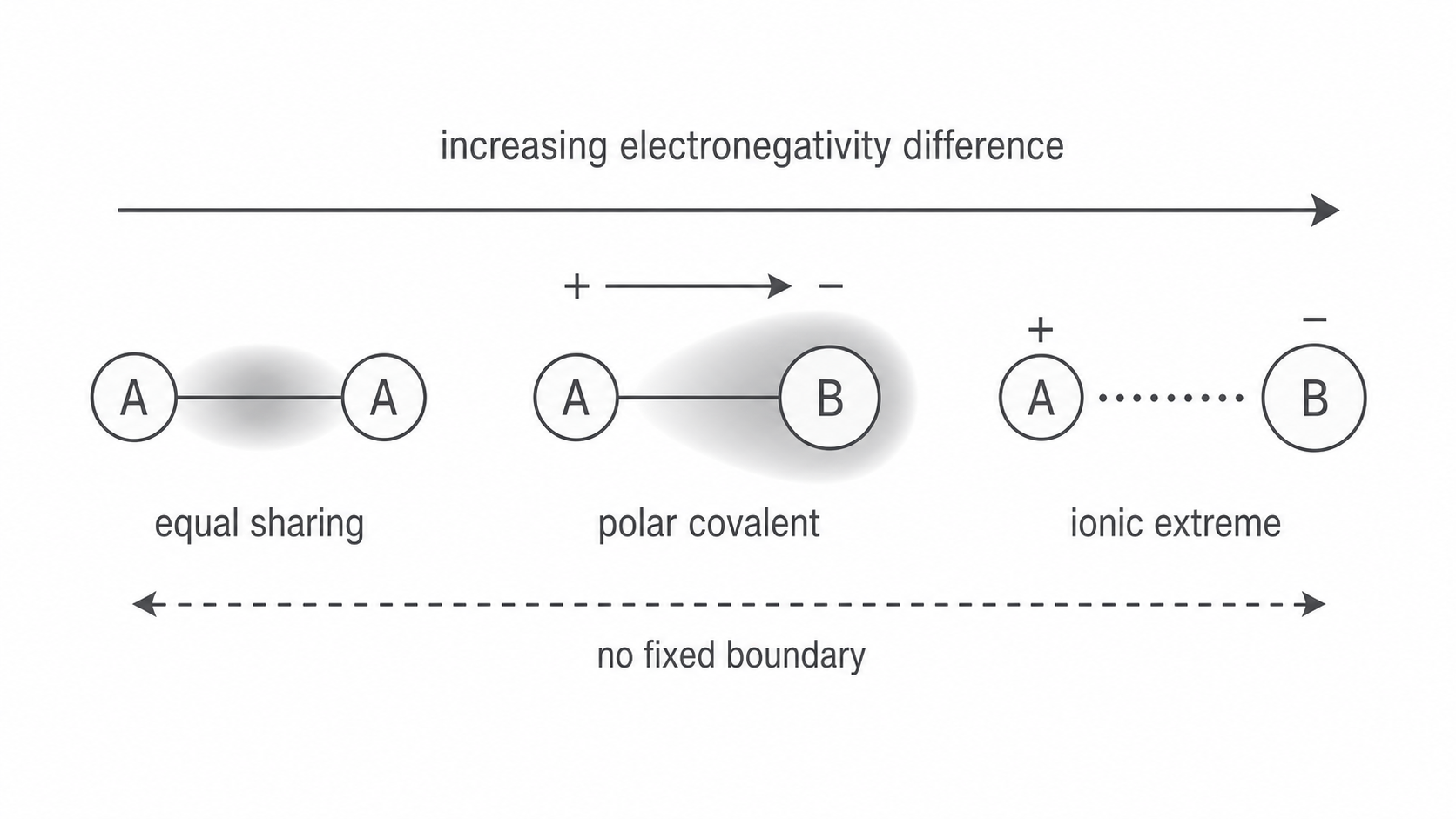
At one extreme, identical atoms such as Cl-Cl have no electronegativity difference, so the bonding electrons are shared equally. In the middle, bonds such as H-Cl or C-F have unequal sharing and are polar covalent. At the other extreme, a very large electronegativity difference favours electron transfer and ionic bonding, as in a metal-non-metal ionic compound.
Avoid learning a hard numeric cut-off for "ionic" versus "covalent" in this specification. The useful reasoning is comparative: as electronegativity difference increases, the bond becomes more polar and has more ionic character. The exact structure also depends on the elements and the chemical context.
Worked example: use the continuum without a cut-off
Question: Compare the bonding in Cl2, HCl, and NaCl using electronegativity.
Route:
- Cl2: both atoms are chlorine, so the electronegativity difference is zero. The bond is non-polar covalent.
- HCl: Cl is more electronegative than H, so the bonding pair is pulled towards Cl. The bond is polar covalent.
- NaCl: Na has a much lower electronegativity than Cl, so the bonding is best described as ionic, with strong electrostatic attraction between oppositely charged ions in a lattice.
Chemical interpretation: these examples do not create three unrelated definitions. They show movement along the same idea: increasing inequality in attraction for electrons.
From Bond Dipoles To Molecular Polarity
To predict whether a molecule is polar, use a two-stage test.
- Are there polar bonds? Use electronegativity differences.
- Do the bond dipoles cancel? Use the molecular shape from electron-pair repulsion theory.
The second stage is why lesson 010 matters here. Molecules are three-dimensional, so bond dipoles are vectors: they have size and direction. Equal dipoles can cancel if the molecule is symmetrical, but they add to give a net dipole if the shape is unsymmetrical.
[DIAGRAM: asset_name: Bond Dipoles Molecular Shape; asset_slug: edexcel_a_level_chemistry_l011_bond_dipoles_molecular_shape; recommended_method: image_gen; description: A monochrome comparison of a linear A-B-A molecule where equal bond dipoles cancel and a bent A-B-A molecule where bond dipoles add to give a net dipole.]
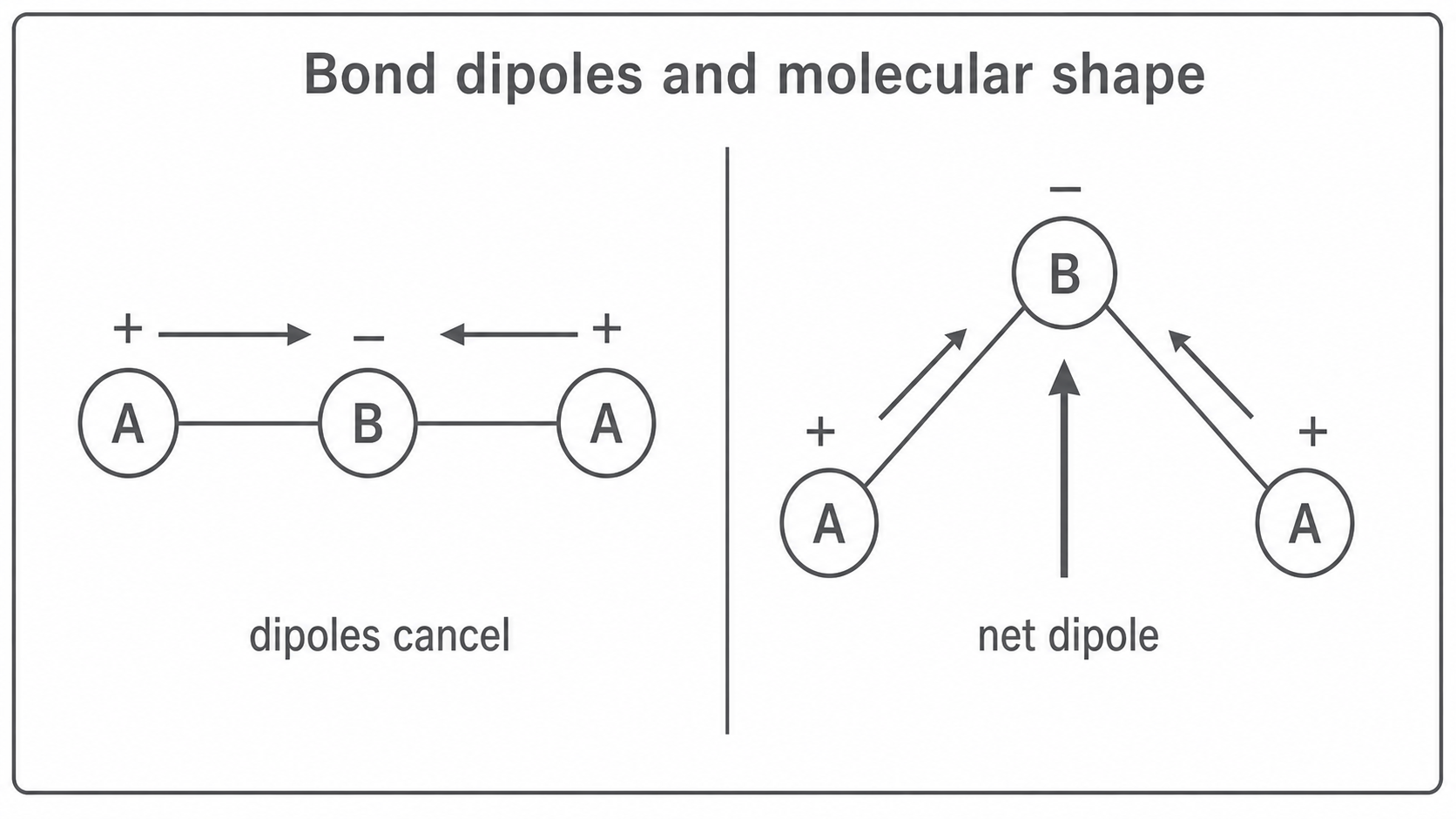
Worked example: CO2 and H2O
CO2:
- Each C=O bond is polar because O is more electronegative than C.
- CO2 is linear.
- The two C=O bond dipoles are equal and opposite.
- They cancel, so CO2 is not a polar molecule.
H2O:
- Each O-H bond is polar because O is more electronegative than H.
- H2O is bent because oxygen has two bonding pairs and two lone pairs.
- The two O-H bond dipoles do not point in exactly opposite directions.
- They add to give a net dipole, so H2O is a polar molecule.
Notice the mark-earning contrast: both molecules contain polar bonds, but only H2O has a permanent overall molecular dipole.
Common-error contrast
Weak answer: "CO2 is non-polar because it has no polar bonds."
Better answer: "CO2 has polar C=O bonds, but the molecule is linear and symmetrical, so the equal bond dipoles cancel."
The better answer earns the chemistry because it keeps bond polarity and molecular polarity separate.
Feynman diagnostic
Explain why "oxygen is very electronegative, so every oxygen-containing molecule is polar" is wrong. Your explanation should include the words bond dipole, shape, and cancel.
Expected direction: oxygen often creates polar bonds, but the molecule is only polar overall if the bond dipoles do not cancel in the molecular shape.
Predicting Molecular Polarity In Exam Conditions
The reliable prediction sequence is:
- Draw or recall the shape.
- Mark the polar bonds using electronegativity.
- Ask whether the dipoles cancel by symmetry.
- State whether the molecule is polar and justify it.
Worked example: predict whether BF3 is polar
- Shape: BF3 is trigonal planar, with three B-F bonds at about 120 degrees.
- Bond polarity: F is more electronegative than B, so each B-F bond is polar towards F.
- Symmetry: the three identical B-F bond dipoles are arranged evenly around the central B atom.
- Conclusion: BF3 is not a polar molecule because the three bond dipoles cancel.
Worked example: predict whether NH3 is polar
- Shape: NH3 is pyramidal, with three bonding pairs and one lone pair around N.
- Bond polarity: N is more electronegative than H, so each N-H bond is polar towards N.
- Symmetry: the pyramidal shape is not symmetrical enough for the three bond dipoles to cancel.
- Conclusion: NH3 is a polar molecule because it has a net dipole.
Guided practice
Predict whether each molecule is likely to be polar. Use one sentence of reasoning for each.
- CCl4
- CH3Cl
- BeCl2
Expected answers:
- CCl4 is not polar overall: each C-Cl bond is polar, but the tetrahedral molecule is symmetrical and the four equal dipoles cancel.
- CH3Cl is polar: the tetrahedral molecule is not symmetrical because one substituent is Cl and three are H, so the bond dipoles do not cancel.
- BeCl2 is not polar overall: each Be-Cl bond is polar, but the molecule is linear and the two equal dipoles cancel.
Pearson command-word habit
For predict, do not just name "polar" or "non-polar". Give the expected result and support it from the model. A concise answer usually needs both the bond evidence and the shape evidence.
Pearson-Ready Recap
The central idea is that electronegativity controls attraction for bonding electrons in a covalent bond. A difference in electronegativity creates unequal sharing, partial charges, and a bond dipole. Increasing electronegativity difference moves bonding along a continuum from non-polar covalent through polar covalent towards ionic character; do not rely on a fixed cut-off.
For molecular polarity, the whole-molecule decision is not finished until shape has been considered. Polar bonds cancel in symmetrical molecules such as CO2, BF3, CCl4, BeCl2, and SF6 when identical bond dipoles are arranged evenly. Polar bonds do not cancel in unsymmetrical molecules such as H2O, NH3, and CH3Cl, so these molecules have a net dipole.
One-sentence exit test
Explain why a molecule with polar bonds may not be a polar molecule.
High-quality answer: the polar bonds have dipoles, but if the molecular shape is symmetrical and the dipoles are equal and opposite or evenly arranged, the dipoles cancel and there is no net molecular dipole.