3.1 - Single Transferable Vote and voter choice
Ranking candidates lets a voter express more than one preference without receiving several votes. This lesson explains how Single Transferable Vote fills multiple seats using quotas and transfers, then considers its effects on candidate choice, party representation and government. A small worked count makes the mechanism visible; the arithmetic is an illustration rather than a separate Politics exam family.
Rankings, multiple seats and the quota
Single Transferable Vote elects several representatives from the same constituency or ward. Voters rank candidates by writing 1 for their first preference, 2 for their next preference and so on. They can rank candidates from different parties or choose between candidates of the same party. They need not give every candidate a preference.
Single Transferable Vote (STV)
A system in which voters rank candidates and seats are filled through a quota and transfers to continuing preferences. Votes above an elected candidate's quota and votes held by eliminated candidates can help elect another candidate.
The quota is the vote total normally needed to secure election. A commonly used UK rule is the Droop quota: divide the valid votes by one more than the number of seats, discard any fractional remainder and add one. With 100 valid votes and two seats, the quota is 34. Three candidates cannot all have 34 of those votes, because that would require 102. This helps prevent more candidates securing a quota than there are seats.
The floor brackets mean round down to a whole number before adding one.
STV is used for Northern Ireland Assembly elections and local councils in Northern Ireland and Scotland. Its count rules vary in detail between elections, so the illustration below states its assumptions rather than pretending to reproduce every administrative procedure. Commons Library voting-systems briefing; Electoral Commission explanation of counting. Scotland's official local-government STV factsheet explains the quota and transfers.
If you sit in 2027: Issue 3's STV glossary says candidates with the “least” votes are eliminated; Issue 4 changes this to “fewest”. The counting principle is unchanged. Explain elimination accurately; reproducing the older wording is unnecessary.
Surpluses and eliminations
A transfer moves vote value to the next available preference rather than creating extra votes. After counting first preferences, candidates at or above the quota are elected. A surplus is the amount above the quota. The quota is retained for the elected candidate, while transferable surplus value can help continuing candidates. If too few candidates are elected and no relevant surplus remains to distribute, the lowest candidate can be eliminated and their votes transferred to the next available preference.
Consider an invented two-seat election with 100 valid votes and a quota of 34. First preferences are A: 36, B: 30, C: 24 and D: 10. Assume all 36 A ballots next prefer B. A is elected and has a surplus of two. A fractional transfer gives each of those ballots a value of 2 ÷ 36, so their total transferred value is two, not 36. B rises to 32; A retains 34. C remains on 24 and D on 10.
No continuing candidate has yet reached 34. D has the fewest votes and is eliminated. Assume six D ballots next prefer B and four next prefer C, with no exhausted ballots. Those first-preference ballots transfer at their full current value. B rises to 38 and C to 28. B is elected and the two seats are filled by A and B. This count stops at that point; it does not need B's further surplus to decide another seat.
| Stage | A's retained value | B | C | D | Total value shown |
|---|---|---|---|---|---|
| First preferences | 36 | 30 | 24 | 10 | 100 |
| A's surplus transferred | 34 | 32 | 24 | 10 | 100 |
| D eliminated and transferred | 34 | 38 | 28 | 0 | 100 |
[DIAGRAM: asset_slug: s03-stv-count; description: Exact vote-value totals in the invented two-seat STV count, with a quota of 34 and transfers of two from A and ten from D.]
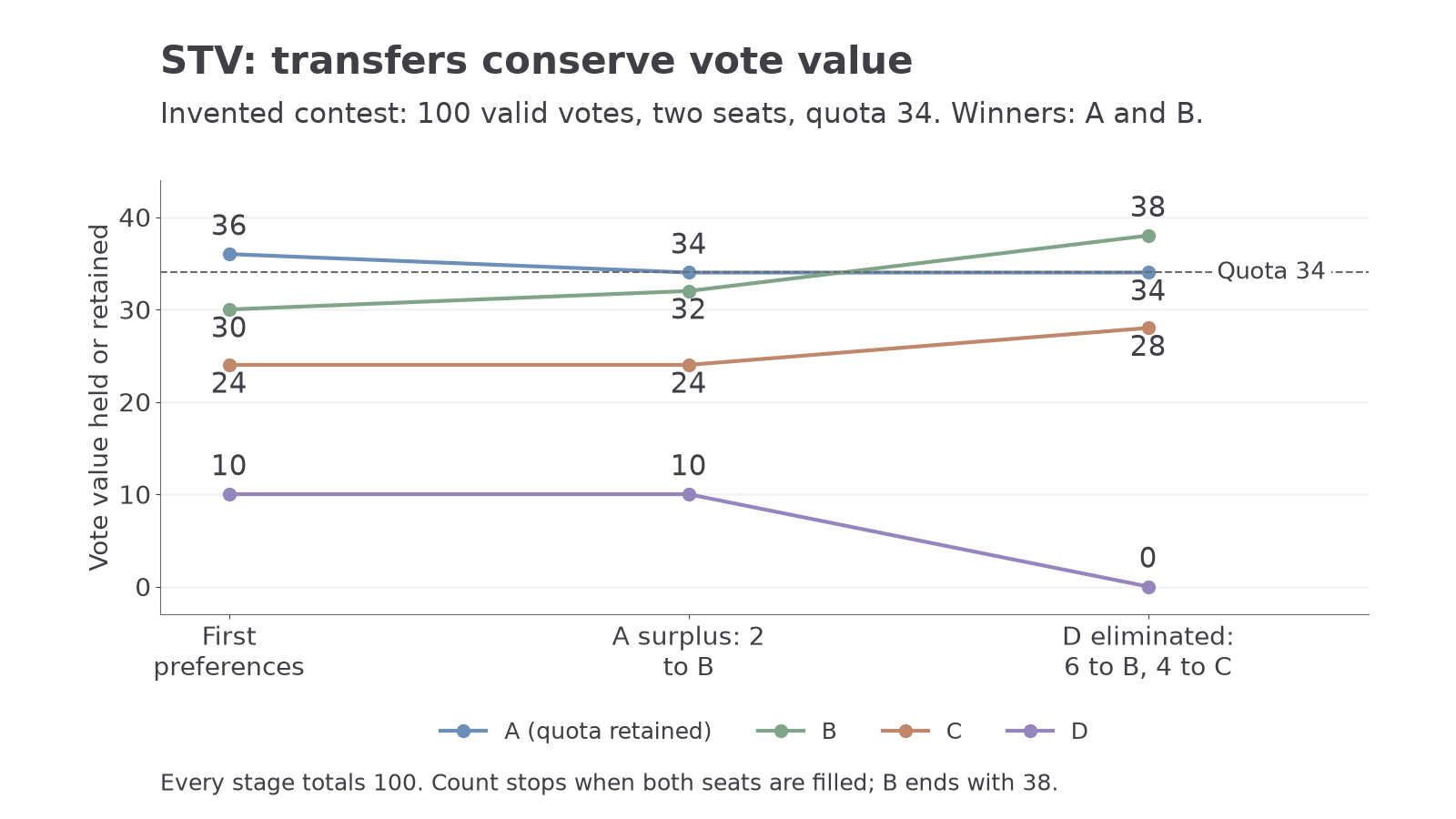
The chart separates A's retained quota from B's changing tally. No stage creates additional vote value.
Real transfers follow the next continuing candidate on each ballot, which may be its third or later preference. A ballot can become exhausted if it has no usable later preference. Surplus rules, rounding and the order of transfers are specified by the election's regulations. Candidates remaining when their number equals the remaining vacancies may be declared elected without reaching the quota. Therefore, “every winner must always reach the quota” is too absolute. The Electoral Commission's Northern Ireland explanation describes both surplus transfers and elimination.
Candidate choice and representation
STV combines wider candidate choice with a more proportional outcome, but these advantages arise through different mechanisms. Rankings allow a voter to express a sincere first choice while keeping later preferences available. If that candidate is eliminated, a continuing candidate can benefit. This reduces some incentives to abandon a weaker first choice simply to block another candidate, although tactical considerations do not disappear completely.
Candidate rankings also permit choice within a party. A voter can place one party candidate above another rather than accepting a pre-ordered party list. Candidates may therefore have an incentive to demonstrate local service and attract later preferences beyond their own party's supporters. Competition within parties can also cause rivalry or encourage candidates to emphasise local interests over a collective national programme.
Multi-member constituencies allow several groups to elect representatives. A quota smaller than half the vote lets a party or candidate with substantial minority support win a seat. Transfers can reduce votes that have no influence on electing anyone. Neither mechanism makes representation perfectly proportional: a small district has only a few indivisible seats, some ballots exhaust, and candidate preferences do not translate neatly into a national party-vote total.
Compare the same dimension with FPTP. In FPTP, a third-placed candidate's votes cannot transfer and the constituency returns only one winner. Under STV, later preferences may contribute and several candidates can represent the area. However, the area may be larger than a single-member constituency, and responsibility is shared among representatives. Having several people to contact can widen access but make it less obvious whom to hold responsible.
Ranking candidates increases what a voter can express. Multiple seats and transfers improve representation, but the number of seats, valid preferences and actual party support still shape the outcome.
Government and the limits of electoral evidence
STV can make a legislature more diverse without automatically making its government stable or unstable. If several parties win substantial representation and none has a majority, they may negotiate a coalition or support a minority administration. A coalition shares government between parties, usually through agreement on policy and ministerial posts. Agreement can widen the support behind decisions, while bargaining can weaken direct accountability for individual manifesto promises.
Northern Ireland demonstrates why the voting system must be separated from the rules of government formation. STV elects the Assembly; the Belfast/Good Friday Agreement and subsequent legislation provide the power-sharing framework. Those institutional rules are an additional cause of multi-party executive government. It would be wrong to attribute mandatory power sharing simply to STV. Northern Ireland Office account of the Belfast Agreement.
Consider this original teaching source: “Ranked ballots let voters distinguish candidates and preserve later preferences. A wider range of representatives can help groups feel heard. But more choice does not guarantee that the representatives can cooperate, and an exhausted ballot cannot influence a later stage.” The source's first claim follows from the ballot design. Its second is a plausible political benefit, not a measured finding that every voter feels represented. Its final sentence identifies two different limits: behaviour after election and the available preferences during the count.
A good argument therefore connects the mechanism to the relevant democratic objective and gives the limit appropriate weight. For candidate choice, ranking is direct evidence. For government performance, evidence about party agreements, institutions and actual decisions is needed as well. The relative complexity and slower count are costs of STV; they must be weighed against what transfers and individual rankings allow voters to express.