1, 3 - Ecology, holism and Carson’s challenge to domination
Ecologism asks how political decisions should change when people recognise their dependence on the natural world. Content area 1 supplies ecology and holism; area 3 shows how Rachel Carson used these ideas to challenge the assumption that governments and businesses may control nature for human convenience.
Ecological interdependence
An action that benefits one person can affect an entire living system. Clearing vegetation may create space for a farm, yet also remove food and shelter, change water movement and expose soil to erosion. The consequences extend beyond the landowner's original purpose.
Ecology
The study of relationships between living beings and their environment, including their dependence on one another.
An ecosystem contains organisms and the physical conditions with which they interact. Plants depend on water and soil; insects may feed on plants; birds may eat insects. Dead plant material is broken down and returns nutrients to soil. People belong within these relationships: food, water and livelihoods depend on functioning ecological systems. Nature is therefore more than scenery outside human society.
[DIAGRAM: asset_slug: ecological-interdependence; caption: A simplified network of dependencies between soil, water, plants, insects and birds; description: Arrows show selected ecological relationships, including nutrients, water, food and decomposition.]
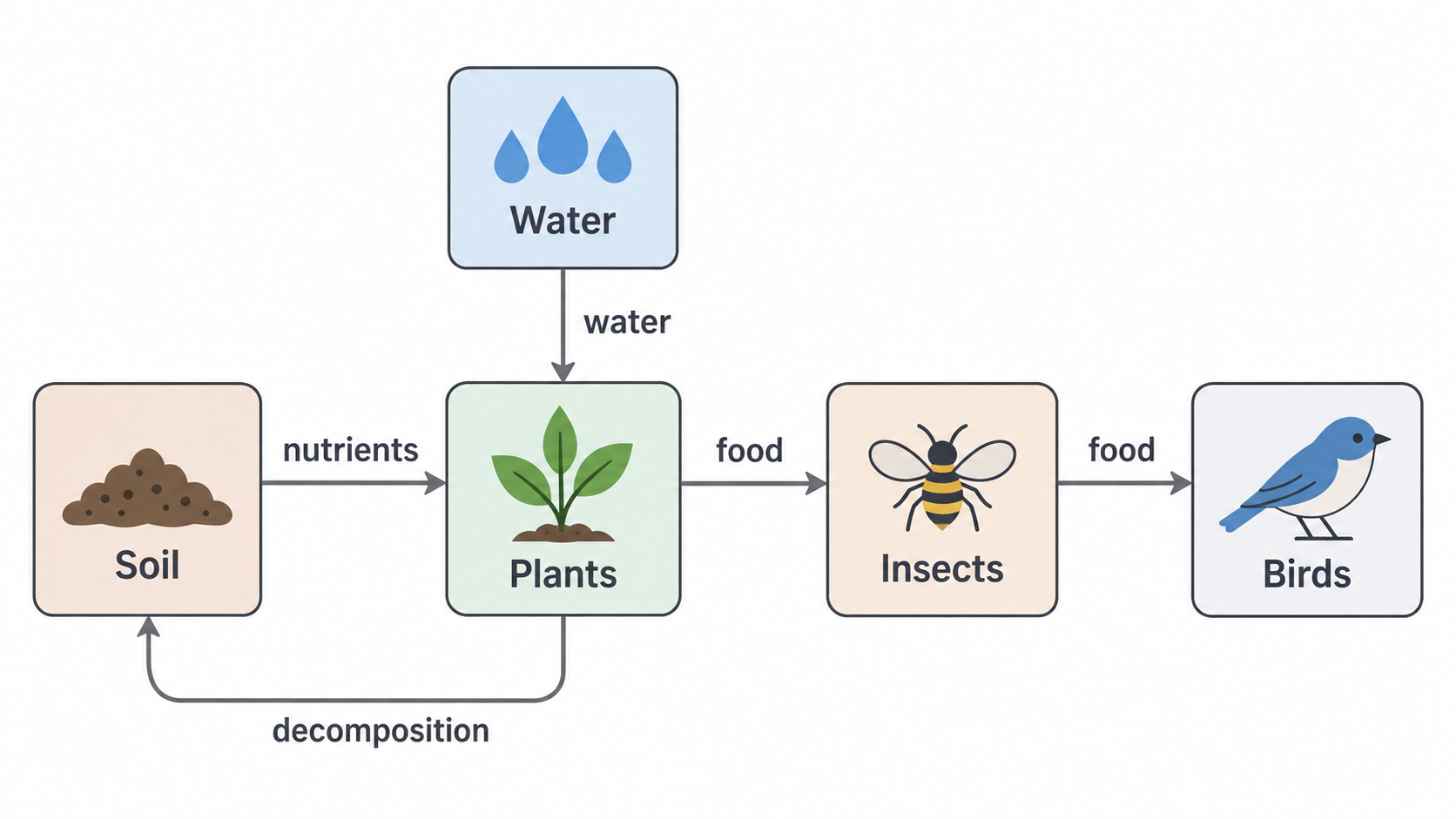
The picture selects a few relationships. It is not a complete food web, a diagram of particular species or a measurement of how much change will occur. Its political lesson is that changing one element may have effects elsewhere.
Ecology is a field of scientific study. Ecologism is an ideology that draws political conclusions from ecological dependence: it challenges the purposes of production, the limits of human power and the values governing society. Scientific evidence about a damaged habitat can inform a decision, but it cannot by itself decide whose interests ought to count. That is also an ethical and political question.
Holism and the mechanistic world view
Ecological connections explain why ecologists question decisions that treat one part of nature in isolation. Holism means understanding a whole through the relationships among its parts. The condition of a river depends on more than the water in one place: upstream farming, organisms, soil and human activity interact.
The mechanistic world view, criticised in ecologism, treats nature like a machine whose separate components can be studied, controlled or replaced independently. Associated with post-Enlightenment science in the specification, it encourages confidence that human beings can master nature and use it as a collection of resources. In politics, this outlook can make a government treat a forest mainly as timber or a river mainly as a channel for industry.
The objection is not that analysing a component is always useless. Analysis may reveal important facts. It becomes inadequate when knowledge of a component is mistaken for complete knowledge of the system, or technical ability is mistaken for unlimited moral authority. Removing an unwanted organism can affect other organisms that depend on it; replacing one damaged resource may fail to restore all its ecological relationships.
For example, evaluating a proposed dam only by the electricity it produces overlooks changes to river habitats and downstream users. A holistic assessment brings these connections into the decision. It does not automatically establish that every dam is wrong. It changes what must be considered and challenges the claim that nature exists solely for our convenience.
If you sit in 2027: Issue 3 uses “non-human nature” or “non-human world” in places where Issue 4 uses “natural world”, including holism. The underlying concern remains the relationship between human activity and the wider ecological whole.
Carson and the limits of domination
Rachel Carson's Silent Spring (1962) challenged the indiscriminate use of chemical pesticides. Her argument joined scientific evidence to a criticism of the assumption that people may control nature without considering wider consequences. The Carson legacy account of the book explains its concern with persistent chemicals and effects on the whole living system.
Some pesticides can affect organisms beyond those being targeted. Their effects may persist, spread through environmental relationships or become apparent only later. This creates a difference between an immediate result, such as reducing a crop pest, and the long-term health of an ecosystem. Carson's concern was therefore more substantial than disliking chemicals: methods of control must be judged in their ecological setting.
Sustainability
The ability of an ecological system to retain its health over time.
Continue this lesson.
You’re previewing NovaLearn without an account. Create a free account to read the rest.
Create free account