1, 2, 3 - hooks: intersectionality and post-modern feminism
Gender matters to women's opportunities, but it does not act in isolation. Content area 1 explains intersectionality, area 2 develops the specification's post-modern feminist account of varied experiences of patriarchy, and area 3 uses bell hooks to show how race, class and gender change both feminist analysis and feminist priorities.
Intersectionality and different experiences
Intersectionality challenges an explanation that treats gender as the single factor shaping every woman's life. A Black working-class woman and a white middle-class woman can both face patriarchy while encountering different opportunities, constraints and forms of discrimination.
Intersectionality
An approach that examines how social divisions and systems of power interact to shape people's experiences, rather than analysing gender, race or class in isolation.
Class concerns economic and social position, including resources and relationships to work. Racism involves racial hierarchy and discrimination. Discrimination means less favourable treatment compared with other people or groups. A woman may face a gendered expectation while her class affects whether she can pay for care and racism affects how an employer perceives her.
Imagine two women expected to provide most care in their families. One has enough resources to buy reliable care; the other works insecure hours and cannot afford it. The expectation is shared, but its impact on paid work differs. Add racial discrimination in recruitment and the second woman's route may be restricted further. This original illustration identifies interacting mechanisms; it does not assume every member of either group has the same life.
The principle applies across the state, society and the economy. Access to public services can interact with resources and racial treatment; cultural stereotypes can differ between groups; labour-market barriers can combine with caring responsibilities. A theory that treats one group's experience as the universal female experience can miss these relationships.
If you sit in 2027: Issue 3 uses lower-case “black” in this content. Issue 4 capitalises Black. The change of style does not alter the requirement to explain differences in experiences of patriarchy.
hooks and whose experience counts
bell hooks brings the experiences and perspectives of women of colour into feminist analysis. Her work challenges a mainstream movement that can speak as though the priorities of white middle- and upper-class women represent those of all women.
In Feminist Theory: From Margin to Center (1984), the movement's margins matter to the theory itself, not simply as extra examples after the main theory has been completed. Women who experience racial and class oppression can identify features of power that a more privileged perspective overlooks. Listening changes the questions being asked and the goals pursued.
For example, a campaign might define liberation as leaving the home to obtain employment. That can address the frustration of a woman excluded from a career. A woman already doing poorly paid work may instead need security, decent conditions and relief from combined paid and unpaid labour. One demand is not automatically the solution to both situations. The comparison is an illustration of hooks' criticism, not a claim that every privileged woman lacks concern for others.
This challenges simplistic sisterhood, the assumption that being women automatically creates identical interests or solidarity. Women can share opposition to sexism while differing in resources and racial power. A privileged woman can benefit from another woman's poorly paid care work. Feminist solidarity therefore requires confronting unequal relations among women as well as domination by men.
The goal need not be abandoning a common movement. hooks' criticism seeks a wider movement against oppression, with its priorities shaped by those whose experiences were excluded. Attention to difference can deepen shared action by making it address actual inequalities.
If you sit in 2027: Issue 3 foregrounds women's cultural concerns and criticises mainstream feminism's focus on white middle- and upper-class women. Retain that criticism. Issue 4 more explicitly foregrounds women of colour's experiences and perspectives. Issue 3 leaves hooks' lifespan open; the accurate dates are 1952–2021.
Interlocking systems of oppression
hooks' analysis connects racism, capitalism and patriarchy as systems that can reinforce one another. In the specification's example, Black female workers experience a triple oppression through these interlocking systems.
[DIAGRAM: asset_slug: interlocking-oppression; caption: Racism, capitalism and patriarchy interact in shaping a Black working-class woman's experience; description: A conceptual network of interlocking systems of oppression, with no measured scale of harm.]
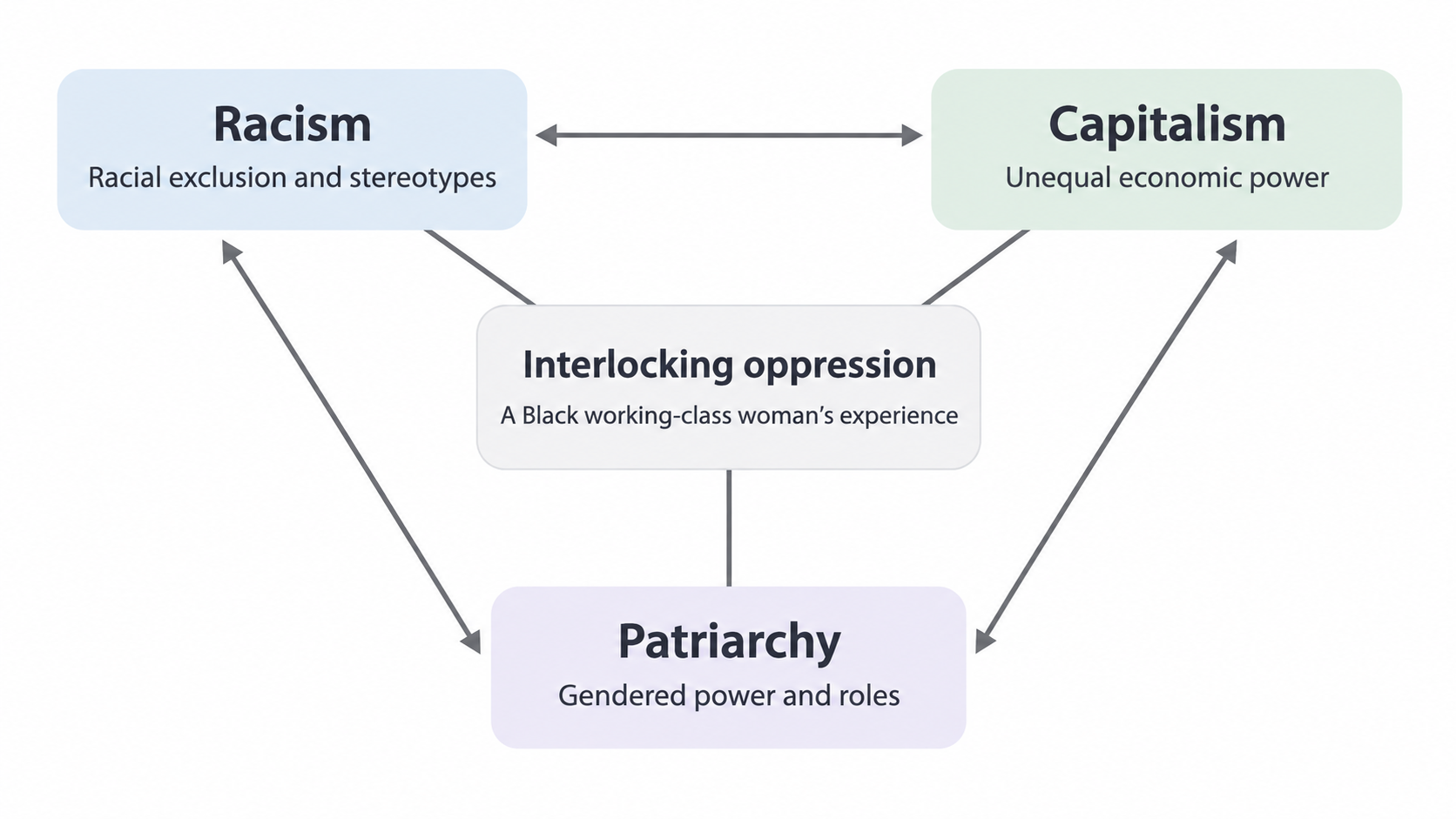
The figure connects the systems in both directions. It is a conceptual model of interaction, not a graph measuring an equal amount of harm from each system.
Racism can restrict access to desirable occupations or devalue particular workers. Capitalist economic power can make a worker depend on an employer's wage and conditions. Patriarchy can assign unpaid care to women or treat some work as naturally female and less valuable. In combination, these relations can shape which jobs a Black woman can obtain, her ability to refuse poor conditions, and her responsibilities after the paid working day.
Continue this lesson.
You’re previewing NovaLearn without an account. Create a free account to read the rest.
Create free account