2.2, 2.2.2 - The legislative process
A proposal can have majority support and still fail to become federal law. Section 2.2 identifies legislation as a congressional function; 2.2.2 explains the route through committees, the different chamber procedures and presidential action. It also asks whether the laws Congress passes make a meaningful difference, rather than treating passage as the end of the story.
Bills, committees and agreement
A bill is a proposed law. Members introduce bills, which are normally referred to committees with responsibility for the relevant subject. Committees can hold hearings, obtain evidence and amend the text in markup. They can report a bill to the chamber, but may also take no action, leaving it without the usual route to a floor vote. Not every introduced bill receives a hearing or vote.
Committees supply specialist scrutiny that the whole chamber cannot provide for every proposal. Their composition and leadership also make them places where parties and organised interests contest policy. A committee may improve a bill's detail or prevent a proposal from advancing. Formal procedures can sometimes bypass a committee, such as a House discharge petition, so committees are powerful gatekeepers rather than an absolute barrier in every case.
Bills can generally start in either chamber, although revenue-raising bills must originate in the House. The Senate may amend such a bill. The other chamber normally considers a passed bill through its own procedures. If it makes changes, both chambers must ultimately agree identical text. Differences can be resolved through exchanges of amendments between chambers or a conference committee of House and Senate members. A conference agreement still needs chamber approval; a conference does not enact the law on its own. House account of the legislative process.
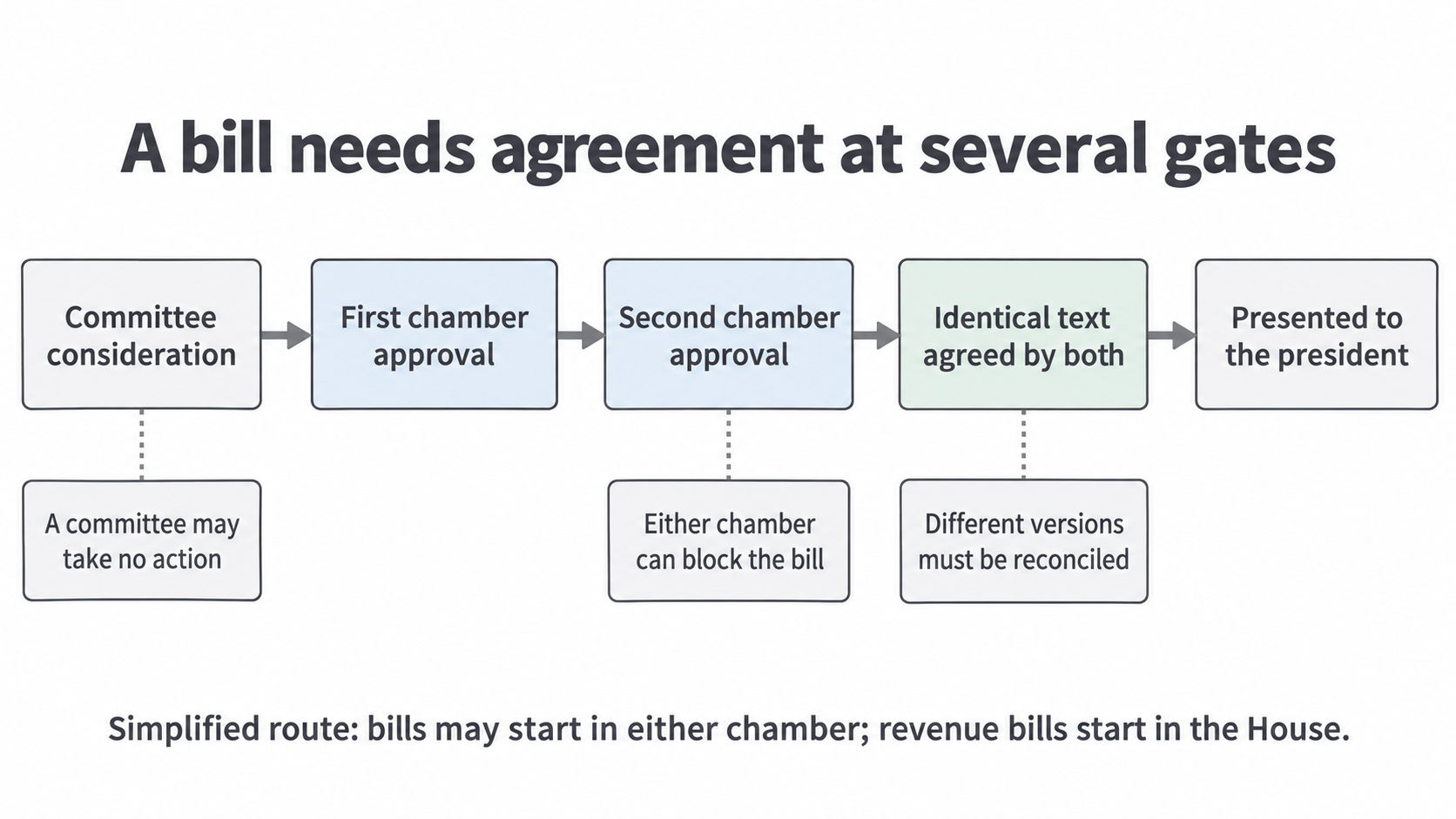
Each gate can prevent progress. The diagram simplifies the route: committees in both chambers can be involved, and the order depends on where the bill starts.
This is bicameral lawmaking: both chambers participate, and each can refuse the other's preferred text. If you sit in 2027: Issue 4 adds a separate Bicameral glossary entry. Issue 3 already requires the two-chamber mechanism; its absence as a glossary heading does not remove the concept.
The requirement for identical text explains why a House vote alone cannot establish that a policy has become law. Look for the completed Senate stage and presidential outcome as well as the headline announcing passage in one chamber.
Floor rules in the House and Senate
The House usually controls debate more tightly than the Senate. A special rule, proposed by the House Rules Committee and adopted by the House, can set debate time and decide which amendments may be considered. An open rule allows amendments complying with the rules; a structured rule permits specified amendments; a closed rule largely prevents floor amendments beyond the committee's text. This helps a large chamber manage business and gives the majority party considerable agenda control. House Rules Committee explanation.
The Senate traditionally permits more extended debate and more individual-member influence. A filibuster is an attempt to delay or prevent action, particularly by obstructing the ending of debate. It need not consist of one senator speaking continuously. Under the ordinary legislative cloture rule, ending debate normally requires three fifths of all senators duly chosen and sworn: usually 60 when all 100 seats are filled. Final passage usually requires a simple majority. Ending debate and passing a bill are different decisions. Senate account of filibusters and cloture.
Unanimous consent can speed proceedings by setting aside a procedural rule or agreeing how a measure will be considered. The absence of an objection is crucial: a single senator can object to a consent request, requiring another route. A negotiated agreement can limit debate or amendments, so the Senate does not always operate through unlimited discussion. Senate procedural glossary.
If you sit in 2027: Issue 4 updates the unanimous-consent glossary wording to use “member of Congress” instead of the older gendered term. The procedural idea remains the same for both series.
There are important exceptions to the 60-vote legislative cloture threshold. Nominations can proceed under majority cloture precedents. Budget reconciliation uses a special process with limited Senate debate, making it possible to pass eligible budget legislation by a simple majority without the ordinary filibuster barrier. The Byrd rule restricts extraneous provisions: reconciliation is not a route for attaching any unrelated policy a majority wants. Senate Budget Committee on the Byrd rule.
For example, the Senate passed the reconciliation bill that became the Inflation Reduction Act on 7 August 2022, with senators dividing 50–50 and the vice president voting in favour. This demonstrates that not every significant law requires 60 affirmative Senate votes. It does not prove that every bill could use the same procedure. Senate roll-call 325.
Presidential action and vetoes
Once both chambers have agreed the same bill, the enrolled text is presented to the president. The president can sign it or return it with objections: a regular veto. Congress can override a returned veto with two thirds of members voting in each chamber, provided a quorum is present. One chamber's supermajority is insufficient.
Article I also allows a bill to become law without the president's signature if it is not returned within ten days, excluding Sundays. If Congress's adjournment prevents its return during that period, it does not become law: this is a pocket veto. There is no returned bill for an ordinary override in that situation; Congress would need to pass it again. The relevant issue is whether adjournment prevents return, not simply whether a congressional holiday occurs. Article I, section 7.
The possibility of a veto affects bargaining before the final stage. Members may alter a bill to obtain presidential agreement or try to build an override coalition. Conversely, a president may sign a compromise that differs from their original preference. The final law can therefore represent congressional influence even when it also advances the president's broad agenda.
A president has no general line-item veto allowing them to delete selected provisions of a presented bill and enact the rest. The constitutional choice concerns the bill as a whole. That makes bargaining over a package important, especially when popular and disputed provisions appear together. GAO's account of the line-item veto ruling.
Continue this lesson.
You’re previewing NovaLearn without an account. Create a free account to read the rest.
Create free account