3.1 - First-past-the-post and constituency representation
An election can identify a clear local winner while producing a very uneven national result. This lesson explains how first-past-the-post turns constituency votes into MPs, why the location of support matters, and how to judge its effects on representation and government.
Plurality and local winners
First-past-the-post elects one MP for each House of Commons constituency by comparing the votes cast for its candidates. Each voter chooses one candidate. The candidate with more votes than any rival wins the seat; votes are not transferred to a second preference.
First-past-the-post (FPTP)
A constituency voting system in which the candidate with the largest number of votes wins. That largest share is a plurality; it need not be more than half of all votes cast.
Suppose an invented constituency records 4,000 votes for Amira, 3,500 for Ben and 2,500 for Cara. Amira wins with 40% of the 10,000 valid votes. Ben and Cara together received 60%, but their votes cannot be combined into a vote for one candidate. Amira's lead over the nearest rival is 500 votes. This is often called her electoral majority, although she has no absolute majority of votes. An absolute majority means more than 50%; a plurality means the largest individual total.
MPs are elected locally; the general election is not a direct national election of a prime minister. Parliamentary seats then shape who can form a government capable of commanding the confidence of the Commons. Adding all a party's votes nationally does not allocate it a matching national share of seats. Parliament's voting-systems briefing, updated 7 October 2026, confirms the Commons use of FPTP.
Geography and seat shares
The distribution of a party's votes can matter more than its national total because the count starts again in every constituency. Broadly spread support that repeatedly finishes second can produce few seats. Concentrated support can win seats even when the party's national share is small.
The following invented country has five equally sized constituencies, each casting 100 votes. It demonstrates the rule without differences in turnout or constituency size.
| Constituency | Party A | Party B | Party C | Seat winner |
|---|---|---|---|---|
| North | 40 | 35 | 25 | A |
| East | 40 | 35 | 25 | A |
| West | 40 | 35 | 25 | A |
| South | 20 | 50 | 30 | B |
| Central | 20 | 50 | 30 | B |
| Total votes | 160 | 205 | 135 | A: 3 seats; B: 2; C: 0 |
Party B has the most votes nationally: 205 of 500, or 41%. Party A wins three local contests, so it has 60% of seats on 32% of votes. Party C receives 27% of votes but no seats. No vote was miscounted; the inequality follows from awarding a whole seat to each local plurality winner. The illustration proves that such an outcome is possible, not that every FPTP election produces this exact pattern.
[DIAGRAM: asset_slug: s03-fptp-votes-seats; description: Invented five-constituency election comparing vote shares with seat shares for Parties A, B and C.]
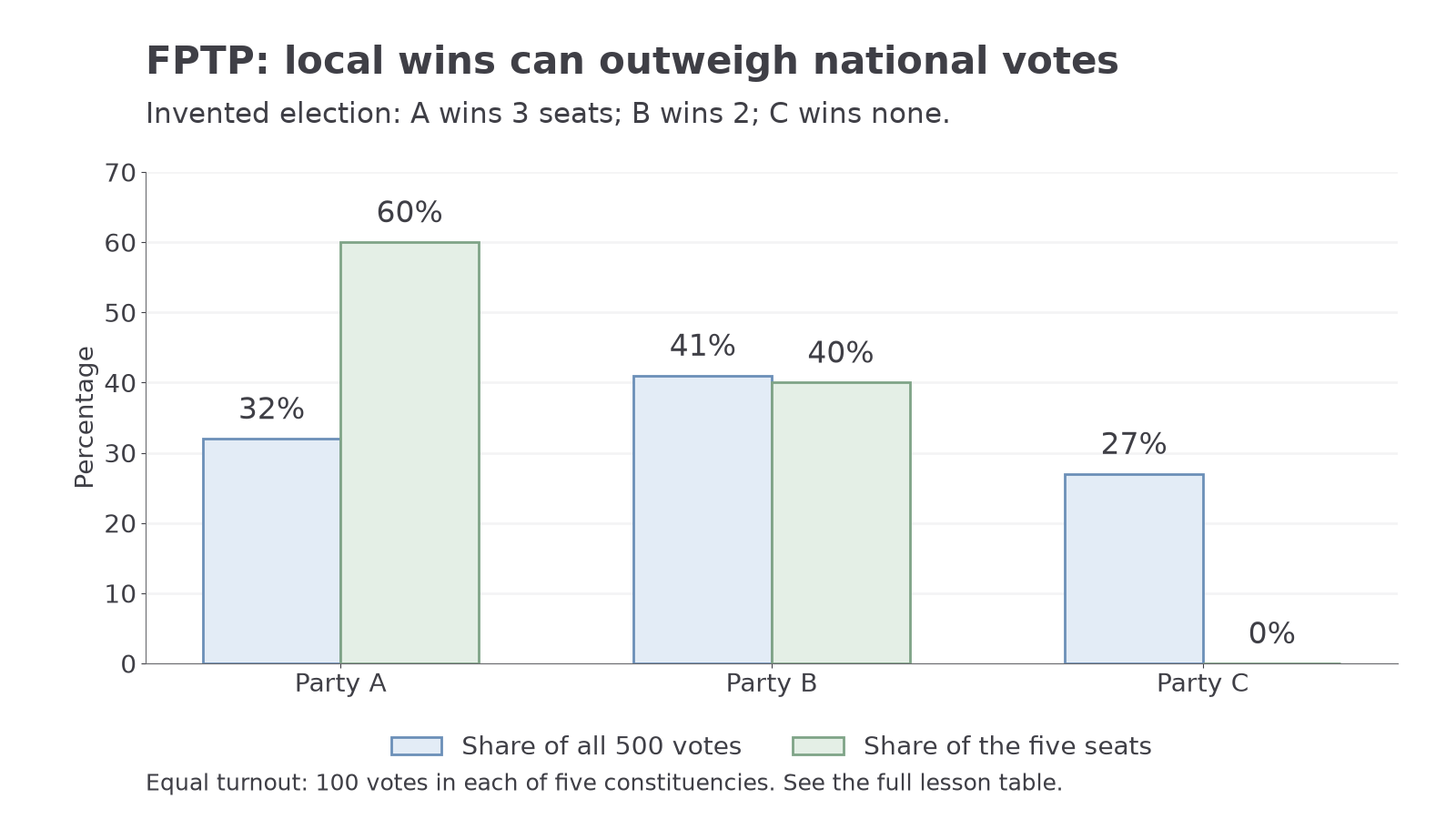
The percentages come from the complete invented table above; they are not UK election results.
In the actual 4 July 2024 UK general election, Labour won 411 of 650 seats with 33.7% of votes; Reform UK won five with 14.3%. These are election results, not present-day party strengths. They illustrate a gap between votes and seats. They do not establish that voting behaviour, turnout or alliances would remain the same under another system. Commons Library results and analysis, updated 3 March 2026.
Safe seats, marginal seats and tactical choice
A constituency's competitiveness changes the incentives facing voters and parties. A safe seat has a large established lead for its incumbent or incumbent party and tends to return that party repeatedly. A marginal seat has a small lead, so a relatively modest change in voting can change its winner. These are political descriptions, not legal categories with one compulsory percentage threshold. An incumbent is the current holder of the seat.
Suppose two leading parties have 45% and 35%, with the remaining votes unchanged. If five percentage points move directly from the first party to the second, both reach 40%. The original ten-point gap has disappeared because one side lost five points while the other gained five. A transfer slightly greater than five points gives the challenger a lead. This simplified two-party swing is different from merely adding five points to one party while leaving its rival unchanged. Real constituencies may involve several parties, turnout changes and different sources of switching.
Parties have an incentive to concentrate campaign resources on constituencies where additional support might change a seat. That can give marginal-seat voters more campaign attention than equally numerous voters in safe seats. It does not mean that voters in a safe seat are legally barred from influencing the result, or that a previously large majority can never collapse.
Tactical voting means supporting a candidate other than one's first choice to influence the outcome. A Party C supporter who expects C to finish third may vote B to stop A. FPTP can therefore make the realistic local contest influence the vote, rather than allowing a second preference to be recorded. Predictions may be wrong; some voters value expressing their sincere preference more than blocking another candidate.
If you sit in 2027: Issue 3's glossary also describes most Westminster seats as safe and only a minority as marginal. Issue 4 removes these generalisations. Learn the definitions and assess competitiveness using dated evidence; do not treat those proportions as permanent facts or required assumptions.
Accountability and government
FPTP creates a clearly identifiable local representative, but accountability and proportional representation are different tests of an election. A constituency has one MP whom residents can contact and whose performance they can assess. The MP represents the whole constituency, including people who supported rivals. Local accountability can be weakened by strong party loyalty or a seat that rarely changes hands; one named representative does not automatically mean every voter feels represented.
Supporters also argue that FPTP often gives a party a Commons majority, enabling it to carry out a programme and making responsibility for government decisions clearer. Opponents reply that a large seat majority can be based on a minority of votes, giving the governing party more parliamentary power than its popular support suggests. Clear responsibility and broad electoral consent may point towards different conclusions.
A hung Parliament means no party has an overall seat majority. A minority government holds office without controlling more than half of the legislature's seats. It must obtain support or abstentions from other parties to win necessary votes. That creates bargaining and vulnerability, but does not make governing impossible. A coalition instead brings parties into government together.
The Parliament explanation of hung Parliaments records that both 2010 and 2017 produced hung Parliaments. The 2010 outcome led to a Conservative–Liberal Democrat coalition. Thus FPTP can help produce single-party majorities but does not guarantee them. A system's effects also depend on the number of competitive parties, the geography of support and the political agreements made afterwards.
Judge FPTP separately for local representation, the votes-to-seats relationship and the conditions for governing. Success on one criterion does not settle the others.
Reading arguments about FPTP
An argument about elections becomes more convincing when its evidence actually supports the criterion being judged. Consider this original teaching source, written for this lesson: “A single constituency MP makes it easy to know whom to contact. Giving a party a workable majority can clarify responsibility for policy. However, millions of votes may elect very few MPs when support is spread thinly, so clarity does not necessarily give equal political influence.”
The first view values identifiable representation and effective government. The counterview values equality between party support and parliamentary strength. These claims can both be true; they attach different weight to desirable outcomes. Selecting only the source's positive sentences would miss the dispute, while simply calling it biased would avoid assessing its reasoning.
To test the argument, connect a mechanism to a result. Awarding one seat to the local winner explains why contact is straightforward, but safe-seat dominance qualifies the accountability claim. The invented five-seat election shows how scattered support can fail to gain seats; the 2024 figures show real disproportionality. Neither example proves that every majority government is effective. The 2010 and 2017 exceptions limit the claim that majority government is a guaranteed consequence.
A defensible judgement might favour FPTP for a legislature whose priority is identifiable local representation while acknowledging its weak proportionality. Another could prioritise equal party representation and prefer reform. What matters is explaining why a criterion is decisive and how the strongest contrary evidence affects the judgement.