2.1, 2.1.1 - The United Nations and its institutions
The UN tries to organise cooperation among sovereign states, yet its institutions have very different powers. Section 2.1 introduces political global governance; 2.1.1 explains the UN’s origins, Charter and four key organs, and why legal authority or a large majority does not always produce effective action.
Origins and the Charter
The United Nations emerged from the destruction of the Second World War and the failure of the League of Nations to prevent aggression. The new organisation sought to retain great-power participation while providing a forum for smaller states. Fifty states signed the Charter at San Francisco on 26 June 1945; Poland signed later and became the fifty-first original member. The UN came into existence on 24 October 1945 after the required ratifications. These are different events: signing agreed the text; ratification brought the organisation into legal existence. UN history.
Global governance
The institutions, rules and processes through which states and other actors manage problems crossing national borders. It can exist without a single world government.
The 1945 UN Charter is a treaty establishing purposes, institutions and obligations. Its purposes include international peace and security, friendly relations, cooperation on economic and social problems, and human rights. It combines sovereign equality and a general prohibition on the threat or use of force with collective-security powers and the right of self-defence. Article 2(7) protects domestic jurisdiction while leaving Chapter VII enforcement powers available. These principles create a tension: states want protection from external interference, but preventing aggression sometimes requires action against a state.
The UN developed beyond its original membership as decolonisation brought newly independent states into the Assembly. Its work broadened through peacekeeping, development, humanitarian assistance and human-rights standards. These developments did not turn it into a sovereign authority over all governments. Its members still supply finance, implement decisions and provide personnel. UN membership history, Charter.
Security Council powers and limits
The Security Council has primary responsibility for maintaining international peace and security. It has fifteen members: five permanent members—China, France, Russia, the UK and the USA—and ten elected for two-year terms. Permanent membership embeds exceptional power within an organisation that otherwise recognises states’ sovereign equality.
The Council can investigate disputes and recommend peaceful settlement. Under Chapter VII it can determine that a threat to peace, breach of peace or aggression exists, impose measures such as sanctions, and authorise military action. Article 25 commits members to accept and carry out Council decisions. This gives certain decisions legal force beyond a diplomatic appeal, although implementation still depends on states. A sanctions resolution needs governments to control trade and financial transactions; a peace operation needs resources and personnel. Council functions.
A substantive decision normally requires at least nine affirmative votes and no permanent-member veto. A permanent member’s abstention does not count as a veto. Procedural decisions need nine affirmative votes without the permanent-member veto rule. The veto protects great powers from a decision they reject, helping explain their participation, but can block action when their interests or allies are involved. Threats to veto may also narrow a proposal before any recorded vote occurs. Council voting rules.
The Council’s strength is concentrated authority: agreement can produce coordinated pressure that no small state could organise alone. Its weakness is selective action. The inability to agree over one conflict does not prove that it can never act; equally, passing a resolution does not prove that the conflict has been resolved.
[DIAGRAM: asset_slug: s29_un_authority; description: Comparison of the mandates and limits of four United Nations organs]
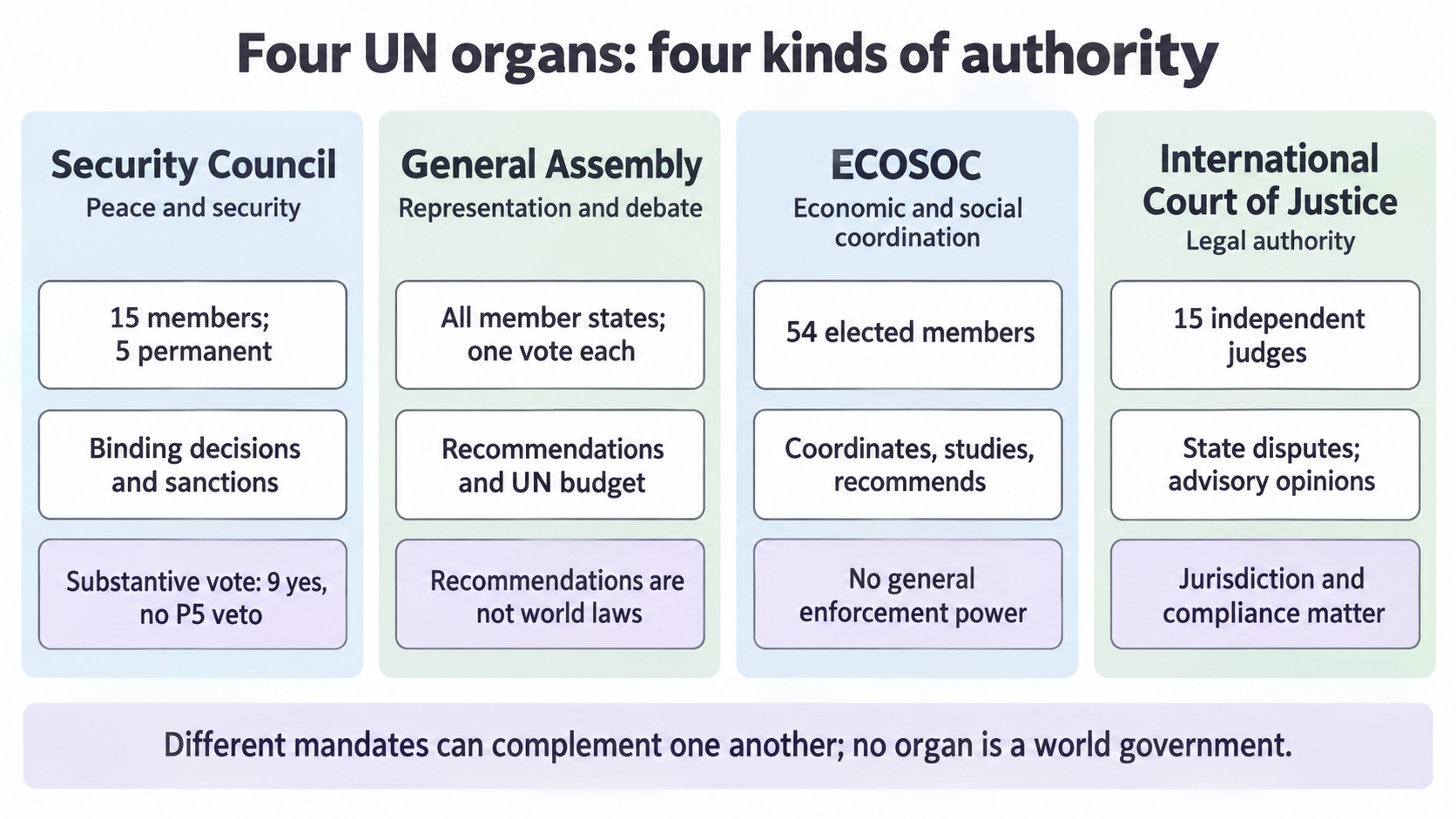
Four kinds of authority. The Council’s binding powers operate within the Charter; the Assembly’s budget decisions differ from its recommendations.
Continue this lesson.
You’re previewing NovaLearn without an account. Create a free account to read the rest.
Create free account