2.4 - Party systems and political success
The UK can show multi-party competition among voters while a single party controls government. This lesson explains that relationship, its consequences for government and the interacting factors that help parties succeed or fail, including leadership and the media.
Classifying meaningful competition
A party system describes relationships between relevant parties, rather than the total number of organisations on the register. Its classification depends on which parties can realistically gain power and how competition is structured.
Party systems
Patterns of party competition and relationships, particularly the number of parties with a credible chance of forming or sharing government.
| Pattern | Meaning | Question to ask of the evidence |
|---|---|---|
| One-party dominant | One party repeatedly wins or dominates government while opposition parties still compete. | Is dominance sustained over several elections? |
| Two-party | Two main parties dominate the realistic governing alternatives. | Can either normally govern alone, with others peripheral? |
| Two-and-a-half party | Two large parties compete with a smaller third party that can matter in forming government. | Does the third party have meaningful bargaining potential? |
| Multi-party | Several relevant parties compete and can affect representation or governing arrangements. | In which electoral or governing arena are they relevant? |
One-party dominance is not a one-party state: opposition remains legal and competitive. A single landslide is insufficient to establish lasting dominance. “Two-and-a-half” does not mean half an organisation; it describes unequal party strength with a potentially important third force.
If you sit in 2027: Issue 3's glossary defines party systems through grouping and structure; Issue 4 explicitly adds realistic prospects of becoming or joining government. The categories remain the same. Apply the explanation to political relevance rather than counting every registered party.
Left–right position is a separate classification. Left-wing generally emphasises reform towards equality and often criticism of capitalist inequalities; right-wing generally emphasises order, continuity and hierarchy. Several parties can compete on one side, and constitutional or environmental questions can divide them independently. Ideology helps explain competition; it does not by itself determine the number of relevant parties.
Fragmentation of votes and concentration of seats
The UK's multi-party development has more than one cause. Class-based loyalties weakened, leaving more voters open to switching; territorial parties offered distinct constitutional choices; devolution created additional governing arenas; and issues such as Europe, immigration and climate offered opportunities for parties outside the largest two. These mechanisms can reinforce one another, but the pattern can also reverse at particular elections.
The Liberal–SDP Alliance challenged the largest parties in the 1980s; the Liberal Democrats later shared government in 2010. The SNP, Plaid Cymru and Northern Irish parties show that party competition is territorial as well as UK-wide. The rise of UKIP and later Reform UK, and Green representation, extended issue competition. Growth in alternatives among voters does not ensure equal growth in Westminster seats.
First past the post elects the leading candidate in each constituency. Votes spread across many constituencies without local first places can produce few seats; efficiently concentrated support can produce more. The 2024 election illustrates the gap:
| Party | UK vote share | Seats won out of 650 |
|---|---|---|
| Labour | 33.7% | 411 |
| Conservative | 23.7% | 121 |
| Liberal Democrat | 12.2% | 72 |
| Reform UK | 14.3% | 5 |
| SNP | 2.5% | 9 |
| Green Party of England and Wales | 6.4% | 4 |
These named parties are a selection, so their shares do not total 100%. The Green figure is for England and Wales's party, not a combined total including separate Scottish and Northern Irish Green parties. Parliament's verified election data, checked 14 October 2026.
[DIAGRAM: asset_slug: party-votes-seats-2024; description: Selected parties' shares of UK votes and Commons seats at the 4 July 2024 general election]
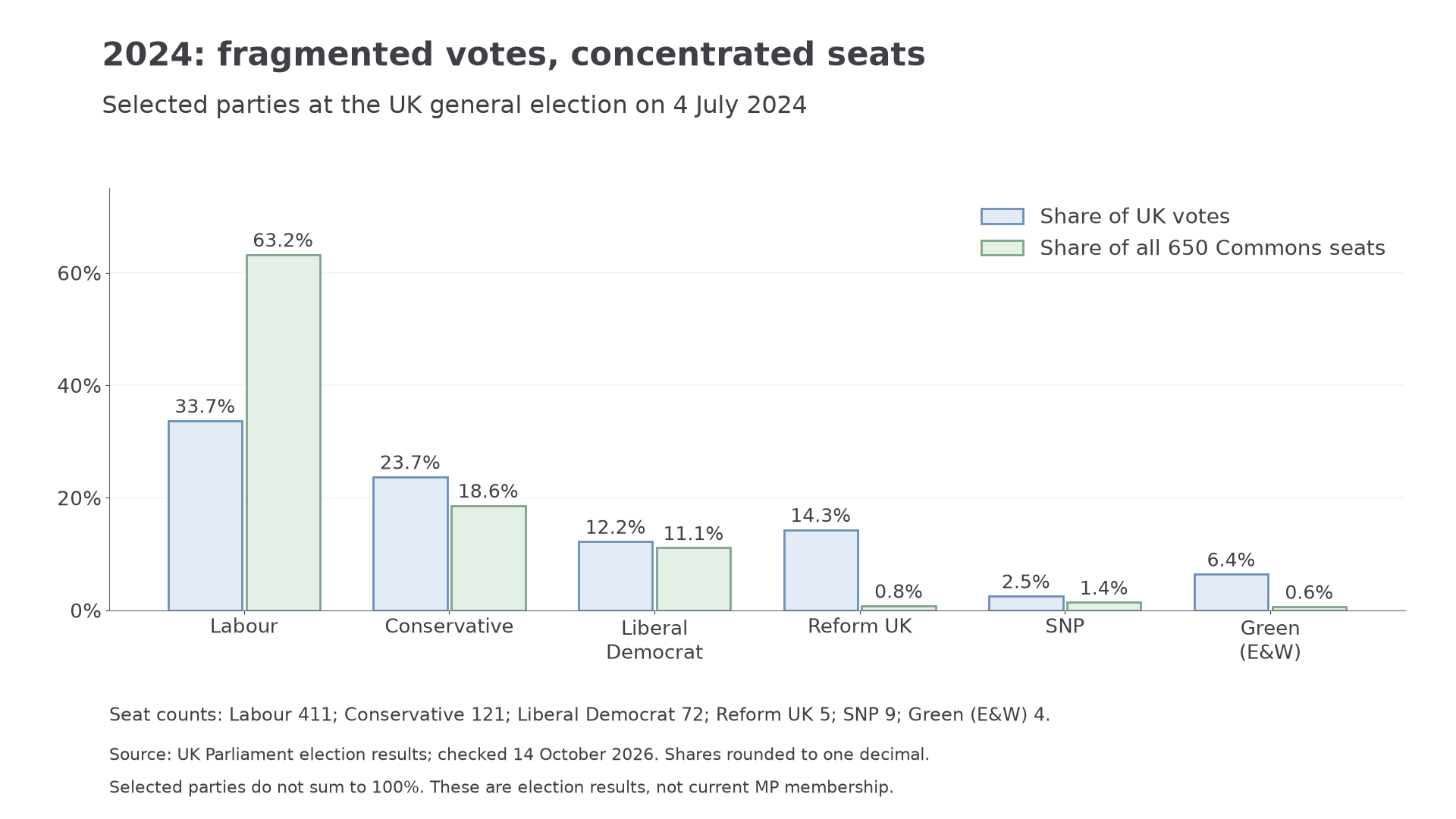
Selected-party vote and seat shares in 2024: both use percentages, but seats are divided by all 650 Commons constituencies. The chart shows an electoral conversion, not current MP membership or a prediction under proportional representation.
Labour and Conservatives together received 57.4% of the votes but won 532 seats. The calculation illustrates the simultaneous persistence of the two largest governing parties and fragmentation of electoral support. It does not prove that voters would choose identically under a different electoral system, or explain why each individual voted as they did.
Majorities, coalitions and support agreements
A government's security depends on its ability to command Commons confidence and supply, not simply on how many parties contested the election. Supply concerns parliamentary approval for government spending. Multi-party competition can produce a hung Parliament, but constituency outcomes can still give one party a large majority.
Hung Parliament
A Parliament in which no single party has an overall majority of Commons seats.
In 2010, Conservatives and Liberal Democrats formed a coalition, sharing ministerial office and agreeing a programme. A coalition can widen representation and pool parliamentary support, but requires compromise and may make responsibility for particular decisions less clear. The smaller partner gains access to power but risks losing its distinctive appeal. Parliament's account.
In 2017, Conservatives instead governed with a confidence-and-supply agreement with the DUP. The DUP supported specified crucial votes without becoming a coalition party in government. Bargaining supplied parliamentary support but did not guarantee agreement on every policy or vote. Commons Library account, 31 March 2020.
The 2024 election returned a large Labour majority despite fragmented votes. With many Commons seats, a governing party is less dependent on smaller parties to survive, although internal dissent, the Lords, territorial governments and public opinion can still constrain it. Electoral pluralism therefore does not automatically create coalition government.
Explaining success through interacting causes
Party success needs a defined measure: vote share, seats, entry into government, policy influence or survival. An explanation of why a party lost seats may differ from why it gained votes. Begin with the outcome before selecting causes.
Governing competence is voters' assessment of whether a party can deliver. Inflation, living standards and public-service performance can affect retrospective judgement of incumbents. However, the economy also responds to international events; an election result is not a controlled test of a government's economic decisions.
Policy appeal matters when a party offers credible answers to issues voters prioritise. Issue ownership means a party is particularly trusted on an issue. A rival can alter this through its proposals or record. Party unity helps communicate a clear programme, while division may signal competing ambitions or uncertainty. Unity alone is insufficient if voters dislike the programme.
Organisation and resources affect candidate selection, campaigning, voter contact and targeting. Tactical voting can concentrate support behind the candidate most likely to defeat an unwanted rival. Electoral rules then convert those local patterns into seats. In 2024 the Liberal Democrats won far more seats than Reform UK despite a lower UK vote share; the geographical and constituency pattern is necessary to explain that seat comparison. It is not evidence that Reform was less popular by the particular measure of national votes.
A causal chain is more useful than a list. For example: a damaged record can reduce trust; an opponent offers a credible alternative; targeted campaigns turn those preferences into constituency wins. The steps interact. Money helps communication but cannot ensure the message is persuasive; leadership may shape credibility, while credibility depends partly on policy and record.
Leadership as a mechanism of party success
Leaders can influence elections by making a party's programme understandable, managing disagreement and appearing capable of governing. Voters often use leadership as a shortcut when evaluating a complicated set of policies. A leader may also choose priorities, candidates or campaign strategy, so influence is broader than personal popularity.
If you sit in 2027: Issue 3 explicitly names the media in the success-and-failure bullet; Issue 4 explicitly adds leadership alongside it. Issue 3 still asks about various factors affecting success, so leadership remains a useful supported explanation. Shared tasks can assess that reasoning; a task specifically testing the amended list should be labelled for 2028 onwards.
Consider the 2010 Liberal Democrat experience. Campaign attention to Nick Clegg illustrates a route through which visibility could help a party be noticed and considered. Yet the party won 57 seats, compared with 62 in 2005. Attention or a favourable performance does not automatically produce additional seats. A proper explanation also considers vote distribution, rivals and electoral rules. Parliament election results.
Leaders can be the expression of deeper change rather than its sole cause. A leader who appears credible may benefit from an opponent's failing record or a popular policy programme. A new leader cannot instantly repair weak local organisation or an unpopular long-term position. Conversely, a poor campaign decision can disrupt an otherwise plausible strategy.
To assess a leadership argument, specify what changed: trust, party unity, publicity or targeting. Identify evidence that connects that change to voter behaviour. A correlation between a leader's poll rating and party support leaves open reverse causation: people may rate a leader favourably because they already support the party. Leadership is an explanatory factor whose weight must be tested against alternatives, not a biography to recount.
Media mechanisms and the limits of evidence
Media influence can operate through what voters encounter, which issues seem important and how events are interpreted. Agenda-setting makes an issue more prominent; framing presents it through a particular angle; endorsement encourages support for a party. Social media can spread a party's own messages, amplify criticism and allow targeted communication without an editor's initial selection.
Influence varies by audience and medium. Broadcast coverage is subject to due-impartiality rules, while newspapers can endorse parties. Social platforms mix reporting, advertising, personal views and misleading material. A national headline is not evidence that every voter saw it, trusted it or changed their mind. Readers may select outlets matching their existing views, creating a problem of selective exposure.
Read this original teaching source, which presents rival causal arguments rather than claiming a measured effect:
View A: Coverage affects party success because repeated attention to mistakes makes competence central to the election. Parties need effective communication to avoid being defined by opponents.
View B: Coverage often follows a party's record and audience preferences. A critical headline may reflect existing discontent, and voters can reject an outlet's endorsement.
Both recognise that media messages enter the campaign. They disagree over how much independent causal influence those messages have. View A supplies mechanisms of prominence and interpretation; View B highlights reverse causation and audience selection. Neither proves a universal effect from one endorsement.
For stronger evidence, combine the content and timing of coverage with exposure, voter attitudes and competing explanations. Before-and-after polling can suggest change but needs caution about other events and sampling. A survey asking voters about media influence gives their report, which may miss effects they do not recognise. Election results show outcomes but cannot isolate media from leadership, policy and governing record.
Explain success through a supported chain of causes. Distinguish votes from seats, visibility from persuasion, and association from evidence that one factor caused the result.