3.1 - Additional Member System and comparison with FPTP
The Additional Member System combines local contests with a second route into a legislature. This lesson follows both votes through the count, then compares the Scottish Parliament's system with FPTP in the House of Commons. The comparison shows how greater proportionality can coexist with constituency representation and why neither system guarantees a particular government.
Two votes and two routes to a seat
The Additional Member System gives a voter a constituency choice and a separate regional choice. It is a hybrid system because it combines two electoral mechanisms rather than replacing constituency elections entirely.
Additional Member System (AMS)
A system combining constituency representatives elected by FPTP with additional representatives allocated through a party-list vote. The additional seats compensate, to a degree, for uneven constituency results.
In Scotland, the first vote is for one constituency candidate. The largest candidate total wins, even if below 50%, just as in a Commons FPTP contest. The second vote is for a party list or an independent candidate in a larger region. A party's list is ordered before the election; voters cannot rearrange its candidates. The two votes need not support the same party. A voter can choose an effective local candidate while backing a different party's wider programme on the regional ballot.
The Scottish Parliament has 73 constituency seats and 56 regional seats: eight regions each elect seven regional MSPs, giving 129 in total. A voter is represented by one constituency MSP and seven regional MSPs. The regional vote does not mean that every voter personally elects one additional member. Scottish Parliament explanation of MSPs and AMS, checked 14 October 2026.
Compensating with additional seats
The regional allocation takes account of seats already won, so the second election is not simply a separate award of seats to the most popular party. Scotland uses a modified d'Hondt allocation. For each regional seat, divide a party's regional votes by one plus the seats it already holds in that region, including its constituency seats and regional seats already allocated. The largest quotient wins the next seat; then recalculate.
This adjustment makes a party with many constituency seats less likely to win the next regional seat than a similarly supported party with few. The Scottish Parliament electoral-system factsheet explains this compensating rule. The following smaller invented region demonstrates it; a real Scottish region has seven additional seats.
Party A has 40,000 regional votes and three constituency seats; B has 35,000 votes and one seat; C has 25,000 votes and no seats. Three additional seats are available. All parties have enough candidates on their lists, and there are no tied quotients.
| Additional seat | A's quotient | B's quotient | C's quotient | Winner |
|---|---|---|---|---|
| First | 40,000 ÷ 4 = 10,000 | 35,000 ÷ 2 = 17,500 | 25,000 ÷ 1 = 25,000 | C |
| Second | 10,000 | 17,500 | 25,000 ÷ 2 = 12,500 | B |
| Third | 10,000 | 35,000 ÷ 3 ≈ 11,666.67 | 12,500 | C |
Final seats are A: 3, B: 2, C: 2. C has gained representation despite winning no constituency. A's constituency seats are kept; they are not taken away. The combined result is closer to the regional vote proportions than the original 3–1–0 constituency result, but not perfectly proportional. A limited number of compensating seats and separate regions constrain the correction. The calculation is a teaching illustration, not a distinct official exam-question family.
[DIAGRAM: asset_slug: s03-ams-compensation; description: Invented AMS region showing the 3–1–0 constituency seats and the final 3–2–2 seats after three compensating seats.]
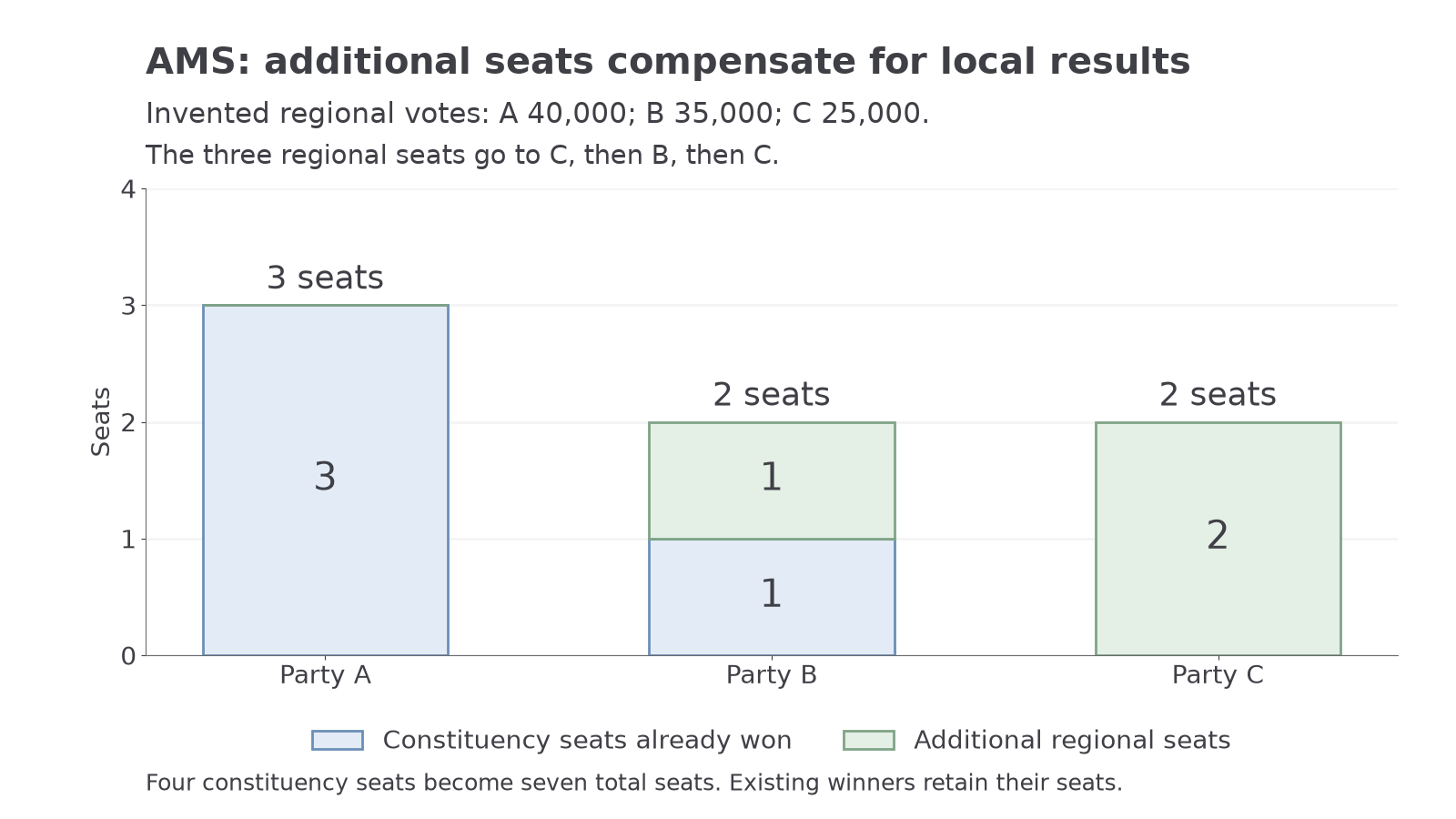
Exact seat counts from the invented allocation above; totals are four constituency seats and seven seats after the top-up.
Comparing Commons FPTP with Scottish AMS
A useful comparison asks the same question of both systems and explains the reason for the difference. Both Commons FPTP and Scottish AMS have single-member constituency elections decided by plurality. Only AMS adds regional seats that compensate for constituency outcomes. The difference is therefore the additional route into Parliament, not the disappearance of local MPs or MSPs.
| Shared dimension | Commons FPTP | Scottish AMS | Explained consequence |
|---|---|---|---|
| Voter choice | One constituency candidate | Constituency candidate plus separate regional list/independent | AMS permits a split vote between local and wider preferences. |
| Party representation | Constituency wins alone determine seats | Regional allocation also counts existing constituency wins | AMS can represent parties whose support fails to win local contests. |
| Representative link | One constituency MP | One constituency and seven regional MSPs | AMS retains a local link while offering several representatives to contact. |
| Government | No compensating seats reduce a winner's seat advantage | Compensating seats usually limit that advantage | AMS often makes a single-party majority harder, but does not rule one out. |
In Scotland's 6 May 2021 election, the SNP won 62 of the 73 constituency seats but only two of the 56 regional seats. The Scottish Greens won eight seats, all regionally. The SNP finished on 64 of 129, one short of the 65 required for an absolute seat majority. These figures show what compensation can do: constituency dominance did not translate into an equally dominant share of the whole Parliament. Scottish Parliament 2021 statistical record.
Compare that mechanism with the 2024 Commons election, where Labour's 411 seats were awarded through constituency wins alone. There was no regional top-up for parties winning few local contests. Commons Library 2024 results. These are different elections with different electorates and party competition. They support an institutional comparison; they do not prove that changing the Commons voting system would reproduce Scotland's parties or its 2021 result.
Choice, party lists and government
AMS broadens the choice voters can express while leaving some choices in party hands. A split vote can separate a judgement about a constituency candidate from support for a party programme. Regional representation gives supporters of a locally unsuccessful party another way to obtain a representative. However, the closed regional list lets parties decide which of their candidates receive the seats. Voters can reject the list but cannot promote a particular person within it.
Having constituency and regional representatives may make access easier, but can also create confusion about responsibility or rivalry over constituency work. Both categories are members of the same Parliament with legislative responsibilities; “additional” does not mean second-class. AMS also asks voters to understand two ballots and an allocation that is less immediately transparent than a local plurality count.
More proportional party representation can leave no party with a seat majority. A coalition government brings ministers from two or more parties into one government, normally after agreement on policies and offices. A minority government instead governs without an overall seat majority and seeks external support. Coalition compromise may widen the interests represented in policy, but can make it harder to assign responsibility and can alter manifesto commitments after voting.
Do not turn tendencies into rules. The SNP won 69 of 129 Scottish seats in 2011 under AMS, enough for a majority. Conversely, Commons FPTP produced a coalition after 2010. Scottish Parliament 2011 result; Parliament on hung Parliaments. The voting system shapes the bargaining conditions; electoral support and party decisions still determine the actual government.
AMS trades a simpler single contest for two forms of representation. Its merits depend on how much weight is given to proportionality, candidate control, local access and clear responsibility.
Interpreting evidence about compensation
Evidence of a regional top-up supports a claim about representation more directly than a claim about good government. Consider this original teaching source: “Giving regional seats to parties that lose constituency contests makes representation fairer. But party-controlled lists weaken voters' control over individual candidates, and cooperation between parties can obscure responsibility for policy.”
The first sentence values party proportionality. The next distinguishes candidate choice and government accountability from party representation. A voter may support the source's first claim while accepting either limitation. “Fairer” needs a specified criterion: a closer votes-to-seats relationship is one meaning, but direct choice of a particular politician is another.
The invented allocation and Scotland's 2021 result show why the compensation claim is plausible. A party with no constituency success can still win additional seats. The list rule supplies a mechanism for the candidate-choice criticism. Neither source nor result proves that all inter-party cooperation obscures responsibility; published agreements, ministerial accountability and subsequent elections can help voters judge the parties involved.
An argument favouring AMS can therefore acknowledge the limitations while giving greater weight to representation of different parties. An argument favouring FPTP can prioritise individual local accountability while acknowledging disproportionality. A reasoned verdict compares criteria rather than assuming that one system possesses every democratic virtue.