1.8-1.9 - Elements, compounds, mixtures and purity
Chemists classify materials by what particles are present and whether those particles are chemically joined. This lesson builds the three key labels, element, compound and mixture, then uses melting and boiling point data to decide whether a substance is pure. The exam skill is not just naming the category; it is giving the evidence for the category.
The classification decision
Start by asking: is the sample made from one substance, or does it contain more than one substance?
If it is one substance, it is either an element or a compound. If it contains more than one substance physically mixed together, it is a mixture.
| Classification | What must be true | Examples |
|---|---|---|
| Element | Contains only one type of atom | helium, oxygen, copper |
| Compound | Contains atoms of different elements chemically joined together | water, carbon dioxide, sodium chloride |
| Mixture | Contains two or more elements and/or compounds not chemically joined to each other | air, salt water, sand and iron filings |
An element can exist as separate atoms, such as helium, or as molecules made from identical atoms, such as oxygen molecules. That still counts as an element because only one type of atom is present.
In a compound, different elements are chemically joined in a fixed arrangement or ratio. Water is a compound because every water particle contains hydrogen and oxygen chemically joined together.
A mixture is different because it has more than one kind of substance present. The substances in a mixture are together in the same sample, but they have not reacted to make one new compound.
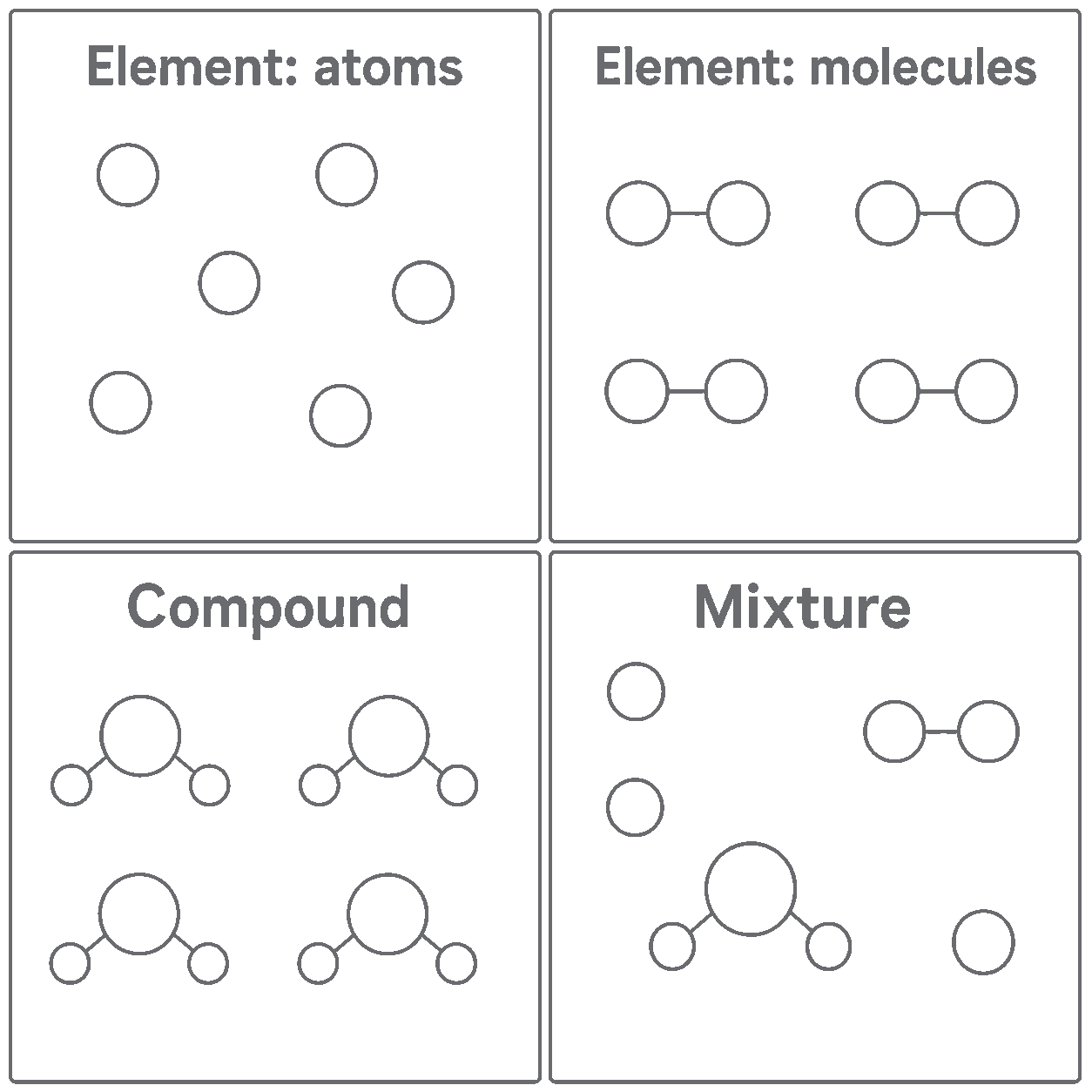
[DIAGRAM: asset_name: Elements, compounds, mixtures and purity - diagram 01; asset_slug: c03_elements_compounds_mixtures_and_purity__diagram_01; recommended_method: image_gen; description: Monochrome particle-model panels showing an element made of separate identical atoms, an element made of identical diatomic molecules, a compound made of identical molecules containing two atom types bonded, and a mixture containing more than one particle type.]
Reading particle pictures
Particle diagrams are a common way to test classification. They usually do not require you to know the real substance; you read the pattern of particles.
If every particle contains only one type of atom, the sample is an element. The atoms may be separate, or they may be joined into molecules made from identical atoms. For example, a diagram of several H-H molecules represents an element because hydrogen is the only atom type present.
If every particle is identical but each particle contains different atom types chemically joined, the sample is a compound. A diagram with only H-O-H particles represents a compound because each particle contains hydrogen and oxygen joined together.
If the box contains more than one type of particle, it is a mixture. A mixture might contain two elements, two compounds, or an element and a compound together. The key is that the whole box does not consist of one identical substance.
Be careful: "molecule" does not automatically mean compound. Oxygen molecules, O2, are molecules of an element. Carbon dioxide molecules, CO2, are molecules of a compound.
Compounds versus mixtures
The hardest boundary is often compound versus mixture. Both can involve more than one element, but the elements are arranged differently.
In a compound, the atoms are chemically joined. The compound is one substance, so it has its own properties. Hydrogen chloride is a compound because hydrogen and chlorine atoms are chemically joined in hydrogen chloride particles.
In a mixture, the substances are not chemically joined to each other. Air is a mixture because it contains several gases, including nitrogen, oxygen, argon and carbon dioxide, in the same sample. Those gases are not all chemically joined into one new substance.
A mixture does not have one fixed composition. Salt water can contain a little salt or a lot of salt. Both samples are salt water, but the proportions of water and sodium chloride can vary. A pure compound does not vary like that: pure water is always water particles, not "mostly water particles".
This is why a mixture does not usually have one chemical formula for the whole sample. A compound can often be represented by a formula, such as HCl or H2O, because it has a fixed composition.
Purity and temperature
In chemistry, a pure substance means a single element or a single compound. It does not mean "safe", "natural", "expensive" or "clean" in the everyday sense.
Pure substances have fixed melting points and fixed boiling points. If a pure substance is heated at steady pressure, the temperature stays constant while it melts or boils. The energy being supplied is used to change state, not to raise the temperature.
A mixture may melt or boil over a range of temperatures. Different substances in the mixture can begin to change state at different temperatures, so the temperature does not stay fixed in the same sharp way.
[DIAGRAM: asset_name: Elements, compounds, mixtures and purity - diagram 02; asset_slug: c03_elements_compounds_mixtures_and_purity__diagram_02; recommended_method: deterministic_drawing; description: Monochrome temperature-against-time graph comparing a pure substance with flat melting and boiling plateaus against a mixture that changes state over a sloped range of temperatures.]
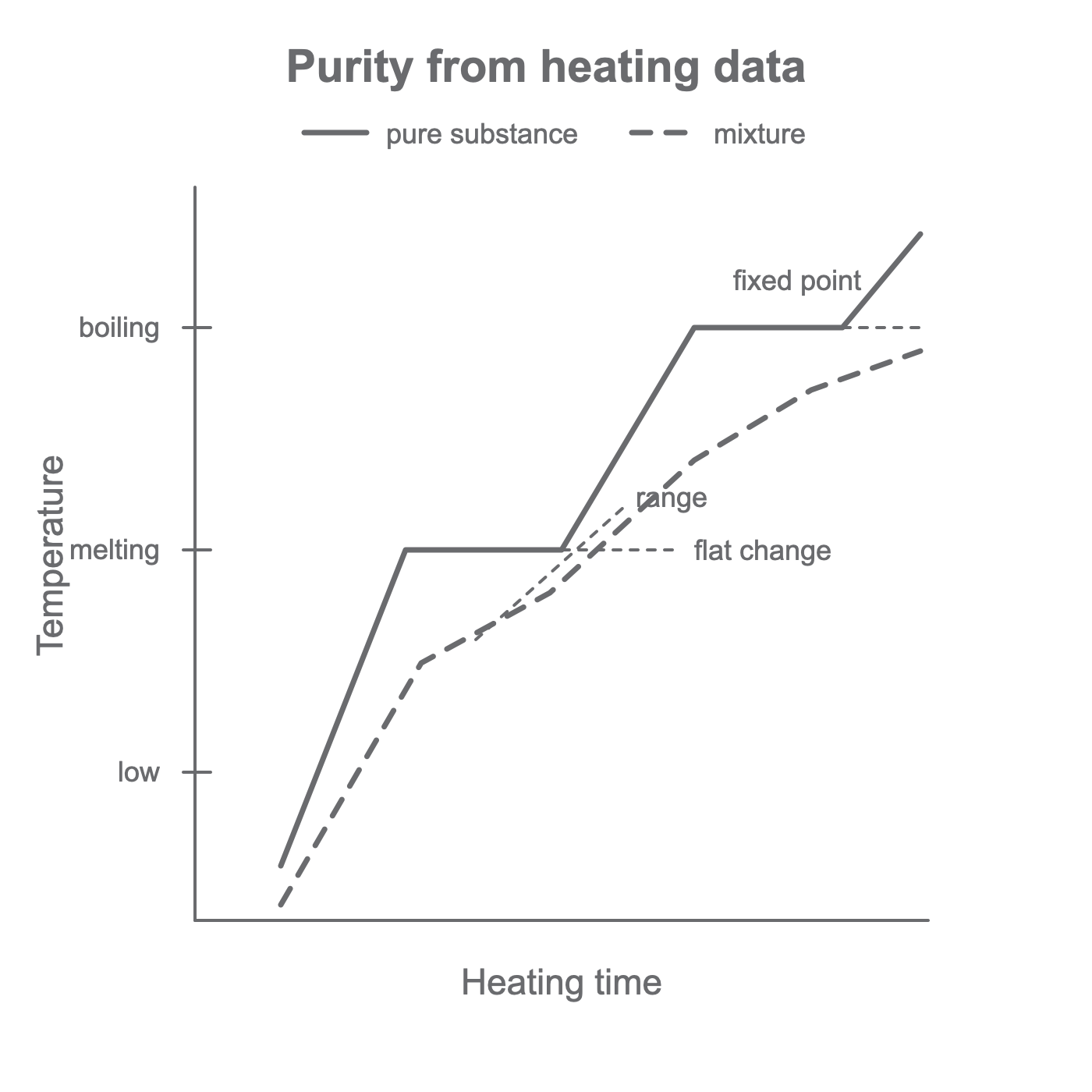
Suppose a liquid is expected to be pure ethanol. Pure ethanol boils at a fixed temperature. If the liquid boils steadily over a range, for example from 78 degrees C to 84 degrees C, that is evidence that the sample is a mixture or is impure.
The same idea works for melting. A pure solid has a sharp melting point. An impure solid or mixture may soften and melt over a range of temperatures.
Exam reasoning
Pearson-style questions often give you a diagram, a formula, a name, or temperature data. Your answer needs both the classification and the reason.
For an element, say that only one type of atom is present. If the element is molecular, such as O2, still focus on the atom type: oxygen only.
For a compound, say that atoms of different elements are chemically joined. Do not call a compound a mixture just because it contains more than one element.
For a mixture, say that more than one substance or more than one type of particle is present and they are not chemically joined into one substance.
For purity, use the words fixed, sharp or range carefully. "It has a boiling point of 100 degrees C" is weaker than "measure its boiling point; pure water boils at a fixed temperature of 100 degrees C at normal pressure". The test and the result both matter.
Worked example: a sample contains only H-H particles and H-O-H particles. Classify the sample.
The sample is a mixture because it contains two different particle types. One particle type is an element molecule and the other is a compound molecule, but together in one sample they form a mixture.