1.23-1.24 - Group trends and noble gases
The Periodic Table is not just a list of elements: it puts elements with related electron arrangements into the same vertical groups. This lesson explains why elements in the same group often react in similar ways, and why the noble gases in Group 0 are different because their outer shells are already full.
Groups and outer electrons
A group is a vertical column in the Periodic Table. For main group elements, group position is linked to the outer-shell electron pattern: Groups 1 to 7 have 1 to 7 outer-shell electrons, while Group 0 has a full outer shell.
Chemical properties
Chemical properties describe how a substance reacts and what substances it forms in chemical reactions.
For Groups 1 to 7, elements in the same group have similar chemical properties because their atoms have the same number of electrons in the outer shell. For Group 0, the shared pattern is a full outer shell. In both cases, the outer shell is the part that is most involved when atoms react.
For example, lithium, sodium and potassium are in the same group. Their electron configurations are different overall, but each atom has one electron in its outer shell:
- lithium: 2,1
- sodium: 2,8,1
- potassium: 2,8,8,1
[DIAGRAM: asset_name: Group trends and noble gases - diagram 01; asset_slug: c08_group_trends_and_noble_gases__diagram_01; recommended_method: image_gen; description: Monochrome Bohr-style diagrams for Li 2,1, Na 2,8,1 and K 2,8,8,1, highlighting that each has one outer-shell electron and therefore similar chemical properties.]
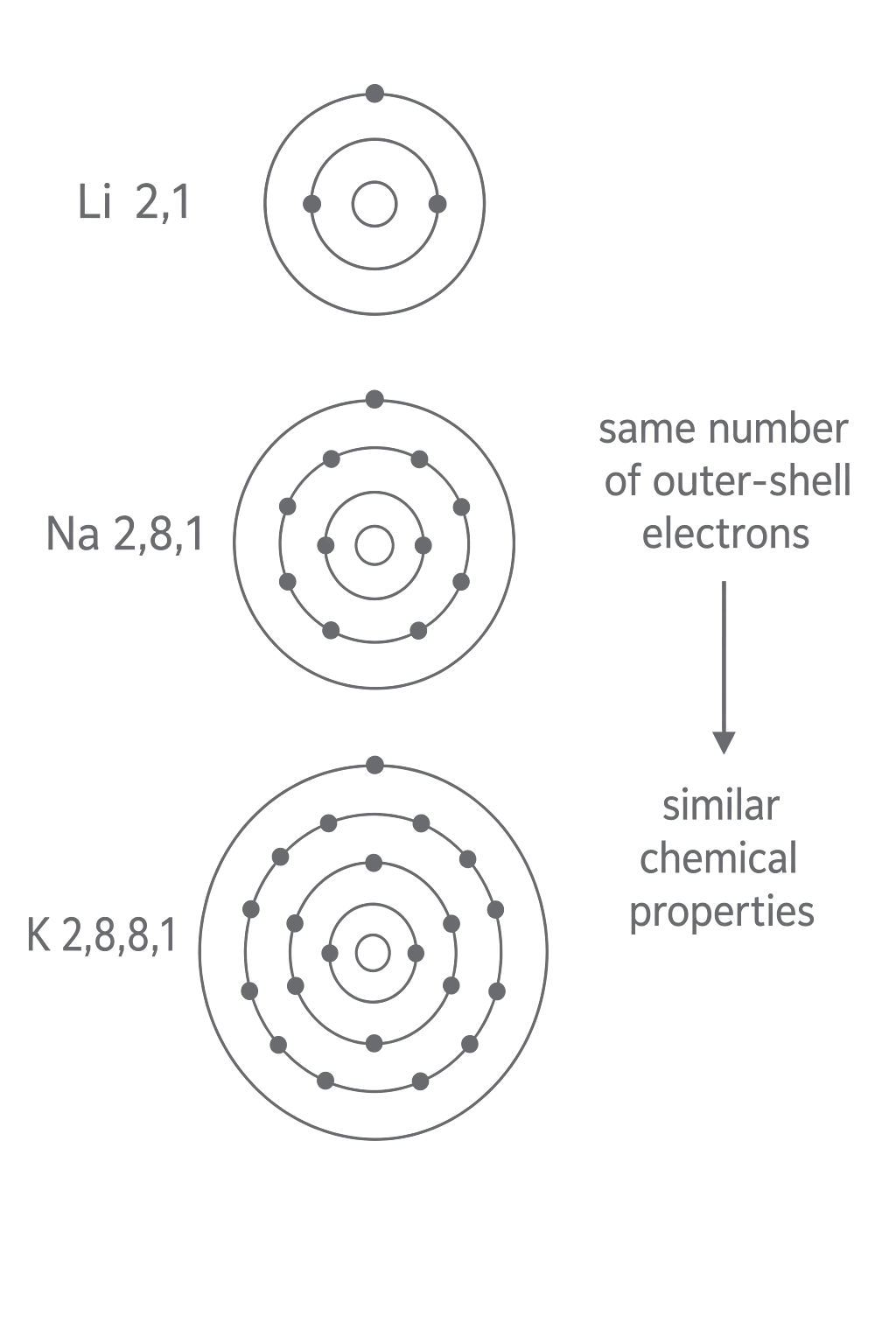
For lithium, sodium and potassium, the exam link is: same Group 1 position means one outer-shell electron, so the atoms tend to take part in similar kinds of reactions.
Similar does not mean identical
"Similar chemical properties" does not mean every element in a group reacts at exactly the same speed or with exactly the same observations. It means the atoms have a related outer-shell pattern, so their reactions often have the same overall type.
It is useful to separate two ideas:
| Idea | What to look for |
|---|---|
| Chemical similarity | Groups 1 to 7: same number of outer-shell electrons; Group 0: full outer shell |
| Physical trends | changes in properties such as melting point, boiling point or density |
This lesson is mainly about the reason for chemical similarity. Later lessons look more closely at particular groups, such as alkali metals and halogens, and how their reactivity changes down the group.
The most common mistake is to say only "they are in the same group" without linking this to electrons. The group position matters because it shows the repeated outer-shell arrangement.
Noble gases
The noble gases are the elements in Group 0. They include helium, neon and argon. They do not readily react because their atoms already have full outer shells.
Noble gas
A Group 0 element with a full outer shell of electrons, so it does not readily react.
Helium is the small exception to the "eight in the outer shell" shortcut: helium has only one shell, and that first shell is full with two electrons. Neon and argon have full outer shells with eight electrons.
| Noble gas | Electron configuration | Why the outer shell is stable |
|---|---|---|
| Helium | 2 | first shell is full |
| Neon | 2,8 | outer shell has 8 electrons |
| Argon | 2,8,8 | outer shell has 8 electrons |
[DIAGRAM: asset_name: Group trends and noble gases - diagram 02; asset_slug: c08_group_trends_and_noble_gases__diagram_02; recommended_method: image_gen; description: Monochrome Bohr-style diagrams for He 2, Ne 2,8 and Ar 2,8,8, showing full outer shells and little tendency to lose, gain or share electrons.]
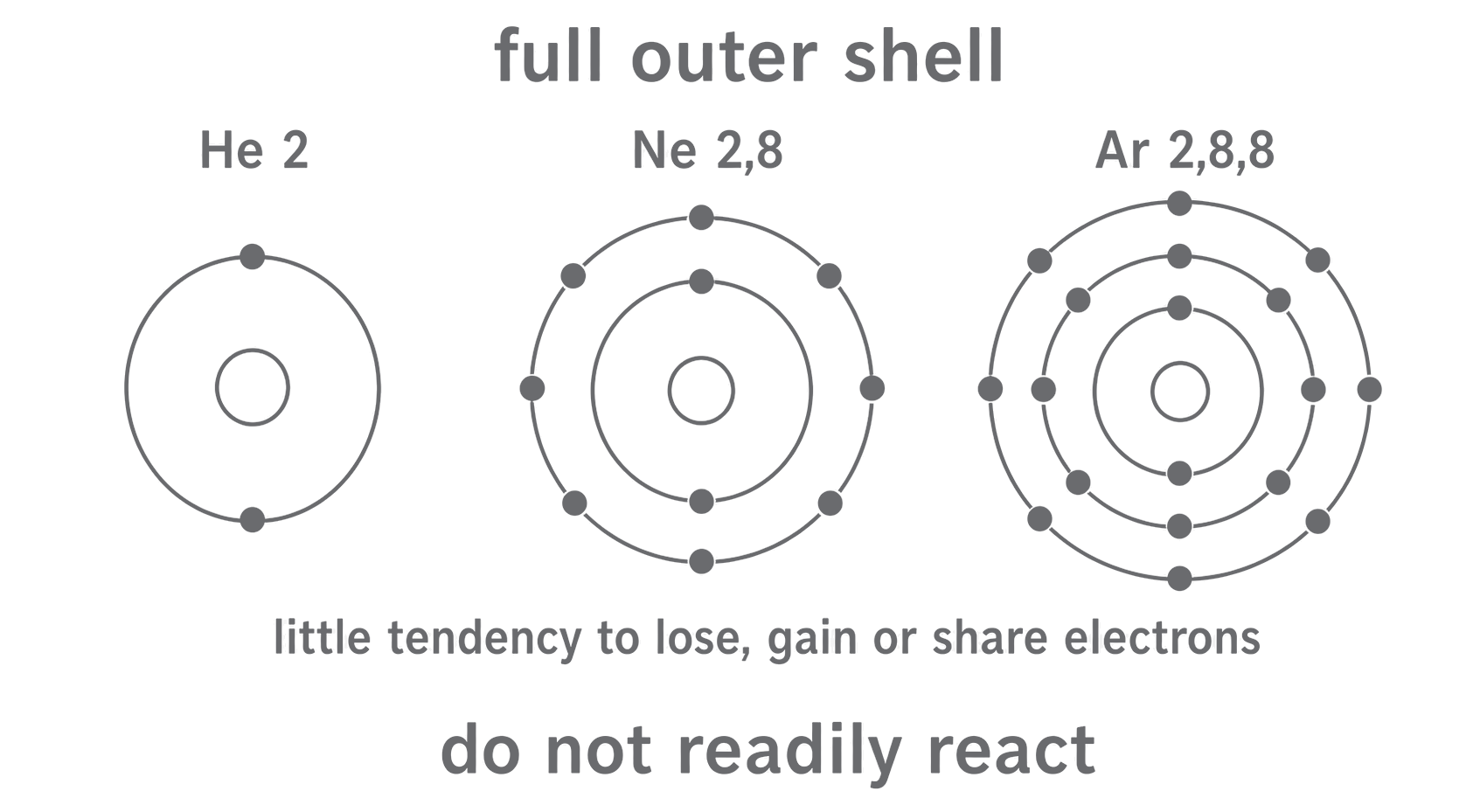
Because their outer shells are full, noble gas atoms have little tendency to lose, gain or share electrons. That is why they do not readily form compounds.
The exam answer chain
Pearson-style answers usually reward linked reasoning. For this lesson, the safest answer chain is:
- Identify the electron arrangement.
- Link it to the outer shell.
- Link the outer shell to chemical reactions.
For same-group elements in Groups 1 to 7, the chain is:
Groups 1-7: same group -> same number of outer-shell electrons -> similar chemical properties
For Group 0 noble gases, the chain is:
full outer shell -> little tendency to lose, gain or share electrons -> do not readily react
Use "do not readily react" rather than "never react". The specification wording is careful: noble gases are very unreactive at this level, but the required reason is their full outer shell.
Outer-shell electrons explain both ideas: in Groups 1 to 7, same-group elements have similar chemical properties because they have the same number of outer-shell electrons; Group 0 noble gases do not readily react because their outer shells are full.
Use that idea to check whether an answer is really explaining the chemistry, not just naming a group.