1.36 - Formula of a metal oxide practical
A metal oxide contains a metal chemically combined with oxygen. In this practical, the formula is found from mass measurements: either oxygen is added to a metal by combustion, or oxygen is removed from a metal oxide by reduction. The skill is not just doing the heating; it is using the mass change to find the simplest ratio of metal atoms to oxygen atoms.
Using mass to find formula
The formula found from this practical is the empirical formula: the simplest whole-number ratio of atoms of each element in the compound.
Empirical Formula
The simplest whole-number ratio of atoms of each element in a compound.
For a metal oxide, the aim is to find the ratio:
The mass data is converted into amounts of substance using relative atomic masses:
Amount From Mass
In a combustion practical, the metal gains oxygen, so the mass of oxygen is found from the increase in mass:
In a reduction practical, the metal oxide loses oxygen, so the mass of oxygen is found from the decrease in mass:
Once the masses of the metal and oxygen are known, the calculation route is always the same: convert each mass to moles, divide both mole values by the smaller value, then write the simplest whole-number ratio as the formula.
Magnesium oxide by combustion
Magnesium oxide can be made by heating magnesium in air. Magnesium reacts with oxygen to form magnesium oxide:
The magnesium is heated in a crucible with a lid. The lid matters because this reaction can produce a fine white powder of magnesium oxide. If the lid is left off for too long, some product can escape, giving an inaccurate final mass.
[DIAGRAM: asset_name: Formula of a metal oxide practical - diagram 01; asset_slug: c13_formula_of_a_metal_oxide_practical__diagram_01; recommended_method: image_gen; description: Monochrome labelled apparatus diagram for determining magnesium oxide formula by combustion. Show a crucible and lid on a pipeclay triangle and tripod, heated by a Bunsen burner on a heat-resistant mat. Tongs lift the lid slightly so air enters while oxide is kept in. Labels include crucible and lid, magnesium ribbon, pipeclay triangle, tripod, Bunsen burner, heat-resistant mat, lift lid slightly, air in, and oxide kept in.]
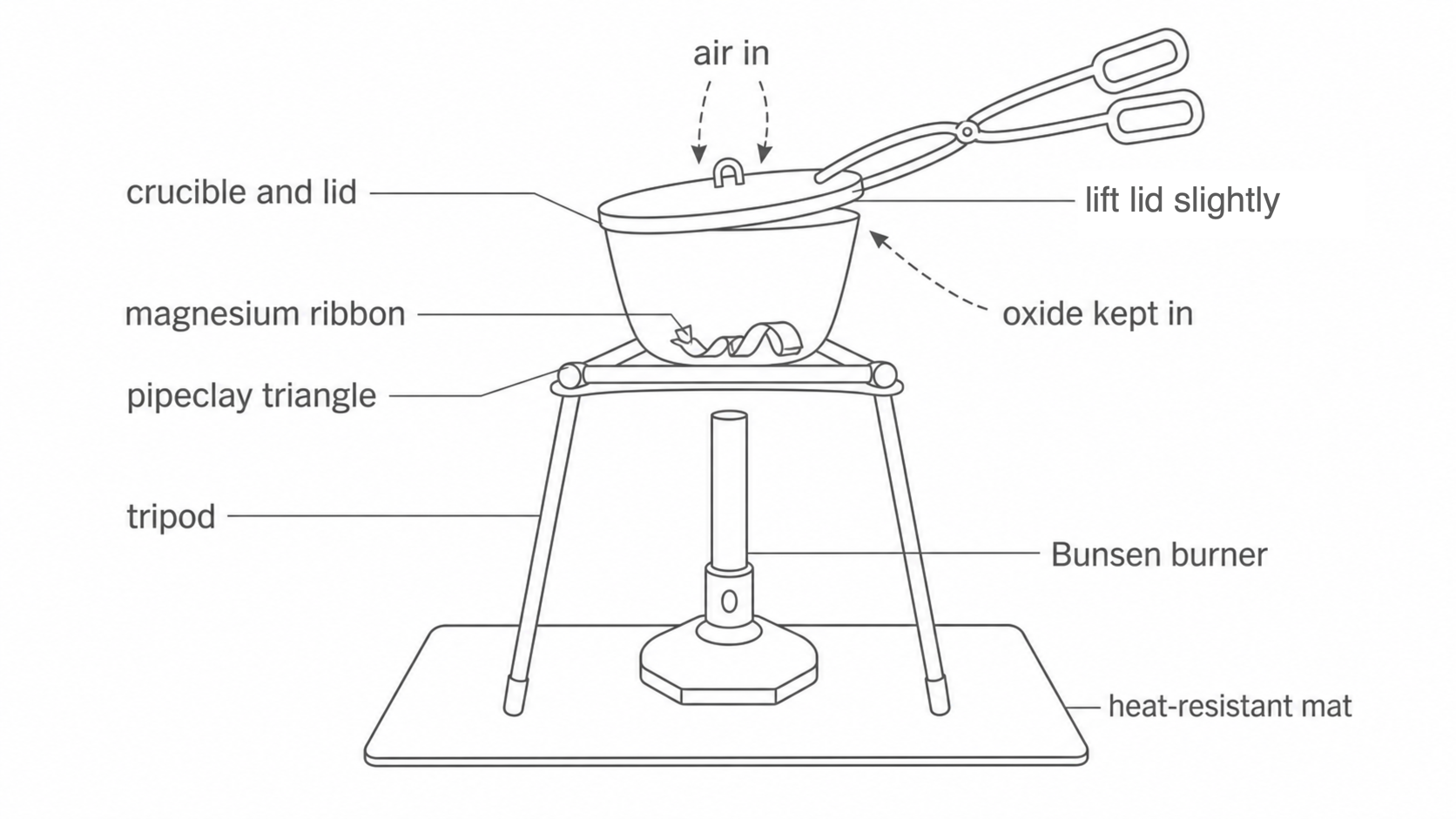
A suitable method is:
- Weigh the empty crucible and lid.
- Clean the magnesium ribbon if it is tarnished, then coil it loosely so oxygen can reach it.
- Place the magnesium in the crucible and weigh the crucible, lid and magnesium.
- Heat the crucible strongly with the lid on.
- Lift the lid slightly from time to time to allow oxygen in, then replace it quickly.
- When there is no further reaction, allow the crucible and contents to cool.
- Weigh the crucible, lid and magnesium oxide.
- Reheat, cool and reweigh until two consecutive masses are the same or very close.
Constant Mass
A solid has been heated to constant mass when repeated heating, cooling and weighing gives the same mass, or nearly the same mass.
Heating to constant mass is evidence that the reaction has gone as far as it can under the conditions. If the mass keeps increasing, more magnesium may still be reacting with oxygen.
Important safety points are to wear eye protection, avoid looking directly at burning magnesium, handle hot apparatus with tongs, and allow the crucible to cool before weighing.
Magnesium oxide data
Suppose the results are:
| Measurement | Mass in g |
|---|---|
| crucible + lid | 23.10 |
| crucible + lid + magnesium | 23.70 |
| crucible + lid + magnesium oxide | 24.10 |
First find the reacting masses:
Then convert masses to amounts:
The ratio is:
The empirical formula is therefore:
Results in this practical are often less neat than the worked example. If magnesium oxide escapes when the lid is lifted, the final mass is too low, so the calculated mass of oxygen is too low. If magnesium is coiled too tightly, oxygen cannot reach all of it, so not all the magnesium reacts. If the product still looks grey, that is a warning sign that some magnesium may be unreacted.
Good evaluation answers name the error and state its effect on the calculated formula. "Some product escaped" is weaker than "some magnesium oxide escaped, so the measured mass of oxygen was too low."
Copper oxide by reduction
Copper(II) oxide can be reduced to copper. In this context, reduction means removing oxygen from the oxide. Hydrogen can remove oxygen from copper(II) oxide, producing copper and water:
The metal oxide is weighed before heating. After reduction, the copper left behind is weighed. The loss in mass is the oxygen removed from the copper(II) oxide.
[DIAGRAM: asset_name: Formula of a metal oxide practical - diagram 02; asset_slug: c13_formula_of_a_metal_oxide_practical__diagram_02; recommended_method: image_gen; description: Monochrome labelled apparatus diagram for determining copper(II) oxide formula by reduction with hydrogen. Show hydrogen entering a clamped horizontal reduction tube containing copper(II) oxide, hydrogen flowing left to right, a Bunsen burner heating the oxide, copper formed in the heated region, and excess hydrogen burning at the outlet. Labels include hydrogen in, flush air out first, reduction tube, copper(II) oxide, hydrogen flow, Bunsen burner, copper formed, clamp stand, and excess hydrogen burns.]
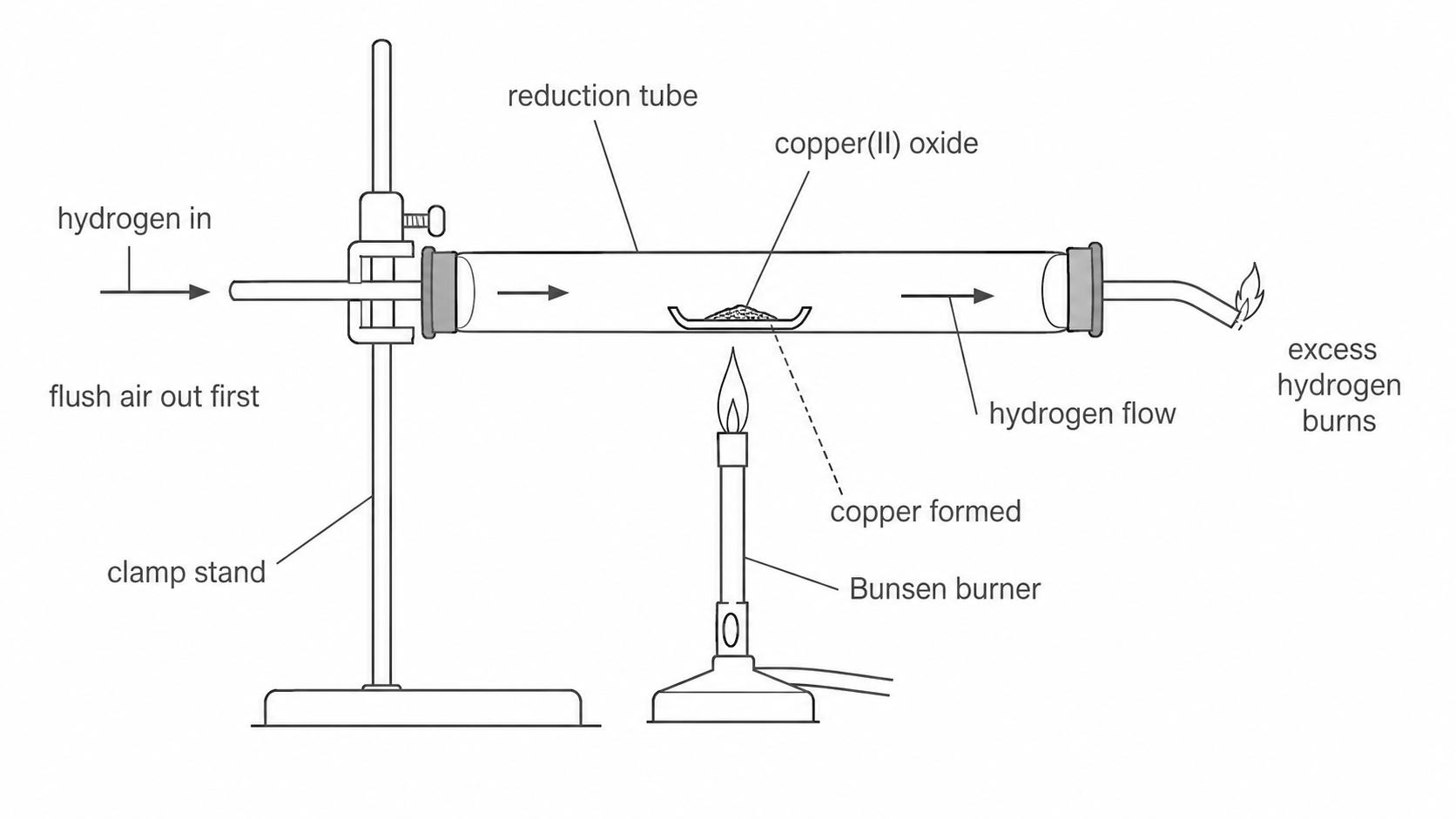
A suitable teacher-demonstration method is:
- Weigh the empty reduction tube.
- Add dry copper(II) oxide and weigh the tube and copper(II) oxide.
- Clamp the tube and pass hydrogen through it to flush out air before heating.
- Light the excess hydrogen at the outlet only after the air has been flushed out.
- Heat the copper(II) oxide strongly with a Bunsen burner.
- Continue heating until reduction is complete.
- Allow the copper to cool while hydrogen is still passing over it.
- Weigh the tube and copper after cooling.
Hydrogen mixed with air can explode, so the air must be flushed out before ignition. Pearson guidance is also clear that hydrogen for this practical should not be generated by reacting an acid with a metal because the explosion risk is high. Depending on the laboratory and class, this reduction practical may be done as a teacher demonstration rather than a student class practical.
Keeping hydrogen flowing while the copper cools prevents hot copper from reacting again with oxygen in air to reform copper oxide.
Copper oxide data and comparison
Suppose the results are:
| Measurement | Mass in g |
|---|---|
| empty reduction tube | 28.93 |
| tube + copper(II) oxide | 33.02 |
| tube + copper after reduction | 32.21 |
The mass of copper(II) oxide at the start is:
The mass of copper at the end is:
The mass of oxygen removed is:
Now convert to amounts:
This is very close to a 1:1 ratio, so the empirical formula is:
The two practical routes use opposite mass changes:
- in combustion, the metal gains oxygen, so the sample mass increases
- in reduction, the oxide loses oxygen, so the sample mass decreases
In both cases, constant mass improves confidence in the result. For magnesium, constant mass shows no more oxygen is being gained. For copper(II) oxide, constant mass shows no more oxygen is being removed.
Common errors in the reduction route include incomplete reduction, copper reoxidising while hot, powder being lost, and weighing the tube before it has cooled. Each error affects the masses, so each can affect the mole ratio and formula.