1.14-1.17 - Atoms, subatomic particles, isotopes and Ar
Chemistry explains substances by thinking about the particles they are made from. In this lesson, you meet the particle vocabulary that sits underneath the rest of the course: atoms, molecules, protons, neutrons, electrons, atomic number, mass number, isotopes and relative atomic mass. The calculation skill is a weighted mean, but the chemistry meaning matters just as much as the arithmetic.
Atoms and molecules
An atom is the smallest particle of an element that still has the identity of that element. A single atom of carbon is carbon because it has the proton number of carbon. If the proton number changed, it would be a different element.
Atom
An atom is the smallest particle of an element that can exist and still be recognised as that element.
A molecule is made when two or more atoms are chemically joined together. The atoms in a molecule may be the same element, such as oxygen molecules, or different elements, such as water molecules.
Molecule
A molecule is a particle made from two or more atoms chemically joined together.
The words atom and molecule are not interchangeable. An atom is one particle of an element. A molecule contains more than one atom. For example, O represents one oxygen atom, while O2 represents a molecule containing two oxygen atoms joined together. H2O represents one water molecule containing two hydrogen atoms and one oxygen atom.
This lesson does not need the detailed bonding explanation yet. For now, keep the particle count clear: one atom is a single atom; one molecule is a group of joined atoms.
Subatomic particles
Atoms are not solid balls. They contain three smaller subatomic particles: protons, neutrons and electrons.
The centre of an atom is the nucleus. The nucleus contains protons and neutrons and has almost all the mass of the atom. Electrons are outside the nucleus. They have a negative charge and a very small mass compared with protons and neutrons.
[DIAGRAM: asset_name: Atoms, subatomic particles, isotopes and Ar - diagram 01; asset_slug: c05_atoms_subatomic_particles_isotopes_and_ar__diagram_01; recommended_method: image_gen; description: Monochrome NovaLearn-style educational diagram of a simple atom. Show a central nucleus containing labelled protons p+ and neutrons n0, with electrons e- outside the nucleus. Include clear labels for nucleus, proton, neutron and electron. White background; #6A6B6E linework and text only.]
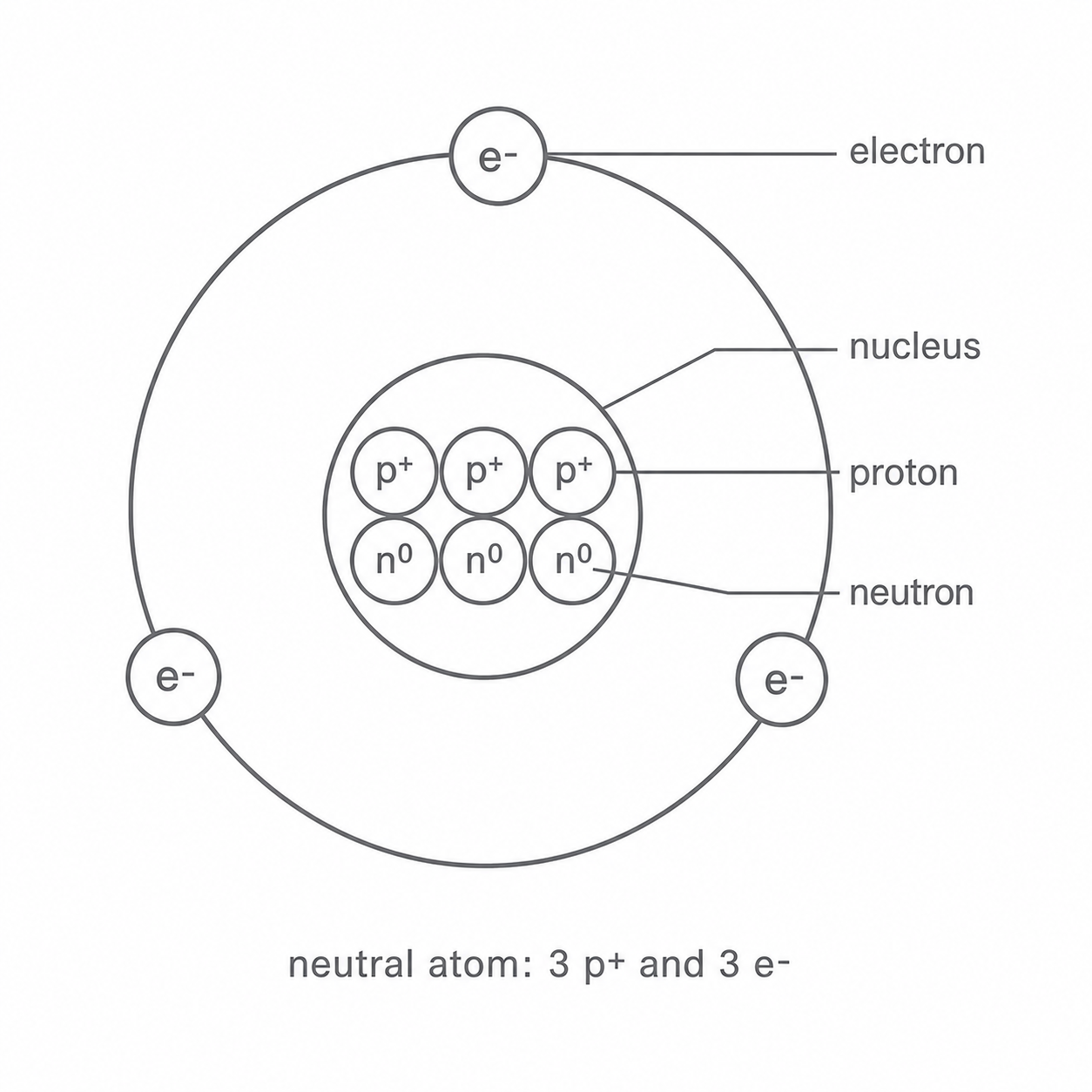
The relative masses and charges are part of the specification and should be learned exactly.
| Particle | Position in the atom | Relative mass | Relative charge |
|---|---|---|---|
| Proton | In the nucleus | 1 | +1 |
| Neutron | In the nucleus | 1 | 0 |
| Electron | Outside the nucleus | Very small, about 1/1840 | -1 |
Because protons and neutrons each have relative mass about 1, nearly all the mass of an atom is in the nucleus. Because electrons have a negative charge and protons have a positive charge, a neutral atom has the same number of electrons as protons. The positive and negative charges cancel overall.
Do not confuse mass with charge. A neutron has mass but no charge. An electron has charge but very little mass.
Atomic number and mass number
Two numbers are used to describe the nucleus of an atom.
Atomic number
The atomic number is the number of protons in the nucleus of an atom.
Atomic number is also called proton number. It identifies the element. Every atom of carbon has 6 protons. Every atom with 6 protons is carbon. If an atom had 7 protons, it would be nitrogen instead.
Mass number
The mass number is the total number of protons and neutrons in the nucleus of an atom.
The mass number counts the heavy subatomic particles in the nucleus. Electrons are not included because their relative mass is very small.
For a neutral atom:
| Quantity | How to find it |
|---|---|
| Number of protons | atomic number |
| Number of electrons | same as number of protons |
| Number of neutrons | mass number - atomic number |
For example, an atom of sodium with atomic number 11 and mass number 23 has:
- 11 protons
- 11 electrons, because the atom is neutral
- 12 neutrons, because
23 - 11 = 12
You may see isotope notation written with the mass number at the upper left of the symbol and the atomic number at the lower left, such as . In this lesson, use the numbers in the same way even if the question gives them in words or in a table.
Isotopes
The atomic number fixes the element, but atoms of the same element do not always have the same number of neutrons. Atoms of the same element with different numbers of neutrons are called isotopes.
Isotopes
Isotopes are atoms of the same element with the same atomic number but different mass numbers.
The definition can be unpacked like this:
| Feature | Isotopes of the same element have... | Why |
|---|---|---|
| Protons | The same number | Same atomic number, so same element |
| Electrons in neutral atoms | The same number | Neutral atoms have electrons equal to protons |
| Neutrons | Different numbers | This makes the mass numbers different |
| Mass number | Different values | Mass number = protons + neutrons |
For example, chlorine has isotopes called chlorine-35 and chlorine-37. Both are chlorine atoms, so both have atomic number 17 and therefore 17 protons. A neutral atom of each isotope has 17 electrons. Chlorine-35 has 35 - 17 = 18 neutrons, while chlorine-37 has 37 - 17 = 20 neutrons.
Element identity is determined by the number of protons. That is why both examples are chlorine. The difference is in the number of neutrons, which changes the mass number.
Relative atomic mass from isotopes
The relative atomic mass, written by Edexcel as Ar and often typeset as , is not usually the mass number of one atom. It is a weighted mean that takes account of the different isotopes of an element and their abundances.
Relative atomic mass
The relative atomic mass of an element is the weighted mean mass of its atoms compared with one-twelfth of the mass of an atom of carbon-12.
At IGCSE, most isotope questions give you the isotope masses or mass numbers and their percentage abundances. The calculation is:
Relative atomic mass from percentage abundances
The word weighted is important. A more abundant isotope has a bigger effect on the final value. That is why relative atomic masses in the periodic table are often not whole numbers.
Worked example:
Naturally occurring chlorine is about 75% chlorine-35 and 25% chlorine-37.
This does not mean that one chlorine atom has mass number 35.5. A chlorine atom in this simplified example is either chlorine-35 or chlorine-37. The value 35.5 is the weighted mean for a large sample of chlorine atoms.
The same idea works if abundances are given as a ratio. For example, if an element has isotopes of mass 10 and 11 in a ratio of 1:4, there are 5 total parts:
Always divide by the total abundance: 100 for percentages, or the total number of ratio parts for a ratio.
Key takeaway: mass number describes one isotope; relative atomic mass is a weighted mean for the element's naturally occurring atoms.