1.20-1.21 - Metals and non-metals
Chemists often begin by asking a simple classification question: is this element a metal or a non-metal? In this lesson, you will use three kinds of evidence: where the element sits in the Periodic Table, whether the element conducts electricity, and whether its oxide behaves as acidic or basic.
What classification means
To classify an element, you place it into a group using evidence. Here the only two groups you need are metals and non-metals.
Metal
An element classified as a metal is usually found on the left or in the centre of the Periodic Table and usually conducts electricity when solid.
That definition gives you two quick checks: position and conductivity. Non-metals are identified using the same kinds of evidence, but the evidence usually points the other way.
Non-metal
An element classified as a non-metal is usually found on the right-hand side of the Periodic Table and usually does not conduct electricity when solid.
The word "usually" matters. Chemistry has exceptions, especially near the stepped boundary between metals and non-metals. In Edexcel questions on this point, use the evidence you are given: position, electrical conductivity, and oxide character.
| Evidence given | What it usually suggests |
|---|---|
| Element is on the left or centre of the Periodic Table | metal |
| Element is on the right of the Periodic Table | non-metal |
| Solid element conducts electricity | metal |
| Element forms a basic oxide | metal |
| Element forms an acidic oxide | non-metal |
Position in the Periodic Table
The Periodic Table gives a quick first classification. Metals are mainly on the left and in the centre. Non-metals are mainly on the upper right.
[DIAGRAM: asset_name: Metals and non-metals - diagram 01; asset_slug: c07_metals_and_non_metals__diagram_01; recommended_method: image_gen; description: Simplified monochrome Periodic Table showing metals mainly on the left and centre, non-metals mainly on the upper right, hydrogen as a non-metal, and the stepped boundary.]
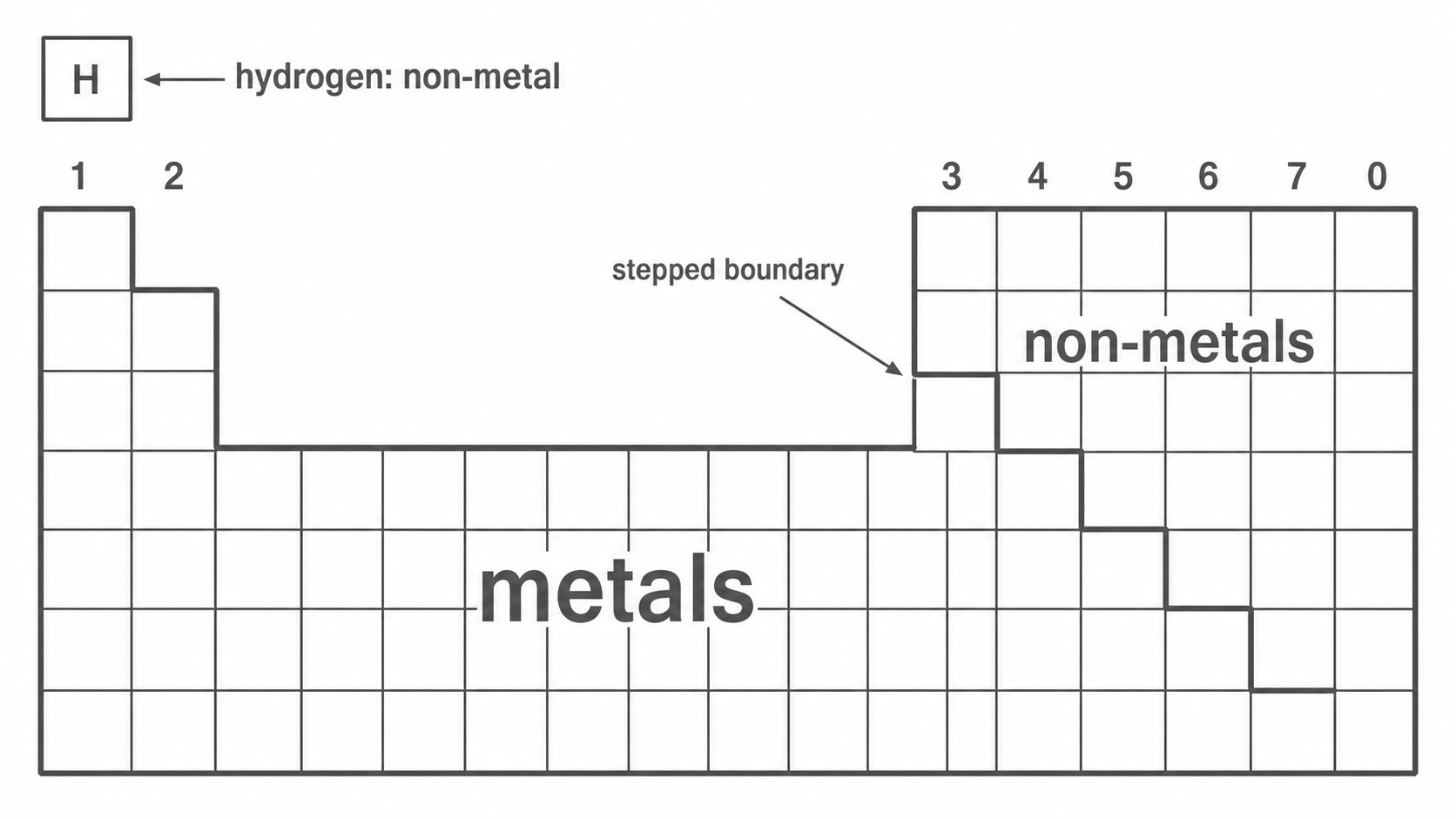
Hydrogen is the common trap. It sits above Group 1, but it is classified as a non-metal. The central block of the Periodic Table contains transition elements, which are metals, but their detailed properties are for later lessons.
For this lesson, the position rule is:
| Position | Classification |
|---|---|
| Group 1, except hydrogen | metal |
| Group 2 | metal |
| Transition block | metal |
| Upper right region, including Group 7 and Group 0 | non-metal |
| Hydrogen | non-metal |
Electrical conductivity
Electrical conductivity means allowing an electric current to pass through. If a solid element is put into a simple circuit and the bulb lights, that is evidence that the element conducts electricity.
Metals usually conduct electricity when solid. Non-metals usually do not conduct electricity when solid. This lesson only asks you to use conductivity as evidence; the bonding explanation for why metals conduct comes later.
[DIAGRAM: asset_name: Metals and non-metals - diagram 02; asset_slug: c07_metals_and_non_metals__diagram_02; recommended_method: image_gen; description: Monochrome evidence flow diagram linking electrical conductivity to metals and acidic or basic oxide character to non-metals or metals.]
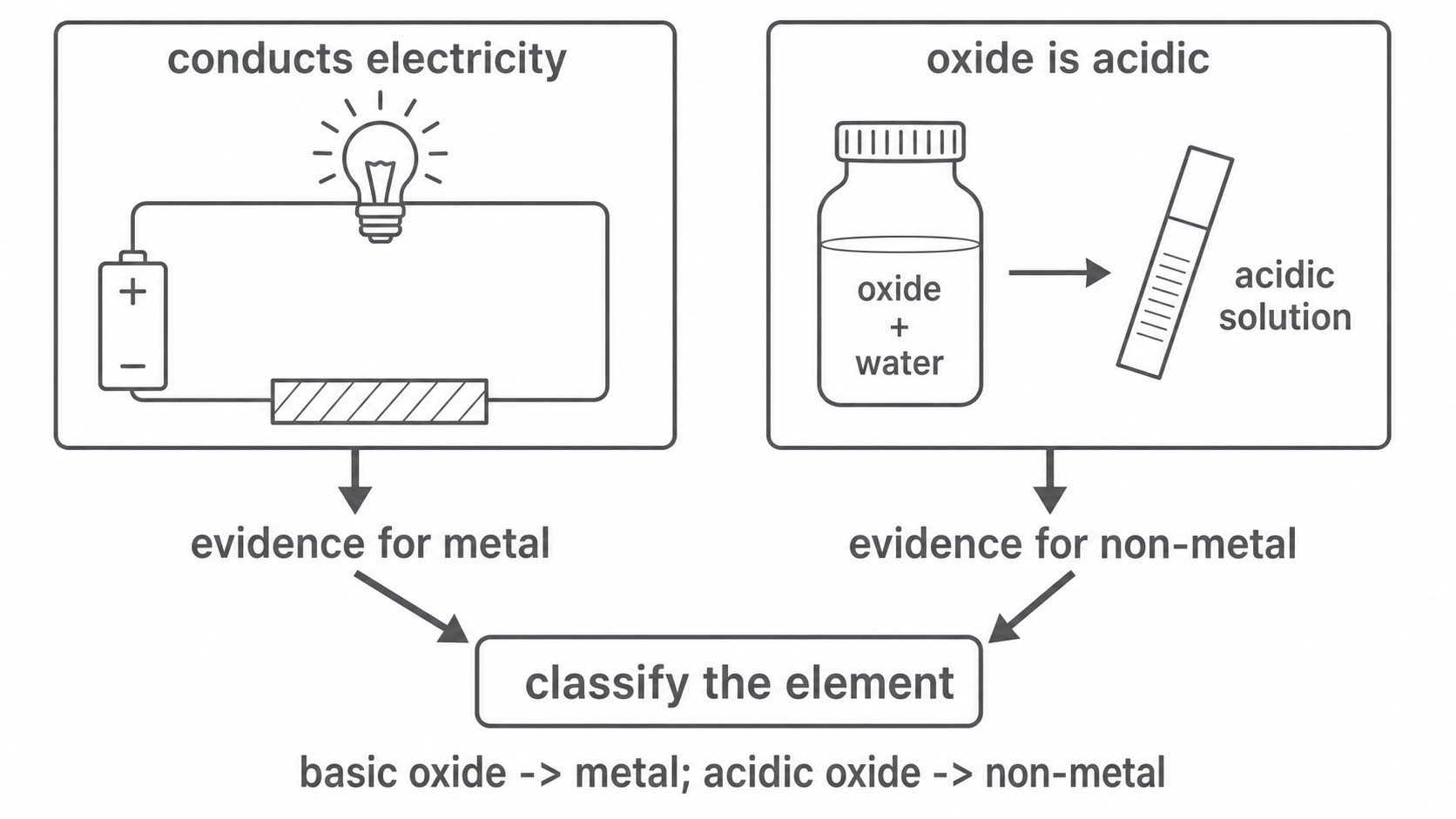
Be careful not to overstate the rule. Graphite, a form of carbon, conducts electricity even though carbon is a non-metal. If a question gives both Periodic Table position and conductivity, use all the evidence rather than relying on one word like "shiny" or "dull".
Oxide character
An oxide is a compound containing oxygen and one other element. The acid-base character of an oxide means whether that oxide behaves as acidic or basic.
Acidic oxide
An acidic oxide is an oxide that forms an acidic solution in water or reacts like an acid.
So oxide character is another clue about the element that formed the oxide. If the oxide behaves as a base instead, it usually points towards a metal.
Basic oxide
A basic oxide is an oxide that reacts like a base, for example by neutralising an acid.
The classification pattern for this lesson is:
| Oxide character | Classification suggested |
|---|---|
| basic oxide | metal |
| acidic oxide | non-metal |
For example, magnesium is a metal and magnesium oxide is a basic oxide. Sulfur is a non-metal and sulfur dioxide forms an acidic solution in water. You do not need to learn detailed oxide equations here; you need to use the acid-base character as classification evidence.
Using more than one clue
Pearson-style questions often give a small data table and ask you to identify or justify a classification. Do not just spot a familiar element name. Work through the clues.
| Element | Position clue | Conductivity clue | Oxide clue | Best classification |
|---|---|---|---|---|
| A | left of the stepped boundary | conducts when solid | basic oxide | metal |
| B | upper right of the Periodic Table | does not conduct when solid | acidic oxide | non-metal |
| C | hydrogen | does not conduct when solid | not needed | non-metal |
If the clues point the same way, the answer is straightforward. If a clue looks unusual, give the classification supported by the strongest evidence in the question and state the reason clearly.