1.10-1.13 - Separation techniques and chromatography
Mixtures can be separated because their substances keep their own physical properties. In this lesson, you will choose and describe the separation techniques named in the Edexcel IGCSE Chemistry specification, then use chromatograms and Rf values to identify dyes in inks or food colourings. The key exam habit is to say what is being separated and which physical difference makes the method work.
Choosing a method
A separation technique is a physical method. It does not make new substances; it uses a difference between the substances already in the mixture.
[DIAGRAM: asset_name: Separation techniques and chromatography - diagram 01; asset_slug: c04_separation_techniques_and_chromatography__diagram_01; recommended_method: image_gen; description: A monochrome overview of simple distillation, fractional distillation, filtration, and crystallisation apparatus, labelled with residue, filtrate, condenser water flow, and crystals.]
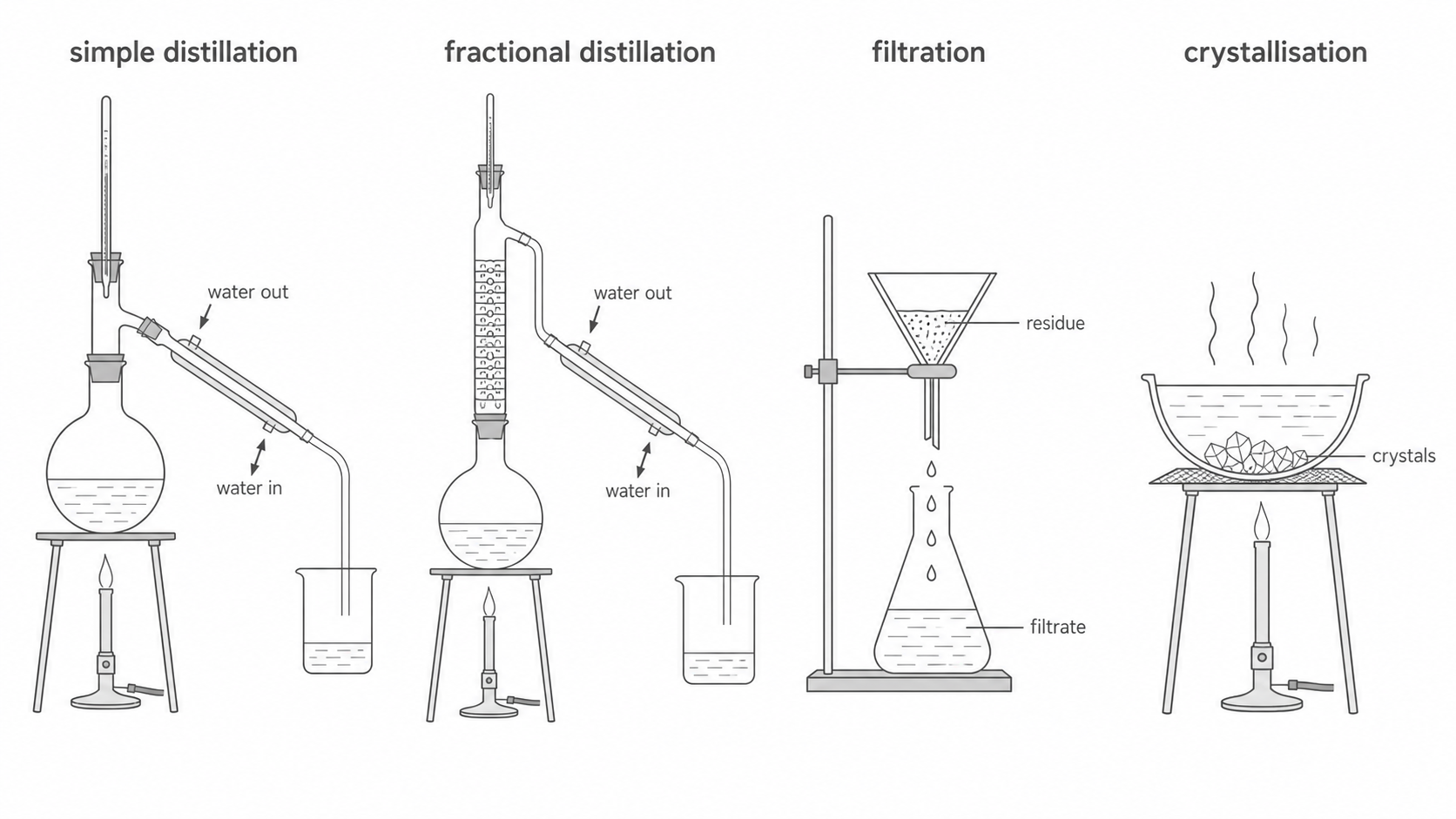
The best method depends on the mixture.
| Mixture or aim | Best method | Why it works |
|---|---|---|
| Insoluble solid mixed with a liquid or solution | filtration | solid particles are trapped by filter paper, while the liquid passes through |
| Soluble solid wanted from a solution | crystallisation | some solvent is removed, then crystals form from the concentrated solution |
| Liquid/solvent wanted from a solution | simple distillation | the liquid boils, then the vapour condenses and is collected |
| Two or more miscible liquids | fractional distillation | the liquids have different boiling points |
| Soluble coloured substances such as dyes | paper chromatography | components move different distances with a solvent on paper |
Residue and Filtrate
In filtration, the residue is the solid left in the filter paper. The filtrate is the liquid or solution that passes through the filter paper.
The common exam trap is choosing a method for the wrong product. To obtain pure water from seawater, use simple distillation because the product wanted is the water. To obtain salt crystals from salt solution, use crystallisation because the product wanted is the dissolved solid.
Distillation methods
Simple distillation separates a liquid from a solution, or separates liquids when one boils off much more easily than the others. The mixture is heated in a flask. The substance with the lower boiling point vaporises, passes into the condenser, cools, condenses back to a liquid, and is collected as the distillate.
Simple distillation is the method for obtaining pure water from salt solution or seawater. Salt does not evaporate with the water, so it remains in the flask while water is collected.
Fractional distillation is used for miscible liquids with different boiling points, such as ethanol and water. A fractionating column is placed between the flask and condenser. Vapour repeatedly condenses and evaporates in the column, so the vapour richer in the lower-boiling liquid reaches the condenser first.
Crude oil can be separated into fractions by fractional distillation, but the industrial details are taught later. In this lesson, you only need the separation idea: different boiling points allow different liquids to be collected.
Distillation always involves evaporation followed by condensation; fractional distillation adds a fractionating column to improve separation of liquids with different boiling points.
When a question shows a fractionating column, name the method as fractional distillation rather than simple distillation.
Filtration and crystallisation
Filtration separates an insoluble solid from a liquid or solution. The mixture is poured into filter paper in a funnel. The solid stays on the filter paper as the residue, while the liquid passes through as the filtrate.
Filtration will not separate a dissolved solid from its solution. For example, sodium chloride dissolved in water passes through filter paper with the water. To obtain the dissolved solid, use crystallisation.
Crystallisation separates a soluble solid from a solution. The usual method is:
- Heat the solution gently to evaporate some solvent.
- Stop heating when the solution is concentrated enough for crystals to start forming.
- Leave the solution to cool so more crystals form.
- Filter off the crystals and dry them carefully.
If you heat all the way to dryness, the crystals may be poor quality or may decompose if the solid is heat-sensitive. In exam answers, say that the solution is concentrated and then cooled to crystallise.
Paper chromatography practical
Paper chromatography separates soluble coloured substances, such as the dyes in inks or food colourings. The paper is the stationary phase. The solvent is the mobile phase because it moves up the paper.
[DIAGRAM: asset_name: Separation techniques and chromatography - diagram 02; asset_slug: c04_separation_techniques_and_chromatography__diagram_02; recommended_method: image_gen; description: A monochrome paper chromatography setup showing chromatography paper suspended in a beaker, pencil start line with spots A, B and C above the solvent level, labelled solvent level and solvent front, plus a finished chromatogram inset.]
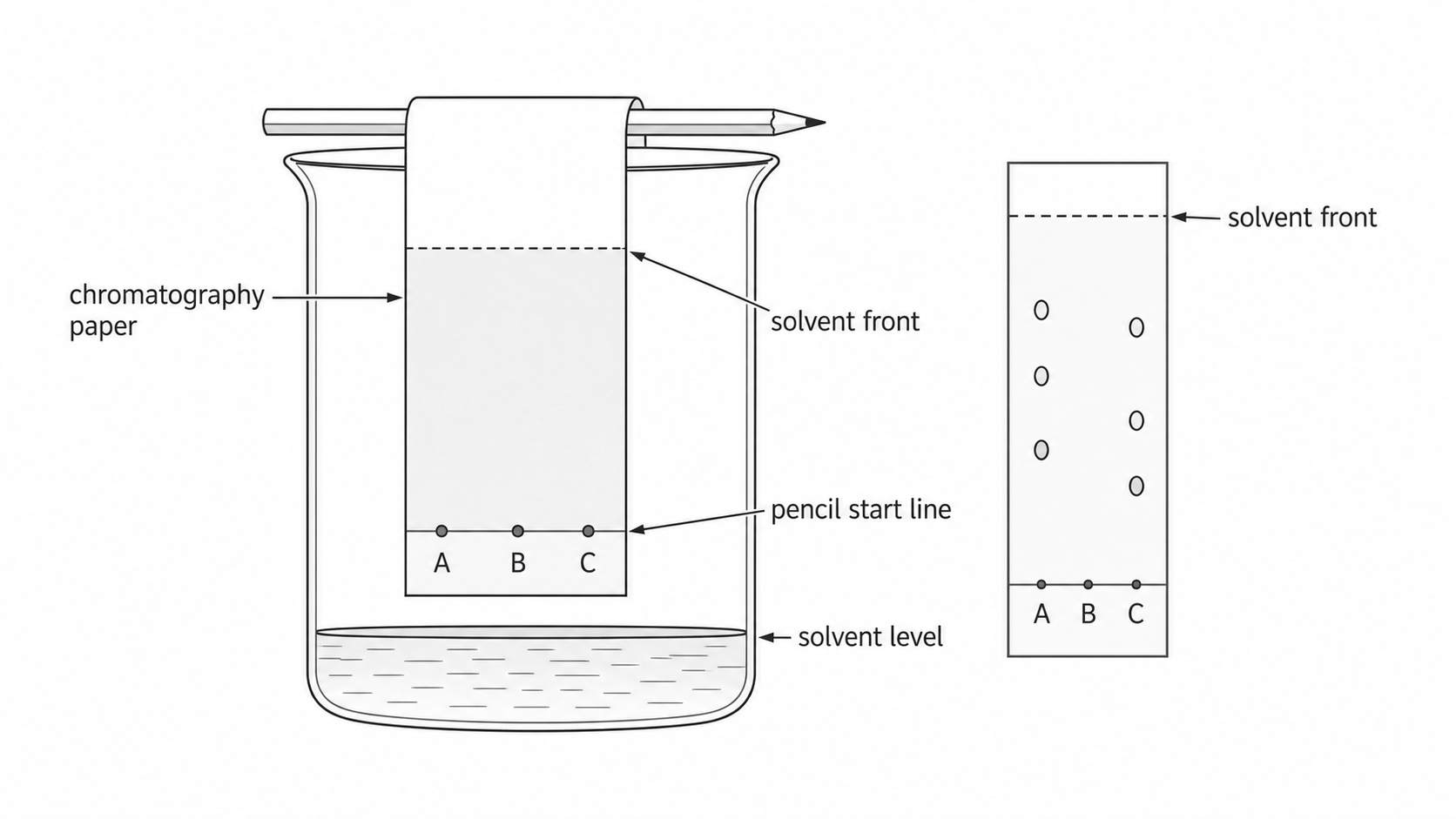
The practical method is precise because small setup errors change the result.
- Draw a pencil start line near the bottom of the chromatography paper.
- Place small spots of ink or food colouring on the start line.
- Add a shallow layer of solvent to a beaker.
- Place the paper in the beaker so the start line and spots are above the solvent level.
- Let the solvent rise up the paper.
- Remove the paper before the solvent reaches the top, mark the solvent front in pencil, and allow the chromatogram to dry.
Use pencil for the start line because pencil does not dissolve in the solvent and travel up the paper like ink could. Keep the spots above the solvent level so the dyes do not simply dissolve into the solvent in the bottom of the beaker.
The components separate because they have different solubilities in the solvent and different attractions to the paper. A dye that is more soluble in the solvent, or less strongly attracted to the paper, travels further up the paper.
Chromatograms and Rf values
A chromatogram is the pattern produced after chromatography. It gives information about the composition of a mixture.
If one ink produces several spots, it contains several soluble dyes. If two samples have a spot at the same height on the same chromatogram, those spots have travelled the same distance and have the same Rf value, so they are evidence for the same dye. If a spot stays on the start line, it did not dissolve in the solvent used, so it may hide more than one insoluble component.
Rf Value
Measure from the start line to the centre of the spot. Measure the solvent from the start line to the solvent front. Rf values have no units because they are a ratio of two distances.
Worked example: a dye spot moves 39 mm from the start line. The solvent front moves 65 mm from the start line.
An Rf value is useful for identifying a component only when it is compared with known substances under the same conditions, such as the same paper and solvent. Changing the solvent can change how far a dye travels.