1.37-1.39 - Ions, charges and ionic formulae
Ionic formulae are built from charged particles called ions. In this lesson you will learn how atoms become ions, which ion charges Edexcel expects you to know, and how to combine those charges to write formulae such as and .
Electron loss and gain
An atom is neutral when it has the same number of protons and electrons. Protons are positive and electrons are negative, so equal numbers cancel out overall.
An ion is formed when an atom, or a group of atoms, has an overall charge. In this lesson, the charge changes because electrons are lost or gained.
Ion
An ion is a particle with an overall positive or negative charge.
If an atom loses electrons, it has more protons than electrons. It becomes a positive ion. If an atom gains electrons, it has more electrons than protons. It becomes a negative ion.
[DIAGRAM: asset_name: Ions, charges and ionic formulae - diagram 01; asset_slug: c14_ions_charges_and_ionic_formulae__diagram_01; recommended_method: image_gen; description: Monochrome diagram showing that a neutral atom with equal positive and negative counters becomes a positive ion when it loses one electron, and becomes a negative ion when it gains one electron. The diagram must emphasise that only electrons change, not protons.]
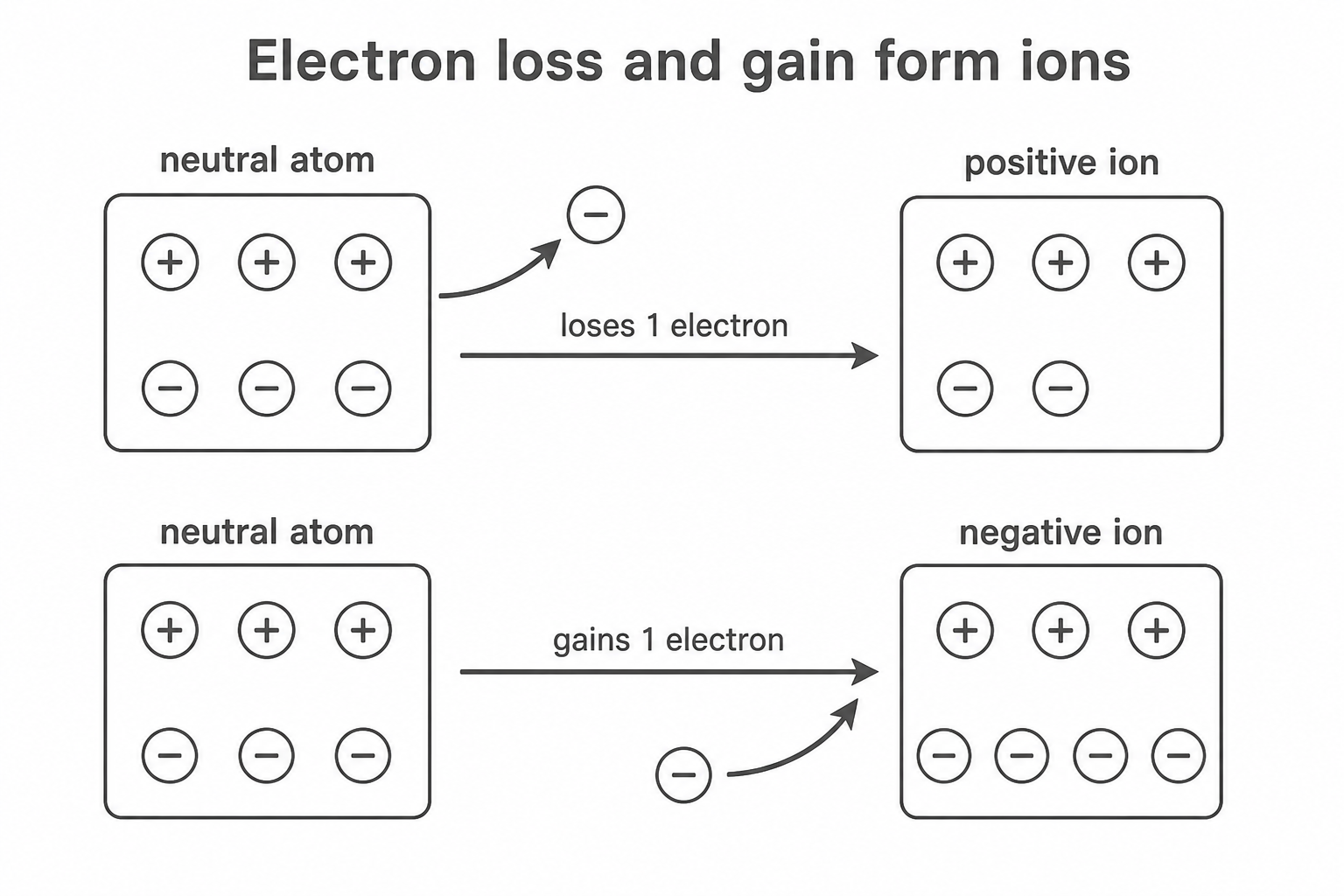
The common trap is to think "losing something negative makes the atom negative". It is the other way round: removing negative charge leaves the particle more positive overall.
Group charge patterns
For the main groups in the specification, the group number tells you the charge pattern. Metals in Groups 1, 2 and 3 form positive ions. Non-metals in Groups 5, 6 and 7 form negative ions.
| Element type in the specification | Ion charge to know | Examples |
|---|---|---|
| Group 1 metals | , , | |
| Group 2 metals | , | |
| Group 3 metals | ||
| Group 5 non-metals | , | |
| Group 6 non-metals | , | |
| Group 7 non-metals | , , , |
The reason is the same electron-loss/electron-gain idea. Group 1 metals lose one electron, so they form ions. Group 2 metals lose two electrons, so they form ions. Group 7 non-metals gain one electron, so they form ions.
For Edexcel formula questions, write the charge as part of the ion, not as part of the final compound formula. For example, magnesium ion is , but magnesium chloride is .
Specified ions to know
Some ions do not follow the simple main-group pattern in a way you can safely work out in the exam. Pearson lists these ions explicitly, so learn them as fixed entries.
| Ion name | Formula and charge |
|---|---|
| silver ion | |
| copper(II) ion | |
| iron(II) ion | |
| iron(III) ion | |
| lead(II) ion | |
| zinc ion | |
| hydrogen ion | |
| hydroxide ion | |
| ammonium ion | |
| carbonate ion | |
| nitrate ion | |
| sulfate ion |
The Roman numeral in names such as copper(II), iron(II), iron(III) and lead(II) gives the positive charge on the metal ion. Iron(II) is , but iron(III) is ; that one digit changes the formula of many compounds.
Hydroxide, ammonium, carbonate, nitrate and sulfate are group ions: several atoms behave as one charged ion. Keep the whole group together when you use it in a formula.
Balancing charges in formulae
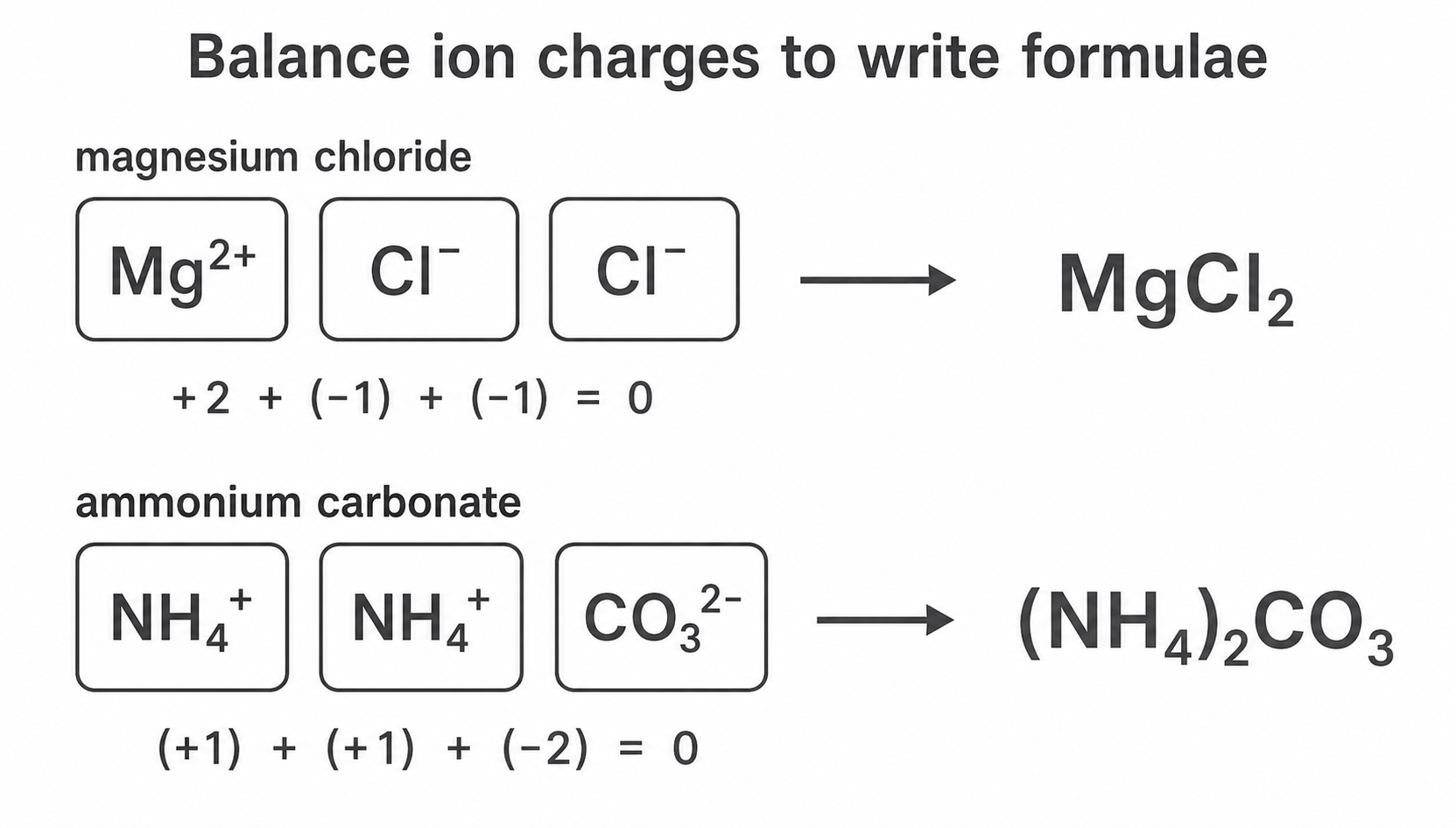
An ionic compound has no overall charge. That means the total positive charge and total negative charge in its formula must balance to zero.
Charge balance
Use this method:
- Write the positive ion and the negative ion with their charges.
- Choose the smallest whole-number ratio that makes the total charge zero.
- Write the formula with the positive ion first.
- Do not include ion charges in the final compound formula.
- Use brackets if you need more than one of a group ion.
[DIAGRAM: asset_name: Ions, charges and ionic formulae - diagram 02; asset_slug: c14_ions_charges_and_ionic_formulae__diagram_02; recommended_method: image_gen; description: Monochrome worked charge-balance diagram for writing ionic formulae. It should show one ion balancing two ions to make , and two ions balancing one ion to make . The final formulae must not contain ion charges.]
For sodium oxide, the ions are and . Two ions give a total charge of , which balances one ion, so the formula is .
For aluminium sulfate, the ions are and . Two aluminium ions give , and three sulfate ions give , so the formula is . The brackets show that there are three whole sulfate ions.
Formula writing checks
A quick way to check any ionic formula is to add the ion charges shown by the subscripts. The answer should be zero.
For , iron(III) is and each hydroxide is . The total charge is:
so is balanced.
For , lead(II) is and oxide is . One lead(II) ion and two oxide ions would give:
so is not the formula for lead(II) oxide. Lead(II) oxide is because .
Common mistakes to avoid:
- writing charges in the final formula, such as instead of
- forgetting brackets around repeated group ions, such as writing instead of
- using the wrong charge for a variable metal ion, such as confusing and
- reducing a group ion formula itself, such as changing to