1.31-1.33 - Empirical and molecular formulae from data
A chemical formula tells you the ratio of atoms or ions in a substance. This lesson shows how experimental mass data can be turned into that ratio, and how an empirical formula can be scaled up to a molecular formula when the Mr is known. The central move is always the same: change masses into moles before comparing the numbers.
Formulae as ratios
The formula of a compound is not a mass ratio. It is a ratio of particles. In MgO, magnesium ions and oxide ions are present in a 1:1 ratio. In H2O, hydrogen atoms and oxygen atoms are present in a 2:1 ratio.
Empirical formula
The empirical formula is the simplest whole-number ratio of atoms of each element in a compound.
The molecular formula can be the same as the empirical formula, but for many molecules it is a whole-number multiple of the simplest ratio.
Molecular formula
The molecular formula shows the actual number of atoms of each element in one molecule.
For some substances, the empirical formula and molecular formula are the same. Water has empirical formula H2O and molecular formula H2O. For other molecular substances, the molecular formula is a whole-number multiple of the empirical formula. Glucose has empirical formula CH2O but molecular formula C6H12O6.
Ionic compounds and giant structures are usually represented by the simplest ratio of ions or atoms. For example, MgO tells you the 1:1 ratio in magnesium oxide rather than describing one separate molecule.
From mass to empirical formula
Experimental data usually gives masses: the mass of a metal before heating, the mass of oxygen gained, or the percentage by mass of each element. You cannot compare those masses directly, because atoms of different elements have different masses. A mole of magnesium atoms has a different mass from a mole of oxygen atoms.
[DIAGRAM: asset_name: Empirical and molecular formulae from data - diagram 01; asset_slug: c11_empirical_and_molecular_formulae_from_data__diagram_01; recommended_method: image_gen; description: Monochrome four-panel schematic showing a balance weighing a metal, heating the metal in oxygen, a mass table for metal and oxygen gained, and the pathway mass -> moles -> ratio -> formula ending with MgO.]
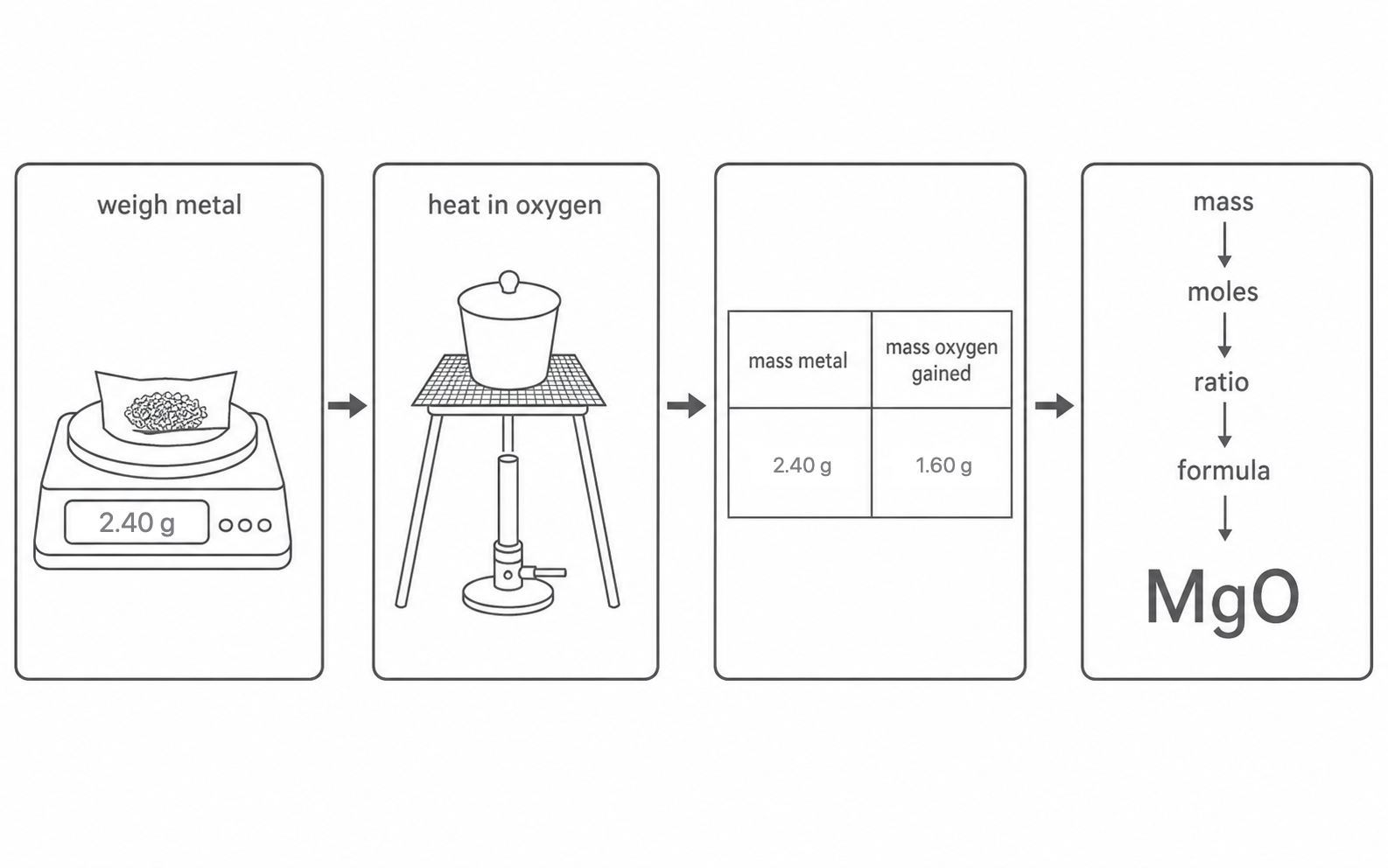
The method is:
- Find the mass of each element present.
- Divide each mass by the relative atomic mass,
Ar, to find moles of atoms. - Divide all mole values by the smallest mole value.
- If needed, multiply every ratio number to get whole numbers.
- Write the empirical formula.
Moles from mass
Worked example: magnesium is heated in oxygen. The student starts with 2.40 g of magnesium and obtains 4.00 g of magnesium oxide.
Mass of oxygen gained:
Now convert each mass into moles:
| Element | Mass / g | Ar | Moles |
|---|---|---|---|
| Mg | 2.40 | 24 | 0.100 |
| O | 1.60 | 16 | 0.100 |
Divide by the smallest mole value:
The empirical formula is MgO.
Percentage composition data
If a question gives percentage composition, assume you have 100 g of the compound. This turns each percentage into a mass in grams.
For example, a compound contains 40.0% carbon, 6.7% hydrogen and 53.3% oxygen by mass. In 100 g of compound, the masses are 40.0 g C, 6.7 g H and 53.3 g O.
| Element | Mass in 100 g / g | Ar | Moles | Divide by smallest |
|---|---|---|---|---|
| C | 40.0 | 12 | 3.33 | 1 |
| H | 6.7 | 1 | 6.7 | 2 |
| O | 53.3 | 16 | 3.33 | 1 |
The empirical formula is CH2O.
Sometimes one element is not given directly. If a compound contains only carbon, hydrogen and oxygen, and the data gives carbon and hydrogen percentages, find oxygen by subtracting from 100%. For example, if carbon is 52.2% and hydrogen is 13.0%, then oxygen is:
Ratios do not always become whole numbers immediately. Use familiar decimal clues:
| Ratio after dividing by smallest | What to do | Example whole-number result |
|---|---|---|
| 1.5 | multiply all ratios by 2 | 3 |
| 1.33 or 1.333 | multiply all ratios by 3 | 4 |
| 1.25 | multiply all ratios by 4 | 5 |
Do not round a ratio such as 1.33 down to 1 or up to 2. The empirical formula must show the smallest whole-number ratio that still matches the data.
Formulae from experiments
The specification expects you to understand how formulae of simple compounds can be obtained experimentally. The detail changes with the substance, but the calculation idea stays the same: measure masses, convert to moles, then find a whole-number ratio.
For a metal oxide, the metal is heated in oxygen or air. The mass of oxygen in the oxide is found by subtraction:
For water, experimental data may give the masses of hydrogen and oxygen that combine or are produced. If 0.040 g of hydrogen combines with 0.320 g of oxygen:
| Element | Mass / g | Ar | Moles |
|---|---|---|---|
| H | 0.040 | 1 | 0.040 |
| O | 0.320 | 16 | 0.020 |
The ratio H:O is 2:1, so the formula is H2O.
For a hydrated salt, heating removes water of crystallisation. The mass lost is the mass of water. Compare moles of the anhydrous salt with moles of water:
Worked example: 2.50 g of hydrated copper(II) sulfate, CuSO4.xH2O, is heated until all the water has been removed. The mass after heating is 1.60 g. Use Mr values: CuSO4 = 160, H2O = 18.
Mass of water lost:
Moles of CuSO4:
Moles of H2O:
Ratio:
So the formula is CuSO4.5H2O.
From empirical to molecular formula
An empirical formula gives the simplest ratio. To find the molecular formula, you also need the relative molecular mass, Mr, of the molecule.
[DIAGRAM: asset_name: Empirical and molecular formulae from data - diagram 02; asset_slug: c11_empirical_and_molecular_formulae_from_data__diagram_02; recommended_method: image_gen; description: Monochrome scaling diagram showing empirical formula CH2O, the calculation Mr divided by empirical formula mass gives 6, six repeated CH2O units, and final molecular formula C6H12O6.]
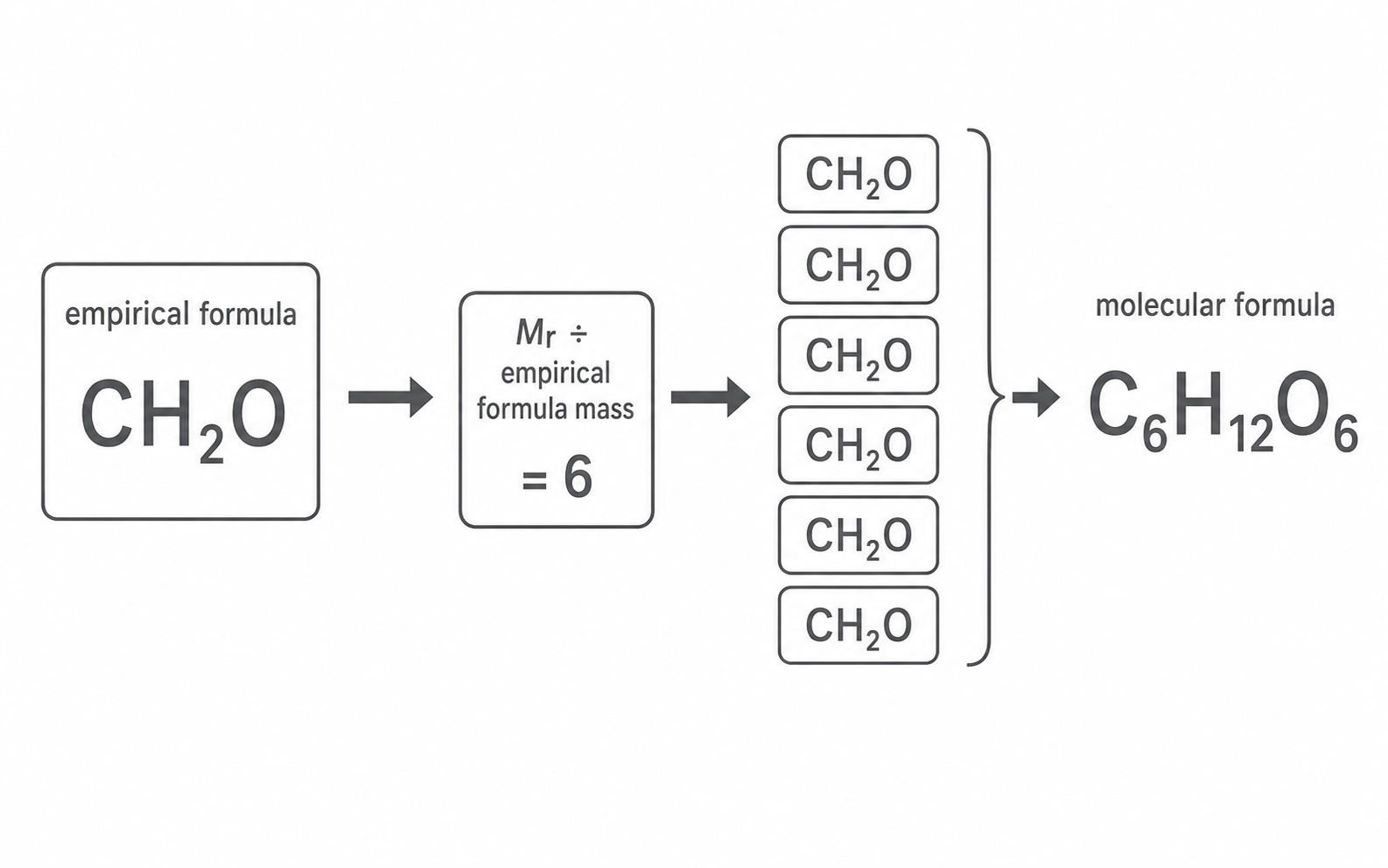
Molecular formula multiplier
Then multiply every subscript in the empirical formula by the multiplier.
Worked example: a compound has empirical formula CH2O and relative molecular mass 180. Find its molecular formula.
First find the Mr of the empirical formula:
Now find the multiplier:
Multiply every subscript in CH2O by 6:
The molecular formula is C6H12O6.
Exam precision
Empirical formula questions are usually marked step by step. You can often earn method marks even if one arithmetic value goes wrong, as long as your method is clear.
Pearson-style answers usually reward:
- dividing each mass or percentage by the correct
Ar - dividing all mole values by the smallest mole value
- multiplying to remove awkward decimal ratios
- writing the final formula with correct element symbols and subscripts
The most common mistakes are small but expensive:
- using atomic numbers instead of
Arvalues - treating percentages as atom ratios
- using oxygen as
O2withMr32 when the calculation needs oxygen atoms withAr16 - rounding 1.33 to 1, instead of multiplying the whole ratio by 3
- finding the empirical formula correctly but not using the given
Mrto find the molecular formula
Here is the awkward-ratio move in a compact example. If the mole ratio is:
multiply both parts by 3:
The empirical formula is Pb3O4, not PbO, PbO2 or PbO1.33.
When a question says "determine" or "calculate", show enough working for the examiner to see the mass-to-moles-to-ratio route. A final formula with no working is a risky answer, even when it is correct.