1.18-1.19, 1.22 - Periodic table arrangement and electron configurations
The Periodic Table is not just a list of elements. Its rows and columns give clues about atomic number and electron arrangement. In this lesson, you will learn how to use an element's position to deduce its electronic configuration for the first 20 elements.
Reading the Periodic Table
Each element has an atomic number. In the Periodic Table, elements are arranged in order of increasing atomic number. The atomic number is the number of protons in the nucleus; for a neutral atom, it is also the number of electrons.
Group
A group is a vertical column in the Periodic Table.
Rows have a different name.
Period
A period is a horizontal row in the Periodic Table.
In the Edexcel Periodic Table used for this course, the main group columns are labelled 1, 2, 3, 4, 5, 6, 7 and 0. Group 0 contains helium, neon and argon among the first 20 elements.
[DIAGRAM: asset_name: Periodic table arrangement and electron configurations - diagram 01; asset_slug: c06_periodic_table_arrangement_and_electron_configurations__diagram_01; recommended_method: image_gen; description: Monochrome simplified Periodic Table map for the first 20 elements, showing correct atomic numbers and symbols, group labels 1, 2, 3, 4, 5, 6, 7 and 0, period labels 1-4, and an arrow showing atomic number increasing across Period 3.]
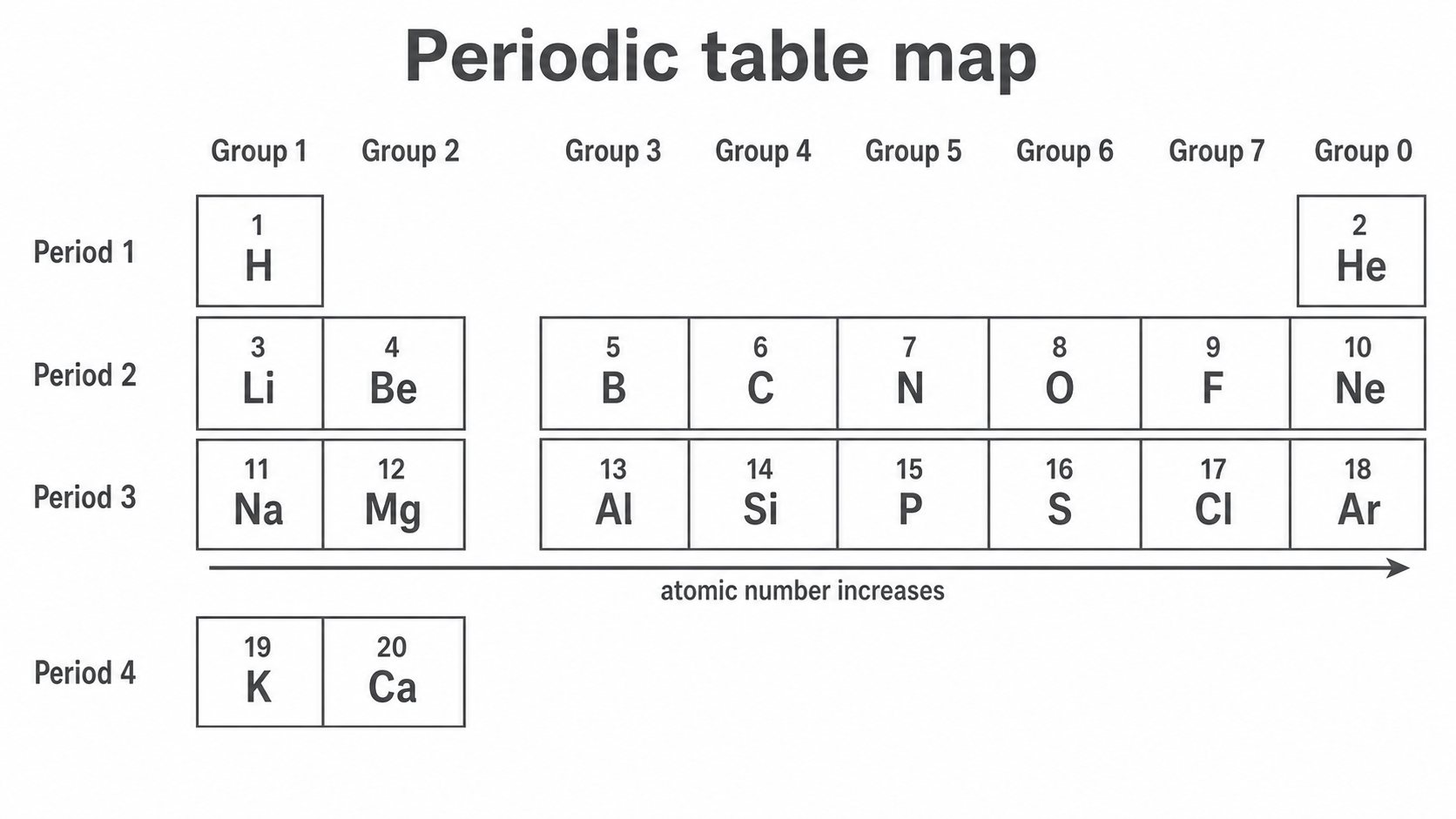
A position can identify an element. For example, the element in Group 2 and Period 3 is magnesium, Mg. The element with atomic number 14 is silicon, Si.
Writing configurations from atomic number
An electronic configuration shows how the electrons in an atom are arranged in shells. At this level, write the shells as numbers separated by full stops, for example sodium is 2.8.1.
For a neutral atom:
- Use the atomic number to find the total number of electrons.
- Fill the first shell with up to 2 electrons.
- Fill the second shell with up to 8 electrons.
- For the first 20 elements, fill the third shell with up to 8 electrons before putting electrons into the fourth shell.
Worked example: chlorine has atomic number 17, so a neutral chlorine atom has 17 electrons. Fill the shells as 2, then 8, then the remaining 7, so chlorine is 2.8.7.
The first 20 configurations are:
| Atomic number | Element | Electronic configuration |
|---|---|---|
| 1 | H | 1 |
| 2 | He | 2 |
| 3 | Li | 2.1 |
| 4 | Be | 2.2 |
| 5 | B | 2.3 |
| 6 | C | 2.4 |
| 7 | N | 2.5 |
| 8 | O | 2.6 |
| 9 | F | 2.7 |
| 10 | Ne | 2.8 |
| 11 | Na | 2.8.1 |
| 12 | Mg | 2.8.2 |
| 13 | Al | 2.8.3 |
| 14 | Si | 2.8.4 |
| 15 | P | 2.8.5 |
| 16 | S | 2.8.6 |
| 17 | Cl | 2.8.7 |
| 18 | Ar | 2.8.8 |
| 19 | K | 2.8.8.1 |
| 20 | Ca | 2.8.8.2 |
Do not use the relative atomic mass to count electrons. For example, silicon has relative atomic mass about 28, but its atomic number is 14, so its electronic configuration is 2.8.4.
Position and configuration
For the first 20 elements, you can often move both ways: from electronic configuration to position, or from position to electronic configuration.
The group shortcut in the diagram applies to Groups 1-7; Group 0 is handled separately as a full outer shell.
[DIAGRAM: asset_name: Periodic table arrangement and electron configurations - diagram 02; asset_slug: c06_periodic_table_arrangement_and_electron_configurations__diagram_02; recommended_method: image_gen; description: Monochrome shell diagrams for lithium 2.1, sodium 2.8.1 and calcium 2.8.8.2, with callouts showing that the period is the number of occupied shells, Groups 1-7 link group number to outer-shell electrons, and Group 0 has a full outer shell.]
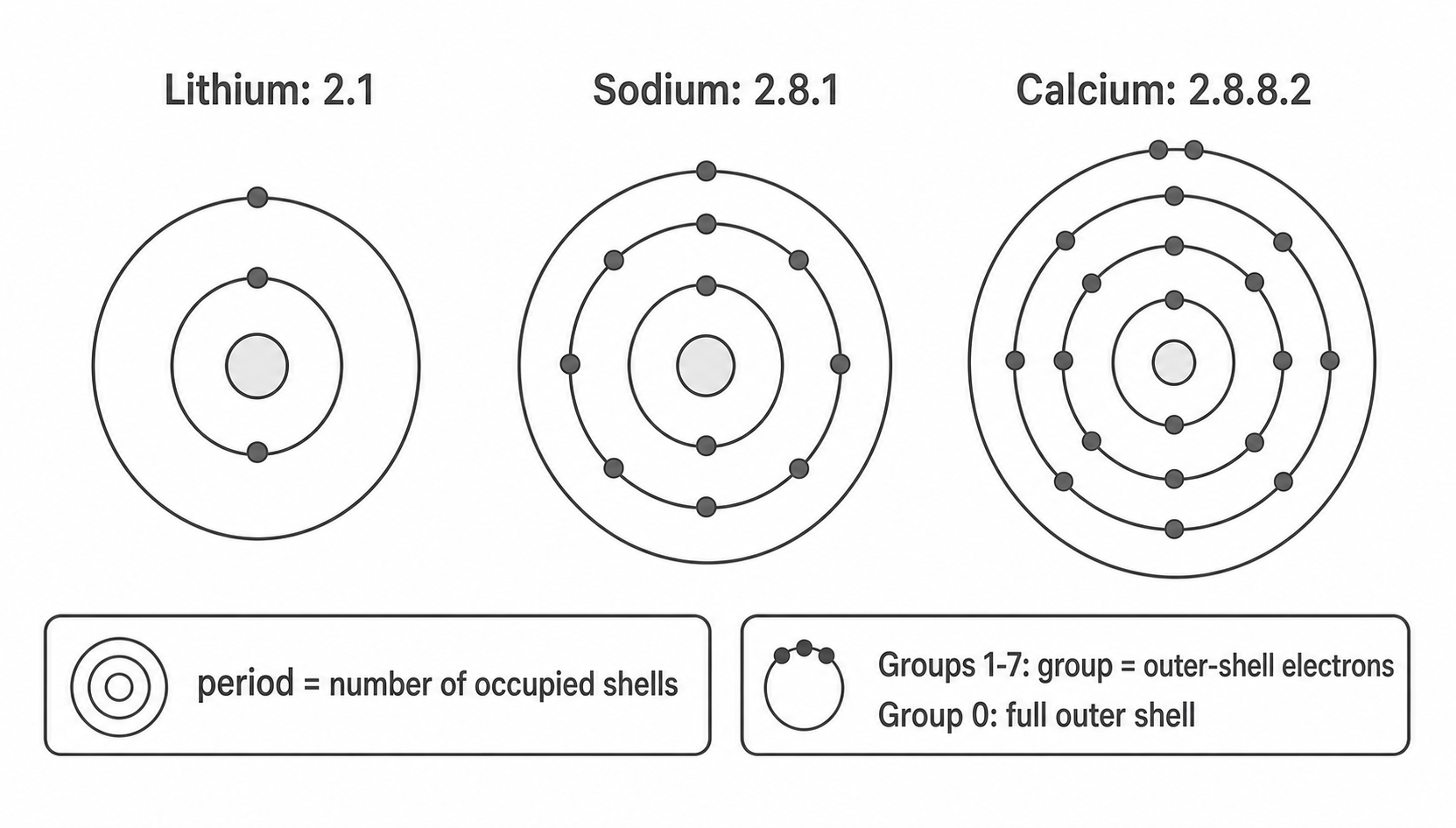
The period number tells you the number of occupied electron shells. Lithium is in Period 2 and has two occupied shells: 2.1. Sodium is in Period 3 and has three occupied shells: 2.8.1. Calcium is in Period 4 and has four occupied shells: 2.8.8.2.
For Groups 1-7, the group number tells you the number of electrons in the outer shell. Magnesium is in Group 2, so it has two outer-shell electrons: 2.8.2. Phosphorus is in Group 5, so it has five outer-shell electrons: 2.8.5.
For main-group elements in Groups 1-7, period number gives the number of occupied shells and group number gives the number of outer-shell electrons.
Practise saying the shortcut out loud, but always check the total number of electrons against the atomic number.
Main group patterns
The specification asks about main group elements. In this lesson, that means the elements in Groups 1, 2, 3, 4, 5, 6, 7 and 0, not the transition metals in the middle of the full Periodic Table.
The pattern is clearest if you look across Period 3:
| Element | Group | Electronic configuration | Outer-shell electrons |
|---|---|---|---|
| Na | 1 | 2.8.1 | 1 |
| Mg | 2 | 2.8.2 | 2 |
| Al | 3 | 2.8.3 | 3 |
| Si | 4 | 2.8.4 | 4 |
| P | 5 | 2.8.5 | 5 |
| S | 6 | 2.8.6 | 6 |
| Cl | 7 | 2.8.7 | 7 |
| Ar | 0 | 2.8.8 | full outer shell |
Group 0 is the special column. Group 0 elements have full outer shells. Helium is in Group 0 with configuration 2, because its first shell is full with two electrons. Neon is 2.8 and argon is 2.8.8, because their outer shells are full with eight electrons.
Worked example: deduce the configuration of an element in Group 6 and Period 2. Period 2 means two occupied shells. Group 6 means six electrons in the outer shell. The configuration is 2.6, so the element is oxygen.
Exam answer style
Pearson questions on this topic are often short. They may ask you to name an element from atomic number, give a configuration, or explain a position in terms of electron configuration.
A strong answer keeps three details separate:
| Prompt | Useful thought |
|---|---|
| "atomic number 16" | 16 protons, and 16 electrons in a neutral atom |
| "Group 2 and Period 3" | magnesium; three occupied shells and two outer-shell electrons |
"2.8.7" | three occupied shells, seven outer-shell electrons, Group 7 and Period 3 |
| "Group 0" | full outer shell, for example neon is 2.8 |
Common errors are using relative atomic mass instead of atomic number, mixing up rows and columns, or saying Group 0 has zero electrons in the outer shell. Group 0 means a full outer shell, not an empty outer shell.