1.34C-1.35C - Concentration and gas volume calculations
Chemists often measure a volume in the lab, but balanced equations compare amounts of substance in moles. In this lesson, the same idea appears twice: a solution volume can be linked to concentration, and a gas volume can be linked to the molar volume of a gas at room temperature and pressure. The main skill is keeping the units under control before using the numbers.
Moles as the bridge
A balanced chemical equation gives a ratio of amounts of substance. It does not directly compare cm3 of solution with cm3 of gas, or a measured solution volume with a formula mass. That is why many calculation questions have a hidden middle step: convert the measured quantity into moles, use the mole ratio, then convert to the quantity asked for.
Amount of substance
Amount of substance is measured in moles, mol. In chemical calculations, moles let you compare the numbers of particles or formula units reacting.
For this lesson, there are two volume-to-mole links:
| Measured quantity | Link to amount of substance |
|---|---|
| Volume of a solution | Use concentration in mol/dm3. |
| Volume of a gas at rtp | Use the molar gas volume, 24 dm3 or 24 000 cm3 per mole. |
The word volume is therefore not enough on its own. Always ask: is it a volume of solution, or a volume of gas? A solution volume is used with concentration. A gas volume at room temperature and pressure is used with molar volume.
Concentration in solution
The concentration of a solution tells you how much solute is dissolved in a certain volume of the final solution. For Edexcel concentration calculations in this cluster, concentration is measured in mol/dm3.
Concentration
Concentration is the amount of dissolved solute per unit volume of solution.
[DIAGRAM: asset_name: Concentration and gas volume calculations - diagram 01; asset_slug: c12_concentration_and_gas_volume_calculations__diagram_01; recommended_method: image_gen; description: Monochrome NovaLearn-style schematic showing three solution vessels ordered by increasing concentration: 1 mol in 2 dm3, 1 mol in 1 dm3, and 2 mol in 1 dm3. Includes the relationship concentration = amount / volume and unit mol/dm3.]
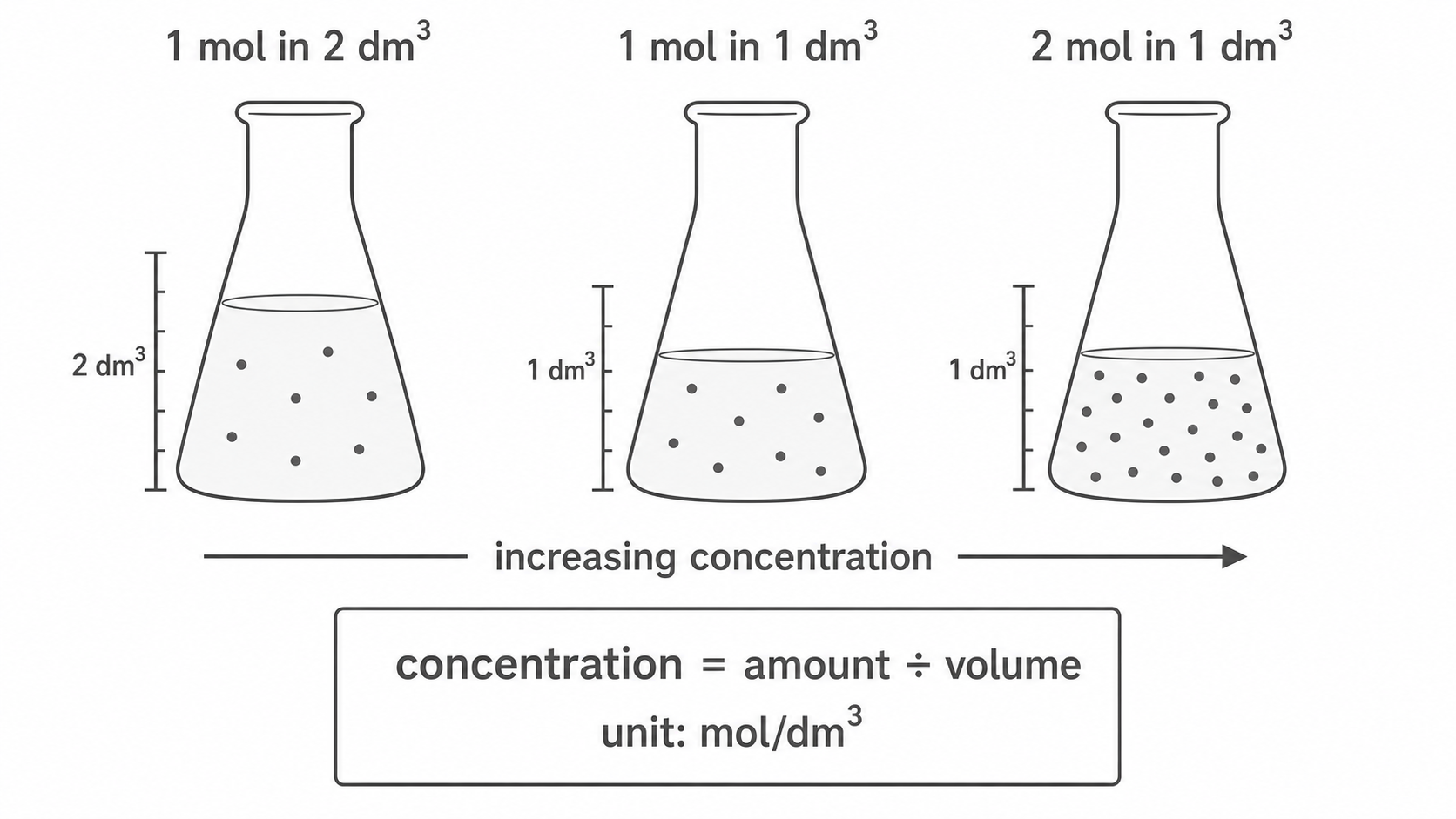
Solution concentration
where is concentration in mol/dm3, is amount in mol, and is volume of solution in dm3.
The volume in the formula must be in dm3, not cm3. If the question gives cm3, divide by 1000 first:
| Volume in cm3 | Volume in dm3 |
|---|---|
| 25.0 cm3 | 0.0250 dm3 |
| 100 cm3 | 0.100 dm3 |
| 250 cm3 | 0.250 dm3 |
| 1000 cm3 | 1.000 dm3 |
Worked example: calculate the concentration of a solution that contains 0.0200 mol of sodium chloride in 250 cm3 of solution.
First convert the volume:
Then substitute:
Notice that the volume is the volume of the solution, not just the volume of water added. The solute and solvent together make the final solution volume used in the calculation.
Solution stoichiometry
Once you have an amount in mol, you can use the balanced equation. This is where many marks are lost: students calculate the moles in one solution correctly, then forget to use the equation ratio before finding the second concentration or amount.
Use this route for a solution-reaction calculation:
- Write or use the balanced equation.
- Convert any solution volumes from cm3 to dm3.
- Use to find the known amount in mol.
- Use the balanced-equation ratio to find the required amount in mol.
- Use or if the question asks for another solution concentration or volume.
Worked example: 25.0 cm3 of 0.100 mol/dm3 sodium hydroxide neutralises 20.0 cm3 of hydrochloric acid. Calculate the concentration of the hydrochloric acid.
The equation is:
The ratio of NaOH to HCl is 1:1.
So:
Now convert the acid volume:
This is not a lesson on titration technique. The calculation works because the equation and volumes are given; the assessed skill here is amount, volume and concentration.
Gas volume at rtp
At room temperature and pressure, Edexcel uses this molar gas volume:
Molar gas volume at rtp
This value applies to gases at the same temperature and pressure. The identity of the gas does not change the volume occupied by one mole under these conditions: one mole of hydrogen, oxygen or carbon dioxide all occupy 24 dm3 at rtp.
[DIAGRAM: asset_name: Concentration and gas volume calculations - diagram 02; asset_slug: c12_concentration_and_gas_volume_calculations__diagram_02; recommended_method: image_gen; description: Monochrome NovaLearn-style gas syringe and calculation pathway showing 1 mol gas = 24 dm3 = 24 000 cm3 at rtp, with separate routes for gas volume in dm3 and gas volume in cm3 plus the reminder 1 dm3 = 1000 cm3.]
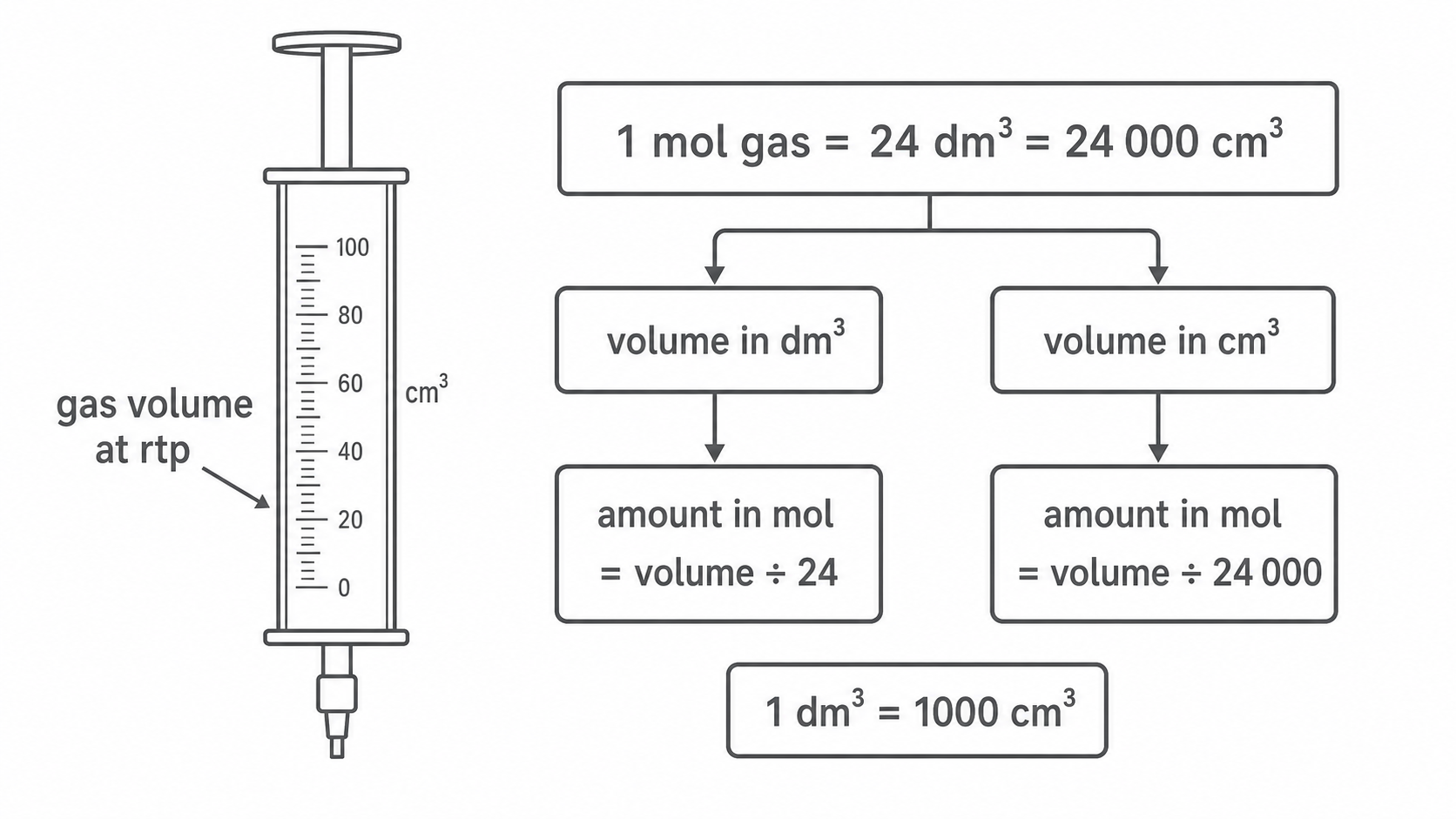
Use the version that matches the units in the question:
| Gas volume unit | Amount in mol | Gas volume from amount |
|---|---|---|
| dm3 | ||
| cm3 |
Worked example 1: calculate the volume of 0.250 mol of carbon dioxide at rtp.
This is the same as:
Worked example 2: calculate the amount of oxygen in 120 cm3 of oxygen gas at rtp.
Do not use 22.4 dm3 in this course for these questions. Edexcel specifies 24 dm3 and 24 000 cm3 at rtp.
Combined calculation route
Some questions combine both parts of this lesson. A solution concentration may give the amount of a reactant, the equation ratio gives the amount of gas produced, and the molar gas volume gives the gas volume at rtp.
Worked example: 50.0 cm3 of 0.100 mol/dm3 hydrochloric acid reacts with excess magnesium. Calculate the volume of hydrogen produced at rtp, in cm3.
The equation is:
Find the amount of HCl:
Use the equation ratio:
Convert moles of gas to volume in cm3:
Common calculation traps are predictable:
| Trap | How to avoid it |
|---|---|
| Using cm3 directly in | Convert solution volume to dm3 first. |
| Dividing a cm3 gas volume by 24 | Use 24 000 for cm3, or convert to dm3 first. |
| Ignoring the balanced equation | Use the mole ratio after finding the first amount. |
| Rounding too early | Keep full calculator values until the final answer. |
| Leaving off the unit | State mol, mol/dm3, dm3 or cm3 as appropriate. |
Convert measured volumes into moles with the correct unit relationship, use the balanced-equation ratio, then convert back only if the question asks for a volume or concentration.
Use that route in the final check below.