1.27-1.30 - Moles, reacting masses and percentage yield
Chemists cannot count atoms or ions one by one, so they use a counting unit called the mole. In this lesson, you will use masses, relative atomic masses, relative formula masses and balanced equations to work out how much substance reacts or forms. You will then compare the maximum possible product with the product actually collected in an experiment.
The mole as amount
The amount of a substance tells you how many particles are present. The unit for amount of substance is the mole, with the symbol mol. The calculation symbol for amount of substance is usually n.
Mole
The mole, mol, is the unit for the amount of a substance.
One mole is a fixed number of particles. The particles may be atoms, molecules, ions or formula units, depending on the substance. For IGCSE reacting-mass calculations, the most useful idea is this:
- 1 mol of atoms has a mass equal to the element's
A_rin grams. - 1 mol of molecules or formula units has a mass equal to the substance's
M_rin grams.
For example, magnesium has A_r = 24, so 1 mol of magnesium atoms has a mass of 24 g. Carbon dioxide has M_r = 44, so 1 mol of carbon dioxide molecules has a mass of 44 g.
[DIAGRAM: asset_name: Moles, Reacting Masses and Percentage Yield - diagram 01; asset_slug: c10_moles_reacting_masses_and_percentage_yield__diagram_01; recommended_method: image_gen; description: Monochrome mole-bridge schematic showing a balance and sample mass, division by Ar or Mr to find amount in mol, use of the balanced-equation mole ratio, then multiplication by Ar or Mr to find product mass.]
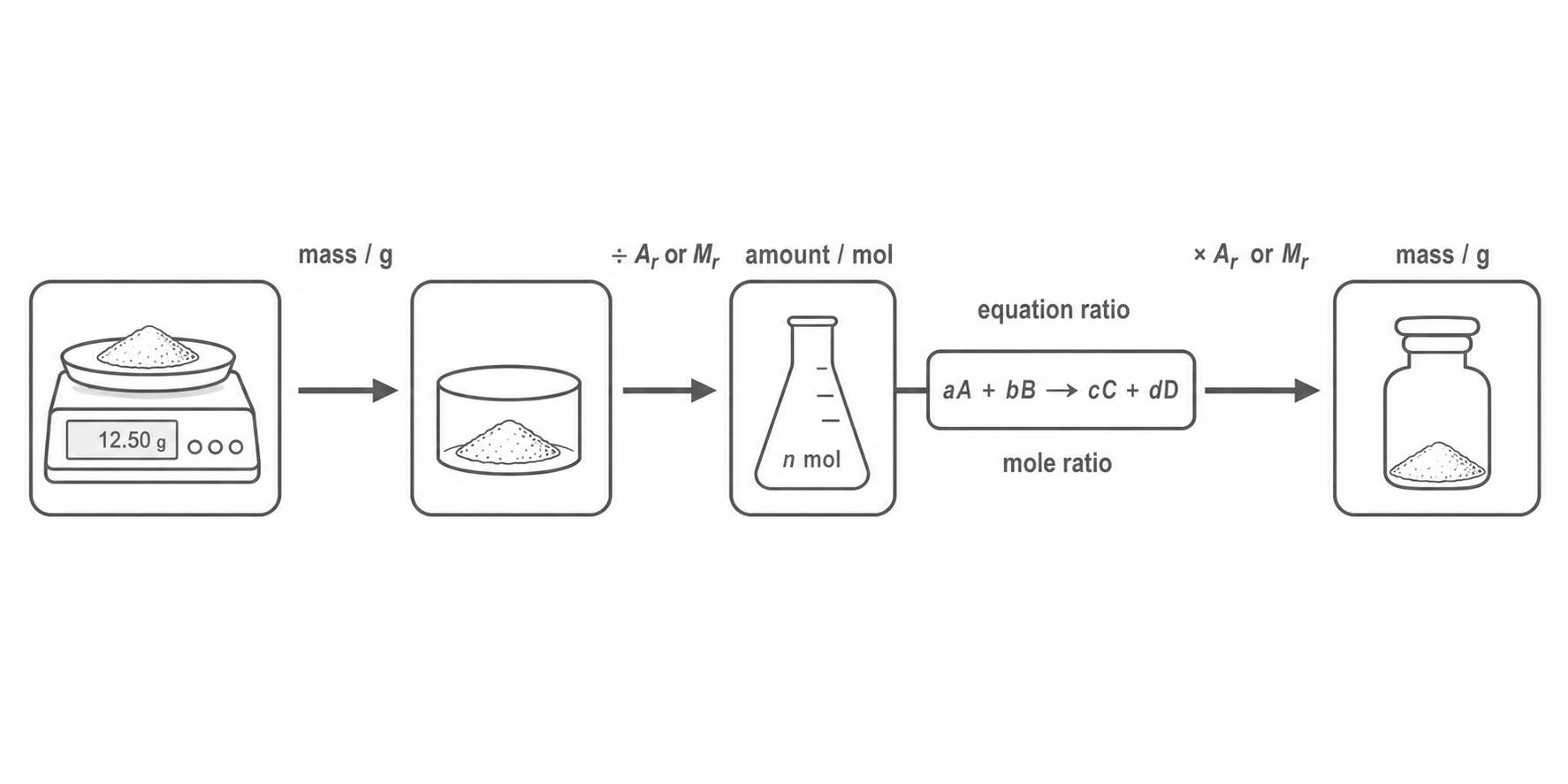
This means a mass in grams can be changed into an amount in moles, and an amount in moles can be changed back into a mass in grams. The equation ratio then connects one substance to another.
Mass and mole calculations
When the mass is measured in grams, use the same numerical value as the A_r or M_r to convert between mass and amount.
Mass and Amount
For atoms of a single element, use A_r instead of M_r.
In these equations:
nis the amount of substance in molmis the mass in gM_ris the relative formula mass of the substance
For example, water has M_r = (2 x 1) + 16 = 18.
If a sample contains 9.0 g of water:
n = m / M_r = 9.0 / 18 = 0.50 mol
If a different sample contains 0.25 mol of water:
m = nM_r = 0.25 x 18 = 4.5 g
Always check that the mass is in grams before using n = m / M_r. Pearson mark schemes commonly reward the method as well as the final answer, so write enough working to show the conversion you used. Keep extra figures during the working and round the final answer sensibly.
Dividing by A_r or M_r turns grams into moles; multiplying by A_r or M_r turns moles back into grams.
Use this relationship carefully in the next calculation, showing the formula mass before you divide.
Reacting masses from equations
A balanced chemical equation tells you the ratio in which particles react. Because a mole is a counting unit, the same coefficients also give the ratio in moles.
For example:
2Mg + O2 -> 2MgO
This equation shows:
- 2 mol of magnesium react with 1 mol of oxygen
- 2 mol of magnesium produce 2 mol of magnesium oxide
- the magnesium to magnesium oxide mole ratio is
2 : 2, which simplifies to1 : 1
Use a steady method for reacting-mass calculations:
- Write or check the balanced equation.
- Calculate the amount, in mol, of the substance with the known mass.
- Use the equation ratio to find the amount, in mol, of the required substance.
- Convert the required amount into a mass.
Worked example:
Calculate the mass of magnesium oxide made when 4.8 g of magnesium reacts completely with oxygen.
2Mg + O2 -> 2MgO
Use A_r: Mg = 24, O = 16.
First calculate the amount of magnesium:
n(Mg) = 4.8 / 24 = 0.20 mol
From the equation, 2 mol Mg produces 2 mol MgO, so:
n(MgO) = 0.20 mol
Now calculate M_r of magnesium oxide:
M_r(MgO) = 24 + 16 = 40
Finally convert the amount of magnesium oxide into mass:
m(MgO) = 0.20 x 40 = 8.0 g
Notice that the product mass is greater than the magnesium mass because oxygen atoms have joined with the magnesium atoms.
Experimental data and excess
Reacting-mass questions often give experimental data instead of directly asking for a product mass. You may need to decide which reactant is used up and which reactant is in excess.
The reactant that is used up controls the amount of product that can form. Extra reactant left over does not make extra product because there is no longer enough of the other reactant to react with it.
Worked example:
A student reacts 1.30 g of zinc with hydrochloric acid. The hydrochloric acid contains 0.00360 mol of HCl.
Zn + 2HCl -> ZnCl2 + H2
Determine whether zinc is in excess. Use A_r: Zn = 65.
From the equation, 1 mol Zn reacts with 2 mol HCl.
The amount of zinc that can react with 0.00360 mol of HCl is:
n(Zn) = 0.00360 / 2 = 0.00180 mol
The mass of this amount of zinc is:
m(Zn) = 0.00180 x 65 = 0.117 g
The student added 1.30 g of zinc, but only 0.117 g can react with the acid present. Zinc is in excess and the hydrochloric acid is the reactant that is used up.
A common error is to compare 0.00360 mol HCl directly with moles of zinc without using the 1 : 2 ratio. The ratio is where many of the marks are earned.
Percentage yield
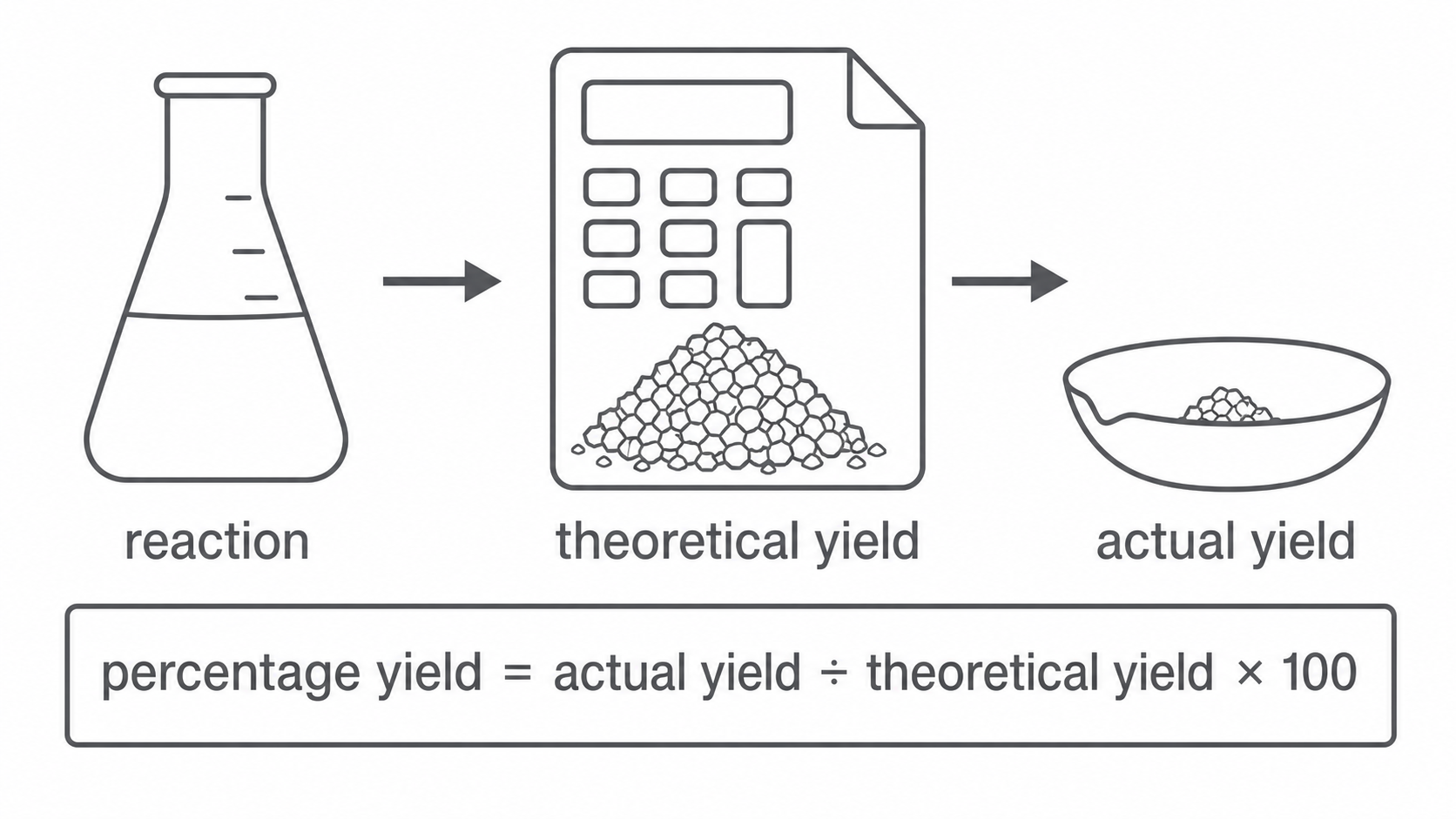
The mass of product calculated from the balanced equation is the theoretical yield. It is the maximum mass that could form if the reaction goes to completion and no product is lost.
The mass of product collected in the experiment is the actual yield. This is often lower than the theoretical yield.
Theoretical Yield
The theoretical yield is the maximum amount of product predicted by the balanced equation.
This is calculated before using the experimental result, so it gives a fair value to compare the experiment against.
Actual Yield
The actual yield is the amount of product actually obtained in an experiment.
Keep these two yields separate: one comes from the equation, and the other comes from the experiment.
[DIAGRAM: asset_name: Moles, Reacting Masses and Percentage Yield - diagram 02; asset_slug: c10_moles_reacting_masses_and_percentage_yield__diagram_02; recommended_method: image_gen; description: Monochrome schematic comparing theoretical yield predicted from the reaction calculation with the smaller actual yield collected in a basin, plus the percentage-yield relationship.]
Percentage Yield
Worked example:
Magnesium burns in oxygen to form magnesium oxide.
2Mg + O2 -> 2MgO
A student burns 6.0 g of magnesium. The student collects 9.2 g of magnesium oxide. Calculate the percentage yield.
Use A_r: Mg = 24, O = 16.
Calculate the amount of magnesium:
n(Mg) = 6.0 / 24 = 0.25 mol
The equation ratio from magnesium to magnesium oxide is 2 : 2, so:
n(MgO) = 0.25 mol
Calculate the theoretical mass of magnesium oxide:
M_r(MgO) = 24 + 16 = 40
m(MgO) = 0.25 x 40 = 10.0 g
Now calculate the percentage yield:
percentage yield = (9.2 / 10.0) x 100 = 92%
Actual yield may be less than theoretical yield because the reaction is incomplete, some product is lost during transfer or separation, or side reactions make other products. If a product is wet or impure, the apparent actual yield can be too high because the measured mass is not just the dry pure product.