1.1-1.3 - Particle model and changes of state
Chemists explain solids, liquids and gases by looking at what their particles are doing. The same substance can change state when energy is transferred, but its particles are still the same kind of particles. This lesson links the particle model to the names of changes of state, dilution of coloured solutions and diffusion of gases.
States as particles
The particle model treats a substance as being made from tiny particles. At this stage, "particle" is a useful general word: it might mean an atom or a molecule, depending on the substance. The important idea is that the arrangement, movement and energy of the particles explain the state of matter.
[DIAGRAM: asset_name: Particle model and changes of state - diagram 01; asset_slug: c01_particle_model_and_changes_of_state__diagram_01; recommended_method: image_gen; description: Monochrome comparison of solid, liquid and gas particle arrangements, showing close regular solid particles vibrating, close irregular liquid particles sliding, and widely spaced gas particles moving randomly.]
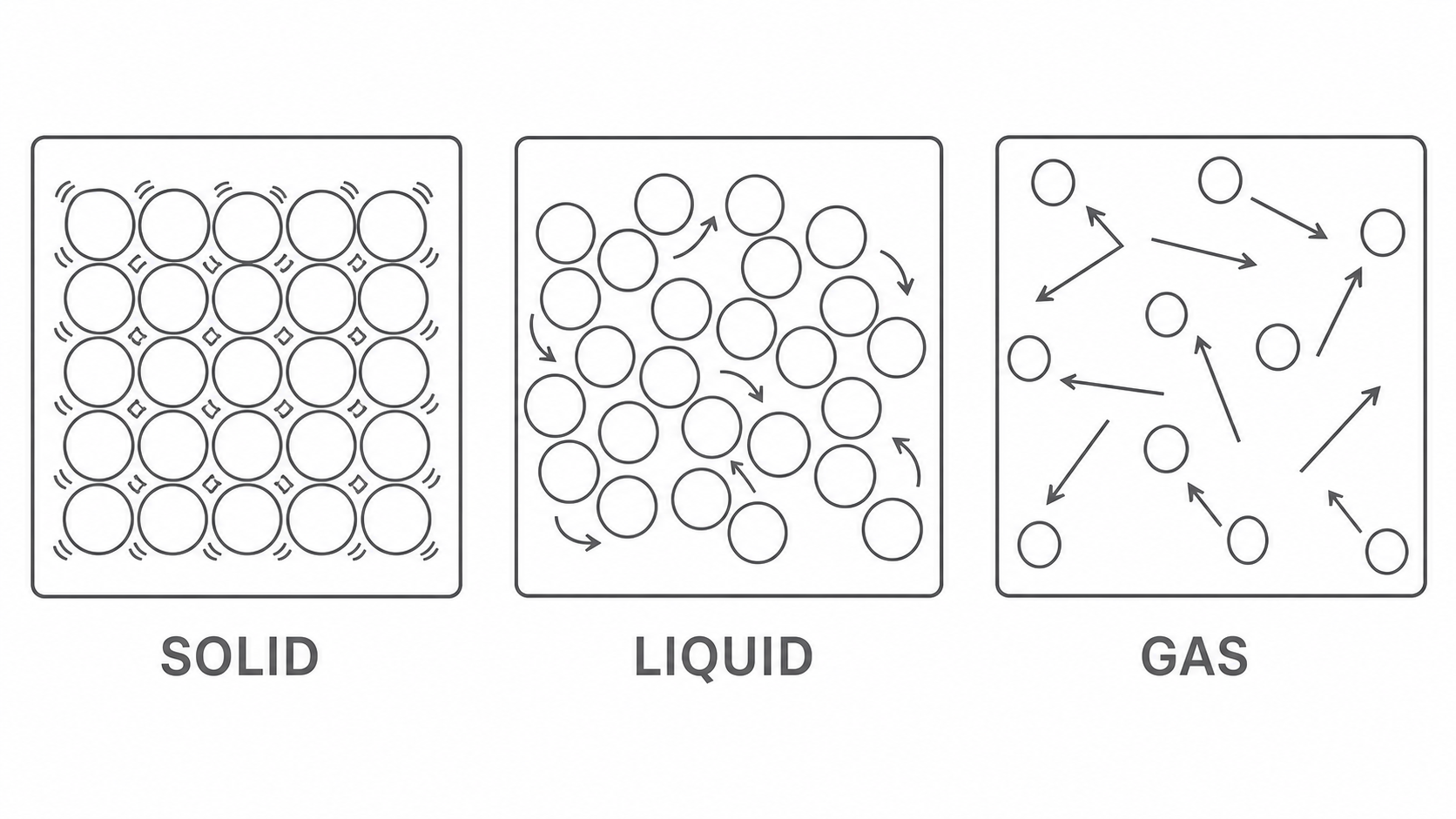
| State | Arrangement of particles | Movement of particles | Relative energy |
|---|---|---|---|
| Solid | Closely packed, usually in a regular arrangement | Vibrate about fixed positions | Lowest |
| Liquid | Close together, irregular arrangement | Move and slide past each other | Higher than solid |
| Gas | Far apart, random arrangement | Move rapidly and randomly in all directions | Highest |
Do not say that the particles in a solid are still. They cannot move from place to place, but they do vibrate. Do not draw gas particles in neat rows or all in one corner: gas particles are spread throughout the available space.
Energy and state
Heating transfers energy to the particles. They move more quickly, and if enough energy is transferred the particles can become less closely held together. Cooling removes energy from the particles. They move less, and the particles can become closer together or more fixed in position.
This means a change of state is a physical change. The particles do not turn into different particles. For example, water particles in ice, liquid water and steam are still water particles; what changes is their arrangement, movement and energy.
If a change of state is written using a formula, the formula stays the same and the state symbol changes:
This equation represents liquid water freezing to form ice. The chemical formula is unchanged because no new substance is made.
During a change of state, the particles stay the same but their arrangement, movement and energy change.
Names of changes
Each interconversion between solid, liquid and gas has a name. You also need to know whether it is achieved by heating or cooling, and what happens to the particles.
[DIAGRAM: asset_name: Particle model and changes of state - diagram 02; asset_slug: c01_particle_model_and_changes_of_state__diagram_02; recommended_method: image_gen; description: Monochrome map of melting, freezing, evaporation or boiling, condensing, sublimation and deposition between solid, liquid and gas, with heating and cooling labels.]
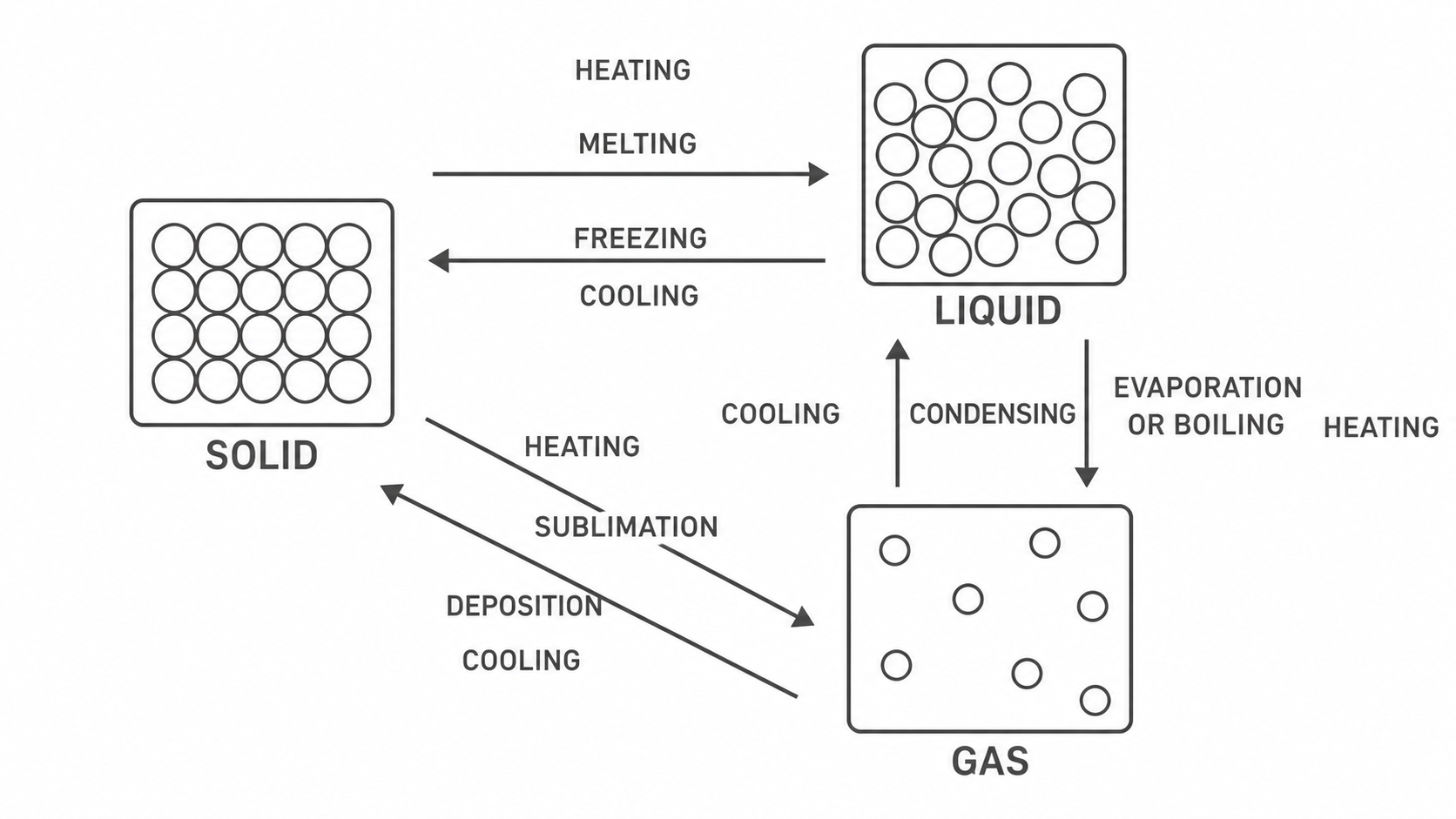
| Change | Name | Achieved by | Particle explanation |
|---|---|---|---|
| Solid to liquid | Melting | Heating | Particles gain energy, vibrate more and leave their fixed positions |
| Liquid to solid | Freezing | Cooling | Particles lose energy, move less and become fixed in a regular arrangement |
| Liquid to gas | Evaporation or boiling | Heating | Particles gain enough energy to leave the liquid and become far apart |
| Gas to liquid | Condensing or condensation | Cooling | Particles lose energy, move less and become close together |
| Solid to gas | Sublimation | Heating | Particles gain enough energy to leave the solid without becoming liquid first |
| Gas to solid | Deposition | Cooling | Particles lose energy and become fixed in a solid arrangement without becoming liquid first |
Evaporation and boiling are both liquid-to-gas changes. Evaporation can happen from the surface of a liquid below its boiling point. Boiling happens throughout the liquid at its boiling point.
Dilution and diffusion
Particle ideas also explain why coloured solutions and gases spread out. If water is added to a coloured solution, the same coloured particles are spread through a larger volume. There are fewer coloured particles in each small volume of liquid, so the colour looks paler.
Diffusion is the spreading out of particles caused by their random movement. In a gas, particles move rapidly and randomly. If a gas starts concentrated in one region, its particles keep moving and colliding until they are spread through the available space.
[DIAGRAM: asset_name: Particle model and changes of state - diagram 03; asset_slug: c01_particle_model_and_changes_of_state__diagram_03; recommended_method: image_gen; description: Monochrome before-and-after particle diagram showing dilution of a coloured solution and diffusion of a gas as particles spread through a larger volume or container.]
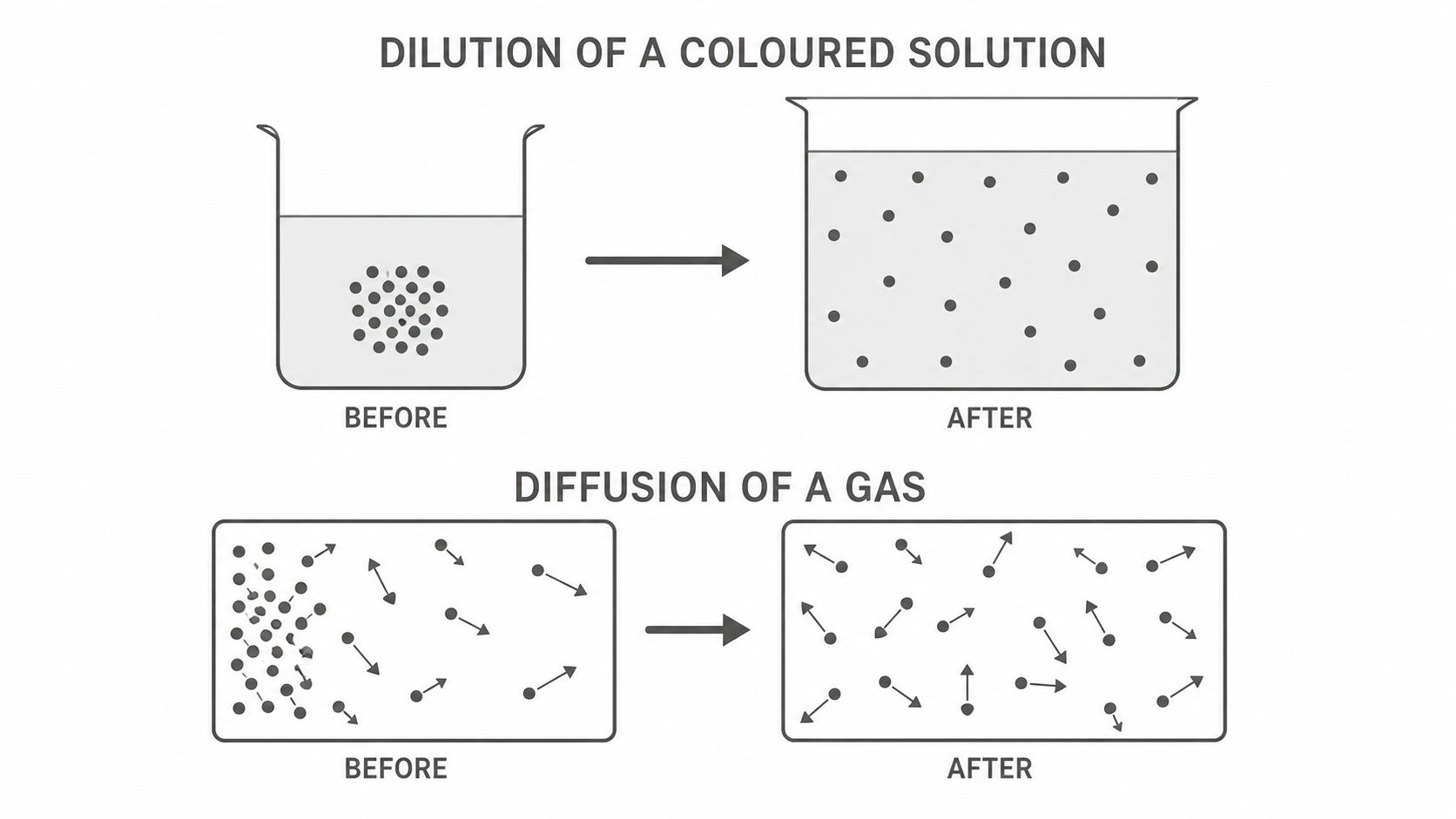
The key word is random. Particles are not pulled towards the emptier region by a special force. Because they move randomly, a region with many particles sends more particles out than come back in, so the overall result is spreading from a higher concentration to a lower concentration until the particles are evenly mixed.
Answering particle questions
Pearson questions often reward precise particle language. If a question asks for a gas particle diagram, make the particles the same size, spread them through the whole box, and arrange them randomly. If a question asks for a solid, mention both close regular arrangement and vibration about fixed positions.
For an explanation question, write a cause-and-effect chain:
Heating transfers energy to particles. The particles move faster. The arrangement changes because the particles can move further apart or escape from fixed positions. Cooling reverses that pattern because particles lose energy and move less.
For dilution or diffusion, link the observation to particle spacing. "The colour is paler" is an observation. The explanation is that the same coloured particles are spread through a larger volume, so there are fewer coloured particles per small volume.